


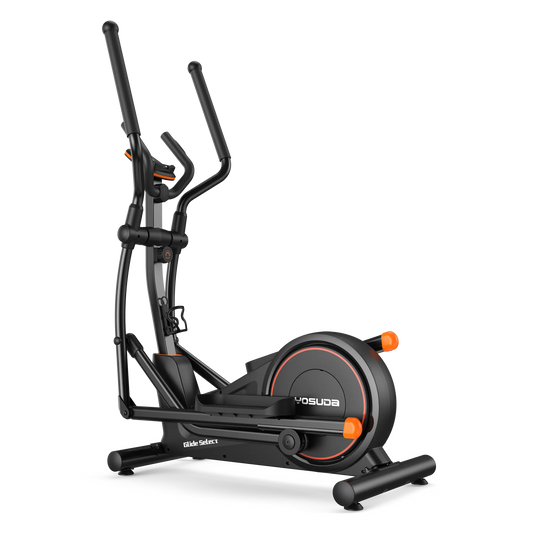
Climbing Stepper Elliptical Machine with 25
What does 25-7-2 mean? Were you also confused when you first saw it? Is 25 a time setting or a parameter of an elliptical machine? Today, we will tell you, and we will explain why it is so popular through research data and experience sharing.
What is 25-7-2?
25-7-2 StairMaster workout created by TikToker Camilla Akbas as a “way to get abs in as little as six weeks,” it is simple, effective, and easy to get started with, while focusing on fat loss, cardiovascular health, and core strength.
You just need a stepper elliptical machine. The steps are also very simple, just these three steps:
- Set the elliptical machine to level 7
- Climb for 25 minutes
- Repeat twice a week
If you just start with StairMaster or cardio, no worries, you can go slow at first or add more time little by little, like at your own pace. The main thing is to keep a steady, kinda moderate speed that you can hold for 25 minutes. But don’t forget to warm up before, keep your posture straight, use your core to push with your heels, and use your heart to feel your legs and glutes working. So, are you ready to give it a try?
Benefits of 25-7-2
So 25-7-2 got some cool points. Like most gyms, you walk in, and they have an elliptical or a stair machine, and honestly, you can buy one for home too; no need for much guidance. That is why we said it was kinda an easy start for beginners, and for people already into fitness, it works like a light extra. It's low-impact cardio, so not too hard on your legs but still makes your heart rate go up.
In a paper, they find out that sprint interval training (SIT) has gained popularity as a time-effective alternative to moderate-intensity endurance training (END). However, whether SIT is equally effective for decreasing cardiometabolic risk factors remains debatable, as many beneficial effects of exercise are thought to be transient, and unlike END, SIT is not recommended daily. Therefore, in line with current exercise recommendations, some people examined the ability of SIT and END to improve cardiometabolic health in overweight/obese males.
What exactly did they do?
Twenty-three participants are randomized to perform 6 weeks of constant workload: SIT (3 d·week−1, 4–6 × 30 s ~170% Wpeak, 2 min recovery, n = 12) or END (5 d·week−1, 30–40 min, ~60% Wpeak, n = 11) on cycle ergometers. Aerobic capacity (V˙O2peak), body composition, blood pressure (BP), arterial stiffness, endothelial function, glucose and lipid tolerance, and free-living glycemic regulation were assessed pre- and post-training.
Both END and SIT increased peak oxygen uptake (END ~15%, SIT ~5%) and glucose tolerance (~20%). However, only END decreased diastolic BP and abdominal fat and improved postprandial lipid tolerance, representing improvements in cardiovascular risk factors that did not occur after SIT. Although the SIT, but not the END, increased endothelial function, arterial stiffness was not altered in either group. Indices of free-living glycemic regulation were improved after the END and trended toward improvement after SIT (P = 0.06–0.09). Glycemic control was better on exercise days compared with rest days, highlighting the importance of exercise frequency. Furthermore, in an exploratory nature, favorable individual responses (peak oxygen uptake, BP, glucose tolerance, lipidemia, and body fat) were more prevalent after END than after low-frequency SIT.
Excerpted from https: //europepmc.org/article/med/33315809
As only high-frequency END improved BP and lipid tolerance, free-living glycemic regulation was better on days that participants exercised, and favorable individual responses were consistent after END. High-frequency END may favorably improve cardiometabolic health.
Another cool thing with 25-7-2 is that it’s kinda functional training, you know? Like it, copy the moves you actually do outside the gym, like walking up stairs and stuff. That way, it helps you do daily things more easily and effectively, so you train for real life, not just to stay inside the gym.
Is the 25-7-2 workout safe?
Well, kinda depends, you know. For most people, it’s pretty safe, cuz it’s low-impact and not crazy hard. But if you're new to cardio or have some joint issues, maybe start slower, like fewer minutes or a lower level. The main thing is to listen to your body; don’t push too fast. If you feel dizzy or in pain, just stop and take a break.
Can 25-7-2 lose weight?
Yeah, it can, but let’s talk real. This workout is simple, like 25 minutes on StairMaster, level 7, two times a week. Sounds easy, but trust me, after a few minutes, you feel sweat coming down. When you keep a steady pace, your body burns calories, and over time, that helps with weight loss. But it’s not magic, you know. If you eat junk food all day, then do 25-7-2 twice, your weight is not gonna drop fast.
The good thing is, it’s low-impact, so your knees and joints don't hurt too much, but still, your heart rate goes up. That means you're burning fat while also building some leg and glute strength. And because it copies real-life movement, like climbing stairs, it makes daily stuff easier too. So yeah, it’s functional and useful.
For beginners, maybe start slower, like 15–20 minutes, or level 5 instead of 7. Then build up. The point is consistency. I think twice a week is a good start, but if you want to lose weight, you can add more cardio or mix it with strength training. Remember, muscles help burn more calories even when you are resting.
So, can 25-7-2 lose weight? Yes, but depends on your lifestyle. Combine it with a balanced diet, enough sleep, and maybe some extra workouts, and then you will see a change. If you only rely on this, progress might be slow. But hey, slow progress is still progress. Better than nothing, right? And the best part is it's easy to follow, no complicated plan, just climb and sweat.
Sports Equipment Selection
Provides low-impact cardio, good for people with sensitive joints.
Not the same as a Stair Climber, but can be used as a substitute for 25-7-2.
Compact home option for cardio.
Not suitable for the original 25-7-2, but it works as an additional cardio choice.
|
Equipment
|
Fit for 25-7-2
|
Features
|
Best for
|
|
Elliptical
|
Substitute
|
Low-impact, smooth motion, lower intensity
|
Beginners, joint-sensitive users
|
|
Incline Treadmill
|
Substitute
|
Adjustable incline, stair-like effect
|
People mix workouts or work without stair machines
|
|
Spin Bike
|
Not original
|
Mainly cardio + legs
|
Extra cardio training |
So in the end, 25-7-2 is a kinda simple but effective workout. You don’t really need a fancy plan; just hop on a stair machine or something similar, go steady for 25 min, level 7, twice a week. It burns calories, makes your legs and glutes stronger, and is still easy on joints. Of course, if you eat badly or never sleep enough, the result is not gonna be magic. But if you keep consistent, mix with good food, and maybe other exercise, you will see progress. Slow or fast, progress is progress. Better than doing nothing, right?


Leave a Comment
We’d love to hear from you — your insights can inspire others!