


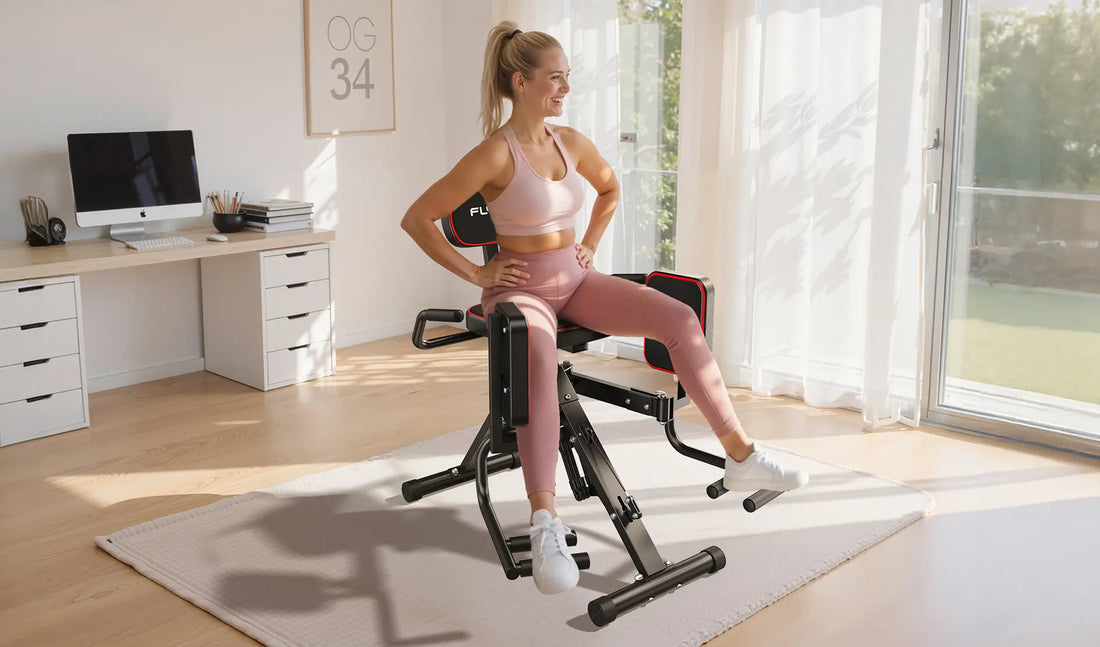
What Does a Hip Abductor Machine Do? Benefits, Muscles Worked & Who Should Use It
There is a lot of information when you start looking into getting a well-rounded workout routine. Among those, you may hear about the value in doing squats, lunges, and deadlifts for your lower body. While they are important, your hips need just as much side-to-side motion and control to help stabilize the pelvis and keep your legs aligned as you walk, run, and climb stairs.
When you’re searching what does hip abductors do, you’re really asking two questions. The first is what hip abduction is. The second is what a hip abductor machine does or how it helps.
In general, hip abduction is the movement of taking the thigh away from the body’s midline. A hip abductor machine adds resistance to that outward motion, helping you build muscles in the outer hips and glutes while in a stable, safe position.
What Does a Hip Abductor Machine Actually Do?
All a hip abductor does, in simplest terms, is build strength and stability in your hips as you push your legs outward, typically with added weight. In most versions of hip abductor machines you’ll find in a gym, this is done in a seated position.
The goal is to focus the movement at your hip joints. When your feet and knees move outward, muscles on the outer hip shorten, producing the force you want. When done right, it helps with:
- Creating a clear movement balance that doesn’t require balancing on one leg or coordinating several joints at once.
- The machine helps with adjusted resistance as you scale your workout for muscle building or strength training.
- Being seated means less worry over balance or single-leg movements.
Basic anatomy shows that the hip abductors contribute to moving the thigh outward or rotating the hip and stabilizing the pelvis (Flack NA, 2012). Whenever you’re holding a heavy bag of groceries and trying to walk, your hip abductors get engaged.
What Muscles Does a Hip Abductor Machine Work?
It’s good to understand that what hip abductors do isn't limited to just one muscle. A group of muscles works together based on how you move, the angle, and the type of exercise.

Gluteus Medius
The gluteus medius is along the outer surface of the pelvis. It helps stabilize your pelvis whenever you shift from one leg to the next. So, if you’re walking up a flight of stairs, this muscle engages whenever you lift one foot and use the other to support your body. You need the gluteus medius to push your thighs outward against the machine’s pads.
Gluteus Minimus
The gluteus minimus is underneath the gluteus medius. Even though it is smaller and slightly hidden, it helps with hip abduction, rotation, gait, and stabilization. Anatomy research (Kumagai M, 1997) shows both the gluteus minimus and the gluteus medius work together whenever you’re walking around, but you may not feel the gluteus minimus as much as the other glutes during the outward movement on a machine.
Tensor Fasciae Latae
Often called the TFL, the tensor fasciae latae is smaller, resting at the front and outer portion of your hips. It helps with abduction and hip flexion. It is what connects to the iliotibial band running along the outer thigh. The TFL keeps your motion steady as you move your legs apart with the machine.
Upper Fibers of the Gluteus Maximus
You’ve probably heard of the gluteus maximus as your “butt.” It’s most used for hip extension, but it's crucial for older people who need to move from a squat or seated position to a standing position. The upper fibers contribute to the outward motion of pressing the legs during a hip abduction workout.
The Mayo Clinic notes this area (Mayo Clinic, 2023) may contribute to pelvic and trunk stability (center of gravity). The upper fibers help support the outward press and add strength when using the machine.
Deep Hip Rotators and Stabilizers
All kinds of smaller muscles surrounding the hip help control the position of your femur in the socket. You’ll hear a lot about these smaller muscles as “stabilizers” during any swimming or Yoga workout.
Using a hip abductor machine helps avoid rapid bouncing or forcing the thighs apart too fast, so these muscles improve without being harmed. The stabilizers help avoid twisting by keeping your hips controlled in the machine.
Top Benefits of Using a Hip Abductor Machine
When you get out a hip abductor machine like the FED Fitness HA1, you want to take your time. Listen to your body. There is a lot of good that can come from doing these workouts smoothly and aligned with your overall workout goals. That may include:
- Improve Hip Stability: You want stability in your pelvis and upper legs as you move through the world. What does hip abductors do in a machine is help you resist unwanted inward movement or pelvic drop. Research shows hip abductor strength (Lanza, M. B., 2023) is a leading contributor to balance and overall mobility.
- Build Stronger Glutes: When you put the gluteus medius and minimus, plus portions of the gluteus maximus under direct resistance, you stabilize your body better. That may reduce back and knee pain and help support more mobility to prevent falls and injuries.
- Support Better Knee Alignment: The hip abductors are part of what controls where your thighs are positioned. When you step down or perform other weight-bearing movements, you want as much hip control as possible so your thighs and knees don’t drift inward. That is why a hip abductor machine is sometimes used as part of physical therapy for knee tracking.
- Improve Balance: Balance is more than simply standing still. You want to remain in control and upright throughout all your movement, even when shifting pressure from one leg to the next. Your hip abductors are important whenever you’re transferring weight between legs, even when you do the workouts in a seated position.
- Complement Lower-Body Training: Finally, a hip abductor machine helps you get more targeted training. When you do a compound lift, you tend to target the largest muscles. With the machine, you can better complement squats, lunges, deadlifts, step-ups, lateral movement drills, or going for a daily walk.
The FED Fitness Flybird Series HA1 is a good introduction to a hip abduction machine. It offers a 2-in-1 hip movement to lift the glutes, tighten inner thighs, and complement full lower body training. You’ll get smooth, noiseless movement with adjustable resistance to customize your workout based on rehab, toning, endurance, or muscle building.

FED Fitness Flybird Series HA1 2-in-1 Hip Abductor and Adductor Machine
2-in-1 Hip Abductor & Adductor Machine, Easy, Smooth & Quiet Operation
$259.99
The Flybird HA1 has a dual foot bar for added stability and comfortable padding while you work out. It holds up to 600 lbs. in capacity and is made from a durable steel frame. All in all, the HA1 can fit easily into your garage or living room workout area with a minor footprint.
Who Should Use a Hip Abductor Machine?
What does hip abductors do can benefit a lot of different target groups of people. For beginners, it helps you practice hip abduction without needing to transfer between different weights or use single-leg balance. That is why so many home gym users go with a hip abductor machine alongside a rebounder or set of adjustable barbells.
Bodybuilders and athletes may use the hip abductor machine for sport-specific drills or when fatigue limits more complex exercise.
Where the hip abductor really shines is with older adults. Having a way to work the hips that helps control movement and stability is crucial to reducing the risk of falls. The seated position adds stability in a controlled state, where the resistance scales to the user's needs. That is a benefit for older users who may need a little more support just starting.
Conclusion
So, what does hip abductors do during movement? They help move the thigh away from the body, contribute to rotation, and stabilize the pelvis. They are needed in controlling the legs as you shift weight for walking, running, and going up stairs.
With a quality hip abductor machine like the FED Fitness Flybird Series HA1, these hip abductor muscles can be worked in a safe, comfortable, and controlled setting that is adjustable to any number of different user groups. That makes workouts more repeatable so long-term health and wellness gains are realized instead of short-term goals.
As long as you’re using controlled repetitions and a manageable level of resistance, you can easily add the hip abductor machine to your regular training plan.
FAQs
Is the Hip Abductor Machine Only for Women?
Not at all. That’s a common misconception. Hip abductors perform the same essential movement support and stabilization in any gender.
Is the Hip Abductor Machine Good for Beginners?
Yes, but as long as the exercise is repeatable and controlled. That’s why the seated position is so beneficial because it helps stabilize the body to better target the muscles in and around the hip abductors.
Does It Help with Glute Growth?
When used correctly, it can contribute to glute growth. Results will always vary based on your training volume and load progressions as well as any nutrition or recovery issues specific to your unique body.
Can Seniors Use a Hip Abductor Machine?
Some seniors will find the seated position more approachable, and the muscles can help a lot with mobility and stability. Anyone with pain or balance issues, or who has recently had surgery, should consult a medical provider before starting any workout.
References:
- Flack NA, Nicholson HD, Woodley SJ. (September 2012). A review of the anatomy of the hip abductor muscles, gluteus medius, gluteus minimus, and tensor fascia latea. Clin Anat. 25(6):697-708.
- Kumagai M, Shiba N, Higuchi F, Nishimura H, Inoue A. (November 1997). Functional evaluation of hip abductor muscles with use of magnetic resonance imaging. J Orthop Res. 15(6):888-93.
- Mayo Clinic. (23 October 2023). Got glutes? Part 1 – The roles of the gluteus maximus and healthy activation patterns in core stabilization. Physical Medicine and Rehabilitation.
- Lanza, M. B., Balshaw, T. G., Folland, J. P., & Kubo, K. (2023). Systematic review of the importance of hip muscle strength, activation, and structure in balance and mobility tasks. Archives of Gerontology and Geriatrics, 105, 104851.
This content is for informational purposes only and does not constitute medical advice. For questions related to your health or medical conditions, please consult your physician. Always seek advice from a qualified healthcare professional before starting any exercise program or health regimen. In the event of a medical emergency, call 911.


Leave a Comment
We’d love to hear from you — your insights can inspire others!