


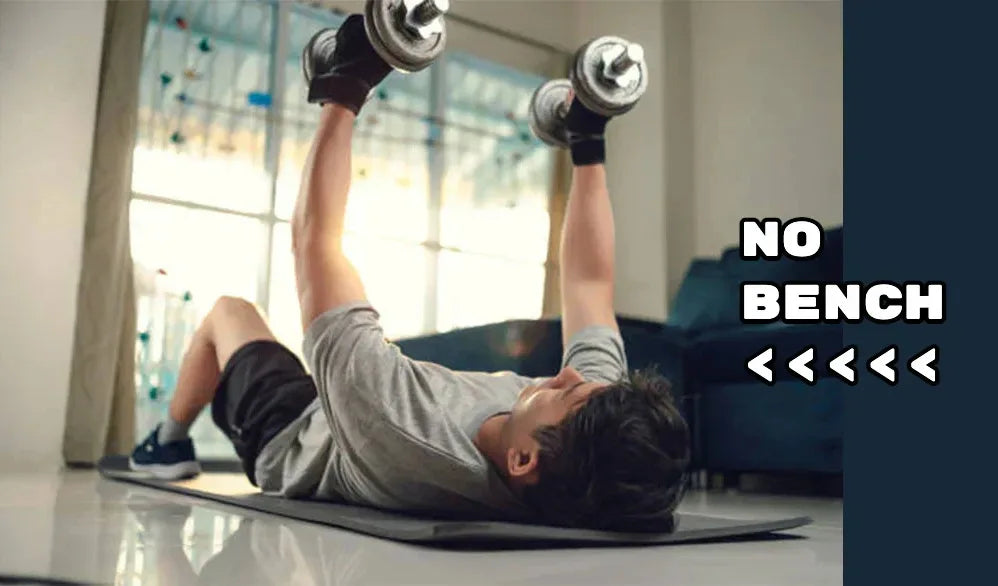
How to do Bench Press Without a Bench
A bench press is a practical approach for building muscles, especially for the chest, shoulders, and triceps. What if "No bench? No problem! Here's how to modify and still get a great workout." The process requires only a pair of dumbbells and a floor. You can perform almost all the exercises by lying on the Floor.
Benefits of the Bench Press
A Dumbbell bench press is a fantastic exercise for building strength in the upper body. It involves the engagement of significant chest muscles, biceps, and shoulders. It also includes the core and stabilizes it.
Compared to barbell presses, dumbbell bench presses make the arms work independently. They help the body address imbalances. This movement also requires stability; this engagement of the muscles can activate more stability than any other pressing. You can opt for various variations of bench presses, including flat, incline, or decline presses. They target specific areas of the chest and promote more balanced muscles. And the barbell bench press can further enhance your strength training, allowing you to lift heavier weights.
Why You Don’t Always Need a Weight Bench
A weight bench plays a crucial role in helping you maintain stability and perform the bench press correctly. But what if you haven’t bought a bench yet, or your space is too limited to fit one? Do you really have to stop bench pressing? The truth is, a bench isn’t always a requirement.
Without a weight bench, you can actually activate muscles you don’t normally use. When lying on the floor, your legs and back must work harder to maintain your body's stability. In many cases, you can perform floor presses even in a small space while also reducing the risk of shoulder strain.
How To Perform A Floor Bench Press
To correctly perform the floor dumbbell bench press, there are many things to consider before, during, and after performing the movement. Although the exercise is quite simple: lying on a flat surface with two dumbbells, put your arms at a 90º angle and push the weight up, then bring it down until the elbows touch the floor, then repeat such motion.
To do the movement safely, there are many precautions one must take to reduce the risk of injury whilst also increasing muscular development. Firstly, the setup to do the exercise must be done safely, lying down on a flattened surface that is comfortable enough, and having dumbbells within reach to start the exercise.
To increase muscular engagement in the desired areas, tighten the core and place both feet on the floor, creating a much more controlled setup that will help provide more stable movements during the performance of the floor press.
Once the setup has been correctly done, pick up both dumbbells and position the elbows at a 90º angle so the dumbbells are at the same height as the shoulders. It’s very important to keep both arms at the same angles and be careful not to do any fast movement, which decreases the muscular engagement of the exercise. If needed, do the exercise with a much more controlled and slower tempo that provides much more muscular tension and better performance.
For the exercise, press the dumbbells upwards until arms are fully extended, locking the triceps and maintaining a stable position with both arms on top, then slowly lower the dumbbells until both elbows touch the floor at a 90º angle, thus completing the exercise with the proper technique.
In order for the correct performance of the exercise, choose the appropriate weight that allows for great muscular stress without compromising technique and movement. It’s better to start with lower weights and slowly put the weight up as the technique is mastered.
A great tip in order to complete the floor press effectively is to squeeze the chest muscles at the top for each of the reps done, even maintaining the weight up and the muscles squeezed for 1 or 2 seconds if necessary. This will help increase chest involvement during the exercise and provide much more tension on the chest’s fibers. The floor barbell press is similar—you simply need to place an appropriate barbell beside your body. If you’re adding weight plates, make sure you have a spotter for safety.
Benefits Of The Floor Press
Accessibility: one of the points that has already been addressed, the floor bench press is one of the most accessible exercises to exist, as it only involves a pair of dumbbells for its correct realization, requiring minimal equipment. The only thing needed, apart from the dumbbells or something that replicates a dumbbell, is a flat surface, making it a great alternative for those who have limited space and can’t fit a bench into their homes.
Safety: Another great benefit the floor press has is its safety, as, by limiting the range of motion, it reduces the risk of injury considerably, especially around the shoulder area, where beginners tend to feel pain while doing the regular bench press. This exercise also allows for improvement in the form without compromising anything else.
Tricep and Lockout Strength focus: as the floor press provides a much more limited range of motion, it emphasizes the top part of the lift, thus improving tricep strength and form. This makes the floor press a great exercise, not only for beginners but also for those looking to improve their pressing capabilities.
Core engagement: doing the chest press on the floor or any other flat surface not only affects the upper half of the lift, but it also engages the core to provide correct stability, balance, and control throughout the movement. The engagement of the core transforms the floor press into a functional exercise focused on balance and control.
Limitations Of the Floor Bench Press
Restricted Range of Motion: One of the main problems the floor press faces is the limited range of motion it involves. With the focus of the exercise being the top part of the chest press lift, chest activation is very limited, as the elbows only reach a 90º angle when on the lower part of the movement. Compared to the bench press, which allows for a broader range of motion, the floor press is very limited, affecting muscle activation and development.
Reduced Muscle Engagement: Although briefly discussed in the previous point, one of the main limitations of the floor press is its restricted muscle engagement. As the movement is cut once the elbows reach the surface, the lower chest isn’t correctly engaged, thus limiting its development and affecting overall chest strength.
Comfort and Stability: changing a bench, a piece of gym equipment that has been scientifically designed to improve performance whilst providing comfort, with a flat surface does have its cons, especially when it comes to comfort during the lift and, especially balance, as maintaining the correct balance throughout the whole movement is much more difficult when lying down on a flat surface rather than a bench.
Progression Challenges: The floor press is an excellent exercise for beginners, but once they start increasing weight, they might find various limitations that may result in lesser or slower development. Especially with heavier weights, the floor press can be much more difficult to perform, as they may be much more difficult to handle and don’t provide the support a weighted bench and a benching rack provide.
4 Bench Press Alternatives You Can Do Without a Bench
It is easily manageable to perform dumbbell bench press exercises without having access to a bench. The process involves various alternatives, all of which are safe and effective in muscle building.
Floor Press
Floor press involves the dumbbells or barbell and the Floor. First, you must lie on the floor with dumbbells of suitable weight placed on both sides of your body, pick up the dumbbells with both hands, and press the dumbbells above your chest until your arms are straight, and stop. Bring the dumbbells down to your chest and repeat this movement. Do not try to make mistakes; this will reduce the pressure on your shoulders and target your chest without endangering your safety.
Stability Ball Press
Stability balls act as a support to your upper back and shoulders. Keep your feet flat and engage your core while performing the dumbbell press or barbell press. Maintaining balance is the key. It will improve the strength and stability of the core muscles and eliminate the need for a bench.
Inclined Push-Ups With Dumbbells
Incline pushups involve the ground and dumbbells or a barbell. Place the dumbbells on the Floor and grip them strongly for support. Now, do the pushup and make sure the chest goes down near the ground. The body posture must be straight. It improves motion and stimulates press position, along with adding depth due to dumbbells.
Using a Low Surface
This process is also known as the decline bench press. It involves an object like an ottoman. Lie your feet flat on it. The upper body will be declined, and it acts as a decline bench. It must be stable to ensure safety. To get an exclusive range of motion, focus on the angle; it must be elevated to get the desired bench press without actually having it.
Maximize results with complementary exercises
Several complementary exercises can help maximize the benefits of bench-free press variations. It includes a workout that targets supporting muscles and elevates balanced strength development. Let us delve into the exercises:
Push-Ups
It can strengthen the chest, shoulder, and triceps muscles while focusing on the engagement of the core. There are different variations in push-ups, including incline, decline, or weighted push-ups. You can add up intensity according to your need and focus on different muscle areas.
Dumbbell Flys on the Floor
Dumbbell Flys on the Floor help you maintain balance in chest-focused exercises. This targets the back and biceps more. It helps in improving the posture and toning up the overall upper body.
Overhead Dumbbell Press
Overhead Dumbbell presses are an amazing source of shoulder and triceps strength. You can expect more endurance in your upper body and muscle coordination.
Plank Variations
Planks are effective in enhancing core stability and Balance. It helps maintain the side muscles through side planks and dynamic planks. The complexity of planks could be arranged according to the stamina. Following these exercises, one can effectively resolve the no-bench issue and maintain the results.
While adding dumbbell press alternatives to your workout plan, you can build strength, improve Stability, and diversify your training. The structure to plan your alternatives includes your bearing capacity. Let us discuss how to structure a routine to get optimal results:
Start with a warm-up of 5 minutes. Add stretching and low cardio exercises to build up the pace. Involve the whole body in it.
Add up a few bench-free dumbbell press variations, including floor presses. Aim for 8 to 10 reps per set.
Move to some complementary exercises like push-ups or dumbbell rows to target your supporting muscles. Ideally, use 3 sets of 10 to 15 reps.
Moving forward, add the core and Stability work, like planks or stability ball presses. Try 2 to 3 sets of 30 seconds to 1 minute.
After the intense workout, you need some time to relax and cool down. In this phase, relax the muscles through static stretches. You can opt for foam rolling to relieve muscle stress and enhance the recovery process.
This is an example plan; you can add the intensity and variation according to your body. Add new exercises and durations gradually so that the body gets used to them.
You can do the bench press without a bench, and it will still provide effective muscle-building results. With just a pair of dumbbells or barbells, you can do a lot of strength exercises that will have a significant effect on your chest, shoulders, and triceps. However, by adding some equipment, you can improve your overall strength and training variety.


Leave a Comment
We’d love to hear from you — your insights can inspire others!