You don't need a $50/month gym membership to put on muscle. Honestly, you don't even need that much equipment. Two dumbbells, enough room to lie down, and a training plan that isn't garbage — that's the whole recipe.
This guide covers which dumbbell exercises actually matter, the science behind why they work, and a 4-week beginner program you can run in your living room.
Can Beginners Build Muscle With Just Dumbbells?
Beginners can build just as much muscle with dumbbells as they can with barbells, cables, or machines, and the science backs this up clearly.
A 2020 study published in the Journal of Strength and Conditioning Research put 46 participants through 8 weeks of training and found identical muscle thickness increases between free-weight and machine groups.
Another 2023 meta-analysis in BMC Sports Science reviewed 13 studies (over 1,000 participants total) and reached the same conclusion: no significant difference in muscle growth between free weights and machines.
So if you've been wondering whether your home setup is "enough," stop worrying. It is.
Why Dumbbell Training Is Actually Effective for Muscle Growth
Here's what a barbell can't do: force each arm to pull its own weight. With dumbbells, your dominant side doesn't get to pick up the slack. I didn't realize how lopsided my pressing strength was until I switched to dumbbells and my left arm started shaking on set two. Embarrassing, but that's exactly the kind of imbalance you want to catch early.
Research from Saeterbakken and Fimland (2012) showed that unilateral dumbbell exercises cranked up core muscle activation compared to bilateral movements. So when you're doing a standing overhead press with dumbbells, your abs and obliques are working hard to keep you upright.
A chest press machine doesn't ask anything of your core. Not even close.
And then there's the range of motion.
A 2017 study by Farias et al. found that dumbbell bench press produced greater pectoralis major activation than barbell bench press. That deeper stretch you feel at the bottom of a dumbbell press?
Not imaginary. It shows up on EMG readings.
Should Beginners Use Dumbbells or Barbells?
For most beginners training at home, dumbbells are the better starting point because they're safer to use alone, take up less space, and build stability that barbells skip over.
Look, barbells are great. You can load them heavier. Nobody's arguing that. But a barbell also needs a rack, probably a spotter, and more square footage than your spare bedroom has to offer. A failed barbell bench press without safety bars can end badly. A failed dumbbell press? You drop the weights to the side and sit up. Done.
My honest recommendation?
Start with dumbbells for your first 6 to 12 months. Build your base. Learn the movement patterns. When you eventually grab a barbell, you'll be way more prepared than someone who skipped straight to it.
What Are the Real Principles of Muscle Growth?
Muscle grows when you challenge it beyond what it's used to (progressive overload), give it enough training volume, and let it recover with proper nutrition and sleep.
That's it. Three things. Everything else you read online is a footnote to those three.
Now, progressive overload — most people hear that phrase and think it means slapping more weight on the bar every week. Not quite. Especially with dumbbells, where your options might jump from 20 lbs to 25 lbs with nothing in between. A 25% increase, by the way.
On a barbell, you'd add 2.5 lbs per side. Totally different.
So what do you do when you can't go heavier yet? Plenty. Add a rep or two. Slow the lowering phase to a 3-count. Cut your rest periods from 90 seconds to 60. Switch a bilateral press to a single-arm press.
All of those count as overload, and your muscles don't know the difference.
I spent way too long early on thinking I was stuck because I couldn't move up in weight. Wish someone had told me about tempo manipulation sooner.
For the actual numbers: 8 to 12 reps per set, 3 to 4 sets per exercise, a weight where the last 2 to 3 reps feel like a real grind. Three sessions a week. Enough to grow, not enough to burn out.
What Are the 6 Best Dumbbell Exercises for Building Muscle?
Goblet squats, dumbbell bench press (or floor press), bent-over rows, overhead press, Romanian deadlifts, and dumbbell lunges cover every major muscle group and should form the backbone of any beginner program.
Quick rundown:
1. Goblet Squat
Hold a single dumbbell vertically at chest height, gripping it by one end with both hands — like you're cradling a goblet. Stand with your feet shoulder-width apart, toes turned out slightly.
Push your hips back and bend your knees, lowering yourself as deep as you can while keeping your heels flat on the floor. Your elbows should track inside your knees at the bottom — use them to gently push your knees out if they cave inward. Drive through your heels to return to standing, squeezing your glutes at the top.
Muscles worked: Quads (primary), glutes, hamstrings, inner thighs, and core.
Benefits: The weight acts as a counterbalance, making it significantly easier to hit depth than a back squat — which is why it's one of the best squat variations to learn first. It also naturally encourages an upright torso, training good squat mechanics that carry over to other lifts and everyday movement.
Precautions: Don't let your heels rise — if they do, your hips are too tight or the weight is pulling you forward; reduce depth until mobility improves. Avoid letting your knees collapse inward. If you have knee pain, start shallow and only go as deep as feels comfortable.
2. Dumbbell Floor Press
Lie flat on your back with your knees bent and feet flat on the floor. Hold a dumbbell in each hand, arms bent at roughly 45 degrees from your body — not flared wide like a push-up. Your upper arms rest on the ground at the start.
Press both dumbbells straight up until your arms are fully extended, then lower them in a controlled arc until your upper arms make contact with the floor again. Pause briefly — don't bounce — then press back up.
Muscles worked: Pectorals (chest), triceps, and anterior deltoids (front shoulders).
Benefits: No bench required, which makes this genuinely one of the most accessible chest exercises you can do. The floor acts as a natural stopper, eliminating the deep stretch at the bottom of the movement — this actually reduces shoulder strain compared to a full bench press, making it a great option for anyone with shoulder niggles.
The limited range of motion also puts extra emphasis on the triceps and the lockout portion of the press, building real pushing strength. For beginners especially, it's a complete bench press substitute for the first few months of training.
Precautions: Keep your lower back flat against the floor throughout — don't arch it to squeeze out extra reps. Make sure you lower the dumbbells in a controlled way rather than dropping your arms; the pause at the bottom should be deliberate, not a crash landing. Start light until you're confident getting the dumbbells into position safely.
3. Bent-Over Row
Stand with feet hip-width apart, a dumbbell in each hand. Hinge forward at the hips until your torso is roughly parallel to the floor — or at least at a 45-degree angle — with a slight bend in your knees. Let the dumbbells hang straight down, palms facing each other.
Pull both dumbbells up toward your ribcage, driving your elbows toward the ceiling rather than flaring them out wide. The cue that makes it click: imagine you're stuffing the dumbbells into your back pockets. At the top, squeeze your shoulder blades together, hold for a beat, then lower the weights back down in a controlled motion. That's one rep.
Muscles worked: Latissimus dorsi (lats), rhomboids, rear deltoids, biceps, and the erector spinae (lower back) as a stabiliser.
Benefits: One of the best all-round upper body exercises you can do with dumbbells. It builds a stronger, thicker back, improves posture by counteracting the hunched position most people spend their day in, and develops the kind of pulling strength that carries over to everything from carrying shopping to other gym lifts.
Using dumbbells rather than a barbell also lets each arm work independently, which helps iron out left-to-right strength imbalances over time.
Precautions: The hinge position puts your lower back under load, so form matters here. Keep your spine neutral — no rounding through the upper or lower back — and engage your core before each set. If your lower back starts to fatigue, stop; it's a sign either the weight is too heavy or your hinge position is breaking down. Avoid jerking the weights up using momentum; the movement should be slow and deliberate on the way down.
4. Overhead Press
Stand with feet shoulder-width apart, a dumbbell in each hand at shoulder height, palms facing forward. Brace your core and glutes — think tall, not rigid. Press both dumbbells straight overhead until your arms are fully extended, then lower them back to shoulder height with control. That's one rep. Don't let your lower back arch to help the weight up.
Muscles worked: Anterior and medial deltoids (front and side shoulders), triceps, upper traps — with your core, obliques, and glutes working hard in the background to keep you stable.
Benefits: Standing turns this from a shoulder exercise into a full-body one. Research backs it up — a standing press fires your abs and obliques significantly more than the seated version, meaning you're building shoulder strength and core stability at the same time without dedicating a separate exercise to either. It also trains the kind of overhead strength that actually translates to real life.
Precautions: The biggest mistake is letting your lower back hyperextend as the weight gets heavy — that's your spine taking load your shoulders should be handling. Squeeze your glutes and brace your core before every rep to keep your torso locked in.
If you find yourself leaning back excessively, drop the weight. Anyone with a history of shoulder impingement should warm up thoroughly and avoid pressing behind the neck.
5. Romanian Deadlift (RDL)
Stand tall, feet hip-width apart, a dumbbell in each hand resting against your thighs, palms facing your body. Push your hips back — not down — letting the dumbbells glide down the front of your legs as your torso tips forward. Keep a slight bend in your knees and your back flat throughout. Lower until you feel a strong stretch in your hamstrings, then drive your hips forward to return to standing. Squeeze your glutes hard at the top. That's one rep.
Muscles worked: Hamstrings and glutes (primary), lower back and core as stabilisers.
Benefits: The RDL is the hip hinge in its purest form — and the hip hinge is foundational to almost every meaningful movement in strength training. Master this and squats, deadlifts, and kettlebell work all get easier. It's also simply the best hamstring and glute exercise you can do with just dumbbells; nothing else comes close for loading the posterior chain without a barbell or machine in sight.
Precautions: This exercise lives or dies by your back position — the moment your spine rounds, you're loading your lumbar vertebrae instead of your hamstrings. Keep your chest up and shoulders back throughout. Range of motion varies by person; only go as low as your hamstring flexibility allows without your lower back rounding.
If you feel it in your lower back rather than your hamstrings, you're either going too deep or losing your hip hinge pattern — reduce the range and reset.
6. Dumbbell Lunge
Hold a dumbbell in each hand at your sides. For a walking lunge: step forward, lower your back knee toward the floor until both legs are at roughly 90 degrees, then drive through your front heel to bring your back foot forward into the next step. For a reverse lunge: step one foot back instead, lower the back knee toward the floor, then push off the back foot to return to standing. Same movement pattern, smaller footprint.
Keep your torso upright throughout — don't let your chest collapse forward — and make sure your front knee tracks over your toes, not caving inward.
Muscles worked: Quads and glutes (primary), hamstrings, calves, and core for balance and stability.
Benefits: Lunges train each leg independently, which builds balanced strength and exposes any left-to-right differences you didn't know you had. They also develop the kind of single-leg stability that carries over directly into running, climbing stairs, and pretty much any activity that involves moving on two feet. The reverse lunge variation is slightly easier on the knees, making it a smart starting point if you're new to the movement.
Precautions: Your grip will likely fatigue before your legs do in the early weeks — that's completely normal and sorts itself out quickly as your forearms adapt. Don't let it tempt you into using lighter dumbbells than your legs actually need.
Watch for your front knee caving inward under load; if it does, reduce the weight and focus on pushing the knee out over your little toe.
4-Week Beginner Dumbbell Muscle-Building Training Plan
Train 3 days per week (with at least one rest day between sessions), using a full-body approach that hits every major muscle group each workout.

Beginners grow faster when they train each muscle group multiple times per week, which is why a full-body approach is recommended, rather than a body-part split.
The ACSM position stand recommends 2 to 3 training days per week for novices, with both unilateral and bilateral exercises.
Plus, if you miss a workout on a full-body plan, you haven't completely skipped your legs (or chest, or whatever) for the entire week.
Weeks 1–2: Learning Phase
- Goblet Squat: 3 sets × 10 reps
- Dumbbell Floor Press: 3 sets × 10 reps
- Bent-Over Row: 3 sets × 10 reps
- Overhead Press: 3 sets × 8 reps
- Romanian Deadlift: 3 sets × 10 reps
- Dumbbell Lunge: 2 sets × 8 reps per leg
Rest 60 to 90 seconds between sets. Don't worry about going heavy yet. Learn the movements. You'll be sore the first week, maybe the second. It goes away fast.
Weeks 3–4: Progression Phase
Add one set to each exercise. Hit all your reps cleanly last round? Good. Either bump the weight up by 5 lbs or add 2 reps per set. If neither is possible, slow down the lowering phase of every rep to a 3-second count.
This isn't just a 4-week thing, either. That progression logic (hit the top of your rep range across all sets, then increase the load and drop back to the bottom of the range) works for months.
One thing I'd be doing you a disservice to skip: nutrition. You can train perfectly and still spin your wheels if you're eating in a deficit. Shoot for roughly 0.7 to 1 gram of protein per pound of bodyweight each day.
Chicken, eggs, cottage cheese, protein powder, canned tuna — whatever you'll actually eat consistently. And get 7 to 9 hours of sleep. Recovery is where the muscle actually gets built.
When Should You Upgrade Your Workout Equipment?
When your legs outgrow your dumbbells (and they will first), when you're cruising past 15 reps on compound lifts, or when you've trained consistently for 3 to 6 months, it's time to level up.

Quads and glutes are huge muscles with a lot of potential, and they adapt fast. Someone starting with 20 lb dumbbells will probably find goblet squats and lunges laughably easy within 8 to 12 weeks.
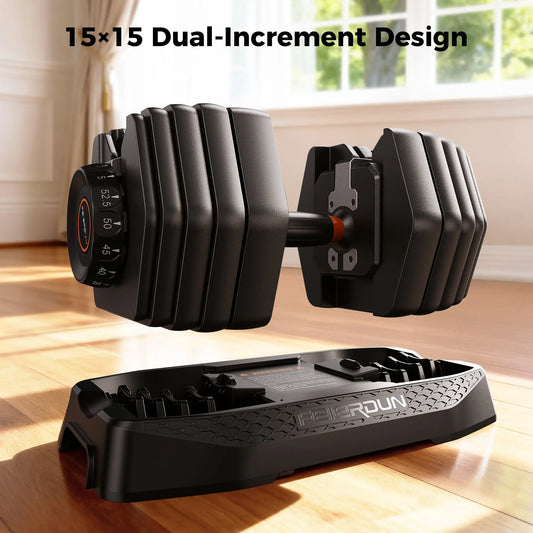
Adjustable dumbbells are the single best investment for a home gym. One pair covers a massive weight range, fits in a closet, and you don't need a whole rack taking up your living room. Get a set that goes to at least 50 lbs with 2.5 to 5 lb increments.
The increment thing matters more than people think — jumping from 25 to 35 lbs overnight isn't just unpleasant, it's risky on exercises like lateral raises and flyes.
Next up: an adjustable weight bench. Opens up incline pressing, chest-supported rows, seated shoulder press, and a bunch of other variations you can't do on the floor.
A few signs you've outgrown your current setup: every set feels moderate at best (even the last rep), you haven't been able to add weight or reps for 2 to 3 weeks straight, your sessions feel like autopilot.
That last one is the big tell.
If your workouts don't challenge you anymore, your muscles don't have a reason to grow.
Start Simple, Stay Consistent
Building muscle with dumbbells at home isn't some consolation prize for people who can't get to a gym. The research is so detailed that it works just as well for beginners. That guy on Reddit who dropped from 240 to 197 lbs using nothing but a pair of dumbbells in his living room didn't have some secret. He just showed up and did the work, over and over.
Pick up a pair of adjustable dumbbells. Run the program above. Write down your numbers after every session. Eat your protein. Give it 12 honest weeks before you decide whether it's working or not.
I think you'll be surprised.
FAQs About Building Muscle With Dumbbells
Should I Choose Adjustable or Fixed Dumbbells?
Adjustable dumbbells win for home training in almost every scenario because they save space, cost less than an equivalent range of fixed weights, and let you make smaller weight jumps.
I get the appeal of fixed dumbbells. They feel solid, look good on a rack, and there's no fumbling with dials or pins between sets. But let's be real: a full fixed set from 5 to 50 lbs would cost you north of $1,000 and eat up a ton of floor space. An adjustable pair covers the same range for a fraction of the cost and sits on a shelf.
How Long Does It Take to See Muscle Growth from Dumbbell Training?
You’ll notice your first strength gains within 2 to 3 weeks, with visible changes around 8 to 12 weeks, and real body composition shifts by month 4 to 6.
The annoying thing about month one is that you'll get stronger without looking different. That's because the early strength gains are neurological — your brain gets better at telling muscle fibers to fire. The mirror catches up later.
Published research puts beginner lean mass gains at somewhere between 1 and 8.5 lbs in the first 6 months. Wide range, but genetics and diet explain most of that variance.
Is Dumbbell Training Suitable for Apartments?
Absolutely, and dumbbells might be the most apartment-friendly strength training option on the planet.
No clanging weight plates. No jumping. You need roughly a 6×6-foot area. Throw down a rubber mat or some foam interlocking tiles so you're not denting your hardwood, set your dumbbells down gently (never drop them), and your downstairs neighbor probably won't even know you're working out. If you train early morning or late at night, switch to slower tempo sets with lighter weight. Still builds muscle, zero noise complaints.
Is Dumbbell Training Enough for Beginners to Build Muscle?
For the first 6 to 12 months, dumbbells are more than enough. Most beginners don't need anything else to make serious progress.
When someone stalls at month three, 9 times out of 10, the problem is their program or their nutrition, not their dumbbells. They're doing the same weight for the same reps every session and wondering why nothing changes. Or they're eating 1,600 calories a day and expecting to build muscle. Track your sessions. Eat enough. Sleep enough. The equipment is almost never the bottleneck.
Should Beginners Do Full-Body or Split Training?
Full-body workouts, 3 days per week, are the better choice for beginners because they provide more frequent muscle stimulation and are simpler to follow.
Bro splits (chest Monday, back Tuesday, etc.) have their place — for intermediate and advanced trainees who need extra volume per muscle group. But if you're new? Hitting each muscle three times a week beats hitting it once. There's solid evidence for that. And the practical upside of full-body training is huge: miss a Wednesday session and you still train everything on Monday and will train it again on Friday. No muscle group gets left behind.
This content is for informational and educational purposes only and does not constitute medical advice. For questions related to your health or medical conditions, please consult your physician. Always seek advice from a qualified healthcare professional before starting any exercise program or health regimen. In the event of a medical emergency, call 911.