


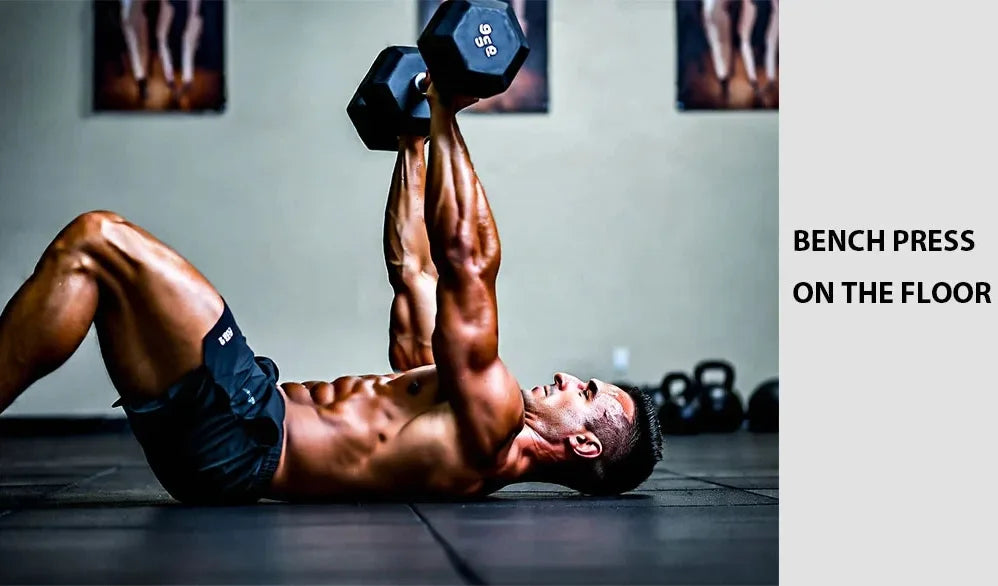
Floor Press Vs Bench Press
Some people who don’t have a weight bench worry that doing dumbbell presses on the floor won’t effectively work their chest. Today, we’re here to clear that up.
Floor Press Vs Bench Press – Key Differences
Range of Motion
Floor Dumbbell Press: The range of motion is much more limited than in the bench press, as movement stops once the shoulders touch the floor. The lower range of motion limits stress on the chest area whilst focusing more on the top part of the chest press lift.
Bench Press: allowing for a much wider range of motion, the bench press provides much deeper and fuller stress on the chest and better overall muscular activation.
Muscle Engagement
Floor Dumbbell Press: With a much more limited range of motion, the focus of the exercise is directed towards the triceps and the shoulders, working as a great accessory exercise to improve strength in both areas, especially shoulder power and tricep lockout.
Bench Press: the broader range of motion allows for a better workout, involving the chest, the shoulders, and the triceps. Also, depending on the angle chosen to perform the exercise, other areas such as the upper or lower chest can also be targeted.
Equipment
Floor Dumbbell Press: a pair of dumbbells and a flat surface, much more accessible for those who can’t buy a weight bench or don’t have the space.
Bench Press: apart from a set of dumbbells, a weighted bench (can be a flat bench or an adjustable bench).
Who Should Choose the Floor Bench Press
For lifters seeking higher-quality training, the floor press also serves as an excellent supplemental exercise, helping you strengthen the muscles that traditional bench pressing doesn’t always target.
If you don’t have a bench, it’s clear that one of the main attractions the floor press has is the ability to perform the chest press movement, or at least some of it, without necessarily needing a weight bench. Suppose you’re someone with limited equipment or limited space. In that case, the floor press is an excellent choice for your workouts, being a practical solution to maintain muscular strength and effectively improve technique and upper body movements. You can follow our workout guide and see if it works well for you.
Recovering from shoulder injuries: due to its lower range of motion and lesser muscular stress, the floor press is an excellent option for anyone who has suffered any type of shoulder injury. Thanks to the lower stress the floor press has on the shoulder area, the floor press is a great exercise to slowly return to the chest press dynamic without having to perform the whole exercise and compromise the shoulders.
Focus on Strength Lockout: as the movement focuses on the top movement of the chest press lift, strength, and tricep lockout are directly trained, which helps massively when performing the regular chest press. As a result, the floor press becomes a great accessory exercise to improve tricep lockout and power, which will directly affect bench press performance.
Common Questions About Floor Press Vs Bench Press
Is Floor Pressing as Effective as Bench Pressing?
There’s no clear answer, as it depends on your goals. Do you want to improve your muscular and tricep lockout? Then, Floor Pressing is as effective, if not better than regular bench pressing. Do you want to increase overall strength in the upper body? Then the bench press is more effective. As said, it depends on the goals someone has, although both exercises can be put into the same workout program.
Can I Build a Strong Chest with Floor Pressing Alone?
You can, but it’s the same as if you only do the regular bench press; you will improve, just not as fast as if you include other chest exercises in your routine. Depending on the equipment, you can also perform exercises such as cable flies or chest machine presses, all the way to regular push-ups. The main thing is to complement the chest press, whether it's floor pressing or bench pressing, with other alternative chest exercises.
How do I Safely Transition to Heavier Weights Without a Bench?
There are many ways to do so, although there are some that are far better than others. Firstly, you must have the proper technique, as only increasing weights won’t have any results if the technique isn’t done properly. Secondly, try having someone spot you during exercise to feel much more secure when lifting heavier weights. Another great way to lift heavier weights is slowly tracking all your reps, and, once you have reached your desired number of reps (let’s say 12 to 15), pick heavier dumbbells of a weight that you can do for 10 reps, then, as you find it much easier to complete, progress to a bigger weight and so on.
With proper form, the floor press can deliver results similar to a traditional bench press—and even strengthen muscles that the bench press doesn’t fully target. If you don’t have a weight bench yet, the floor press is a great way to start bench-press training. If you already have a bench, you can use the floor press as a valuable accessory exercise for your chest workouts.


Leave a Comment
We’d love to hear from you — your insights can inspire others!