


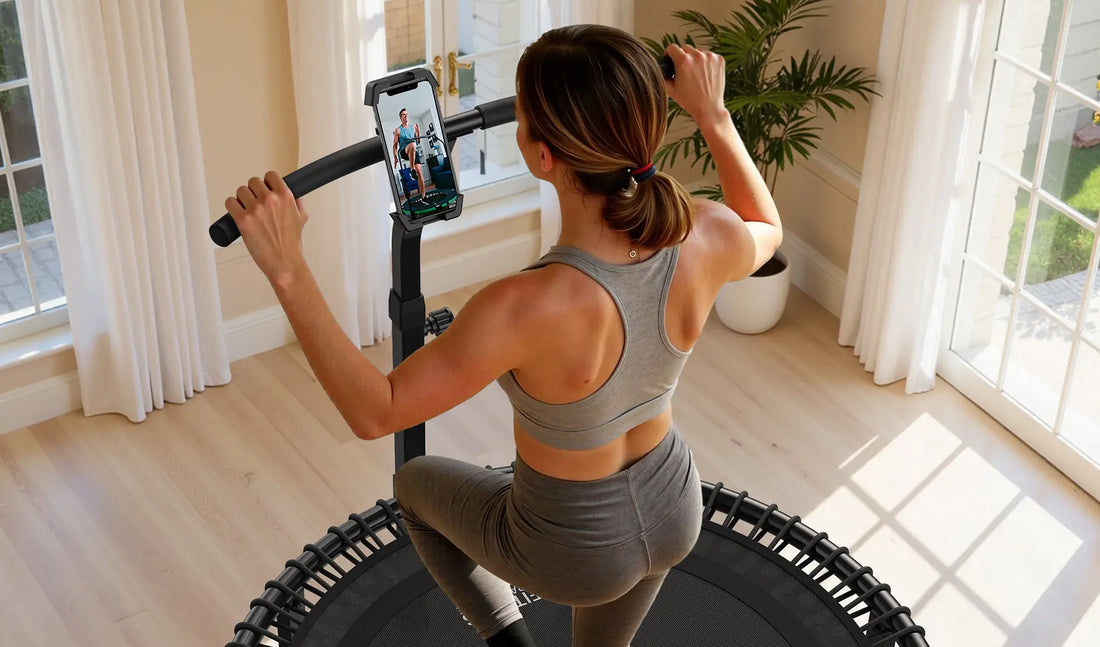
How Many Calories Does Rebounding Burn?
Google "how many calories does rebounding burn" and you'll get answers ranging from 200 to over 1,000 per hour. A difference this big is practically meaningless, which is why it’s important to examine the actual research rather than relying on marketing-driven summaries of the findings.
Two peer-reviewed studies have directly measured calorie burn on a mini-trampoline. They came up with very different numbers (6.9 and 12.4 calories per minute), and the reason they disagree is the reason your results will be different from your neighbor's.
Your weight, your effort level, and what you actually do on the rebounder matter more than most articles admit.
Quick Takeaways
- Rebounding burns roughly 6.9–12.4 calories per minute, but it depends on your weight and exercise intensity (ACE 2016, Cugusi 2017)
- A 155 lb person burns approximately 250–370 calories in a 30-minute session
- Heavier bodies burn more calories at the same effort: about 40% more at 200 lb vs 130 lb
- Rebounding falls between brisk walking and running for calorie burn, with far less joint stress
Does Rebounding Actually Burn a Lot of Calories?
Yes, and the range is wider than most guides admit. Depending on your body weight and how hard you push, you'll burn somewhere between 6.9 and 12.4 calories per minute. That puts rebounding in the same calorie-burning zone as jogging at 5–6 mph.
Those two numbers come from the only peer-reviewed studies that have directly measured calorie expenditure on a rebounder, and understanding why they're so different is the key to predicting what your own sessions will look like.
The higher number — 12.4 calories per minute.
It comes from a 2016 study sponsored by the American Council on Exercise and led by John Porcari, Ph.D., at the University of Wisconsin–La Crosse. His team had 24 college students (12 men, 12 women) perform a 19-minute choreographed JumpSport routine while hooked up to metabolic monitoring equipment.
The men averaged 12.4 cal/min during the workout portion. Women averaged 9.4. Including the warm-up and cool-down, those numbers dropped to 11.0 and 8.3, respectively, still well within the range that ACSM says is enough for weight management.
The lower number — 6.9 calories per minute.
That comes from Italian researcher Lucia Cugusi and her team, published in Science & Sports in 2017. They tested 18 overweight women (average BMI around 26.8) during a 45-minute rebounding session.
The total burn came out to about 317 calories for the full session, with an average heart rate sitting at 72% of max.
So why the gap?
It's not that one study is right and the other wrong. Porcari's participants were young, fit college students doing a fast-paced, choreographed routine.
Cugusi's were overweight women bouncing at a moderate, sustainable pace.
Different bodies, different intensities, different results. And that's the point: where you fall in the 6.9–12.4 range depends entirely on who you are and how you train.
The Compendium of Physical Activities — the reference database exercise scientists use to classify how demanding different exercises are- backs this up.
It rates mini-trampoline jogging at 4.5 METs (moderate), recreational trampolining at 6.3 METs (moderate-vigorous), and competitive trampolining at 10.3 METs (vigorous).
That's a big spectrum, and it tells you something important: the rebounder itself isn't the variable. You are.
How Many Calories Can You Burn Rebounding?
For a 155 lb person bouncing at moderate-to-vigorous intensity, roughly 250–370 calories in 30 minutes. Heavier bodies burn more. Higher intensity burns more. Both of those matter more than duration.
The formula exercise physiologists use to estimate calorie burn from MET values is straightforward:
Calories per minute = (METs × body weight in kg × 3.5) ÷ 200
You don't need to memorize that. The tables below show what two different intensity levels look like in practice: 7 METs (a solid moderate workout with tempo changes) and 10 METs (all-out HIIT intervals with tuck jumps and high knees).
Moderate intensity (7 METs):
|
Body Weight
|
Cal/min
|
10 min
|
20 min
|
30 min
|
|
130 lb (59 kg)
|
7.2
|
72
|
144
|
217
|
|
155 lb (70 kg)
|
8.6
|
86
|
172
|
258
|
|
180 lb (82 kg)
|
10
|
100
|
200
|
301
|
|
200 lb (91 kg)
|
11.1
|
111
|
222
|
334 |
High intensity (10 METs):
|
Body Weight
|
Cal/min
|
10 min
|
20 min
|
30 min |
|
130 lb (59 kg)
|
10.3
|
103
|
206
|
309
|
| 155 lb (70 kg) |
12.3
|
123
|
245
|
368
|
| 180 lb (82 kg) |
14.3
|
143
|
287
|
430
|
| 200 lb (91 kg) |
15.9
|
159
|
318
|
477
|
A few things jump out. Body weight is the single biggest lever. A 200 lb person burns about 54% more calories than a 130 lb person doing the same workout.
That's just physics.
And duration scales pretty much linearly: 20 minutes gets you roughly double the burn of 10 minutes. There's no magic threshold where "fat burning kicks in" at the 20-minute mark or whatever you've read online. More time equals more calories, full stop.
One honest caveat: these are estimates.
The Compendium itself notes that MET-based calculations carry roughly ±15–20% individual variation based on fitness level, body composition, and movement efficiency.
And if you're relying on a smartwatch, know that most wearable algorithms weren't calibrated for vertical, unstable-surface movement. Your Apple Watch may overestimate the duration of your rebounder sessions compared to running or cycling.
Rebounding vs Other Cardio Exercises
Rebounding sits between brisk walking and steady-state running for calorie burn: roughly 40% more than walking, roughly 25% less than a 6 mph run. But the comparison that matters most isn't calories per minute. It's what you'll actually do five days a week.
The Compendium MET values tell the story for a 155 lb person over 30 minutes:
|
Exercise
|
METs
|
Cal/30 min (155 lb)
|
|
Brisk walking (3.5 mph)
|
4.3
|
158
|
|
Rebounding (moderate)
|
6.3
|
231
|
|
Rebounding (vigorous)
|
7–10
|
258–368
|
|
Cycling (12–14 mph)
|
8
|
294
|
|
Running (5 mph / 12 min mile)
|
8.5
|
312
|
|
Running (6 mph / 10 min mile)
|
9.3
|
341
|
|
Jump rope (moderate)
|
11.8
|
433
|
Running wins on raw calorie burn. It always will.
The biomechanical demand of propelling your entire body forward against the ground is hard to beat. But here's where rebounding makes its case: in the Porcari study, participants rated their perceived exertion as lower than the physiological data suggested.
They were working at about 60% of VO₂max and 79% of max heart rate, but they felt like they were working less hard than that. Bouncing is one of those rare exercises that trick you into working harder than you think you are.
That matters because the workout you enjoy is the workout you repeat.
A 2022 study in Frontiers in Psychology by Teixeira and colleagues (273 health-club members) found that enjoyment was a significant predictor of exercise habit, intention to keep exercising, and how often people actually showed up.
If bouncing is fun for you in a way that the treadmill isn't, that advantage compounds over weeks and months.

A quick note on the NASA claim you'll see everywhere: the 1980 Bhattacharya study (Journal of Applied Physiology, 49(5):881-887) did find that trampolining produced about 68% more "external work output" than running at the same oxygen consumption.
But that's a biomechanics measurement.
It's about how force is distributed through the body. It has nothing to do with how many calories you burn. The study also used a full-size competition trampoline (a mini-rebounder would have been a different test) and included only 8 men.
It's interesting research, but it doesn't mean rebounding burns 68% more calories than running. It doesn't.
Best Rebounding Exercises for Burning More Calories
High knees and tuck jumps consistently push past 75% of VO₂peak in testing — that's where the calorie numbers jump from "moderate" to "impressive." The exercise you choose on the rebounder matters almost as much as how long you bounce.
A 2018 study by Höchsmann et al. in the European Journal of Sport Science tested six specific mini-trampoline exercises on both trained athletes and overweight, inactive adults.
The VO₂peak range went from 42% to 87%, depending on the movement, meaning the same rebounder can deliver a gentle recovery session or a seriously intense workout, depending on what you do on it.
The exercises that burn the most, ranked by intensity:
Tuck jumps and high knees
The hardest-working moves in any rebounder routine. You're driving your knees toward your chest against gravity, which demands significant power output from your quads, hip flexors, and core.
These are the moves that pushed subjects in the Höchsmann study past 75% VO₂peak.
Sprint bouncing
Jogging in place on the rebounder at maximum cadence. Less flashy than tuck jumps but sustainable for longer intervals, which can mean more total calorie expenditure across a session.
Jumping jacks
A full-body movement that raises heart rate quickly. The lateral component forces your adductors and abductors to stabilize on an unstable surface, which adds a training stimulus you don't get from floor-based jacks.
Squat bounces
Drop into a quarter-squat at the bottom of each bounce. This loads the posterior chain (glutes, hamstrings) and keeps tension on the largest muscle groups in your body, which drives calorie burn up.
Twist jumps
Rotate your hips side to side while your shoulders stay forward. Recruits the obliques and adds a rotational challenge that most cardio misses entirely.
Want a simple HIIT structure?
Try 30 seconds of high knees or tuck jumps, followed by 30 seconds of easy health bouncing (feet barely leaving the mat). Repeat for 10 rounds.
That's 10 minutes of work, and for most people, it'll land in the 100–160-calorie range, depending on body weight. That's more than most people burn in 10 minutes of jogging.
A bungee-cord rebounder like the BCAN BT4 Soft Land Pro with its adjustable T-handlebar is especially useful here. The handlebars give you stability during explosive moves so you can push intensity without worrying about losing your balance.
Common Mistakes That Reduce Calorie Burn

Bouncing as high as possible
The rebounder isn't a trampoline park. The calorie burn comes from controlled deceleration and muscle engagement, not airtime. Excessive height shifts stress toward your spine and reduces the number of reps you can sustain per minute.
Standing rigid
Locked knees and a stiff upper body shut down your core. Keep a soft bend in the knees, ribs stacked over hips, and let your torso move naturally with the bounce.
Flat-footed landings
Land through the ball of your foot, not your heel. Flat-footed bouncing increases joint stress and short-circuits the elastic energy return that makes rebounding efficient and comfortable.
Death-gripping the handlebar
The T-bar is a balance aid for high-intensity moves, not a crutch. If you're leaning on it constantly, you're offloading work from your legs and core, exactly the muscles that drive calorie expenditure.
Ignoring your arms
Pumping your arms or holding light weights (1–3 lbs) for short intervals recruits more muscle mass and measurably raises your heart rate. Your upper body is free. Use it.
How Long Should You Rebound for Weight Loss?
The ACSM recommends at least 150 minutes per week of moderate activity to maintain weight and more than 250 minutes per week for meaningful fat loss. On a rebounder, that translates to roughly five 30-minute sessions or daily 35-minute sessions at moderate intensity.
But those are general exercise guidelines. In rebounder-specific terms, the progression looks like this:
Beginners (first 2–4 weeks)
Start with 10–15-minute sessions, 3–4 times per week. Focus on the health bounce (your feet barely leave the mat), and the goal is building comfort, balance, and baseline stamina. Don't worry about calorie burn yet. Just build the habit.
By week 3 or 4, aim to extend sessions to 20 minutes and add some tempo variation: 30 seconds faster, 30 seconds slower.
Moderate training (weeks 5–12)
Work up to 20–30-minute sessions, 4–5 times per week. Mix steady-state bouncing (arm movements, tempo changes, lateral shuffles) with short bursts of higher-intensity moves. This is where you'll start seeing body composition changes if your nutrition supports a calorie deficit.
Cugusi's 12-week study used three 60-minute sessions per week at about 5.2 METs and found significant reductions in fat mass, waist circumference, and blood pressure, alongside increases in lean mass and aerobic capacity.
You don't need 60-minute sessions to get results, but consistency matters.
HIIT approach (for experienced bouncers)
Two to three HIIT sessions per week (15–20 minutes of intervals with a 30:30 or 40:20 work-to-rest ratio), plus two longer steady-state sessions.
This is the most time-efficient strategy for calorie burn, but it's genuinely demanding. Don't jump to this if you've been bouncing for less than a month.
And here's the part that no amount of bouncing can replace: weight loss requires a calorie deficit.
Exercise is one side of the equation, but what you eat is the other, and for most people, it's the bigger one.
A 30-minute rebounder session might burn 250–370 calories. That's meaningful, but it's also about the same as one large blended coffee drink or a couple of handfuls of trail mix. Rebounding can absolutely be the exercise foundation of a weight-loss plan.
It just can't be the entire plan.
Final Thoughts
The honest answer to "how many calories does rebounding burn?" is somewhere between 200 and 475 in a 30-minute session, depending on who you are and what you do on the mat. That's a real workout.
The miracle some marketers promise? No.
Competitive with jogging and cycling while being dramatically easier on your joints? Absolutely.
What I like about rebounding for calorie burn is the sneaky efficiency of it. The ACE data showed people were working harder than they felt like they were. That's rare in fitness. Most exercises feel at least as hard as they are.
Bouncing somehow gets you to 79% of your max heart rate while you're grinning like a kid. And the exercise you enjoy is the exercise you do next week, and the week after that, and the week after that.
If you're starting out, grab a bungee-cord rebounder with a handlebar, commit to 10–15 minutes three times a week, and build from there. Track what you eat. Don't chase the number on your watch. Chase consistency. The calories will take care of themselves.
FAQs
How Many Calories Does Rebounding Burn in 10 Minutes?
Roughly 70–160 calories for most adults, depending on body weight and intensity. A 155 lb person bouncing at moderate intensity burns about 86 calories in 10 minutes. Push to HIIT-level effort, and that climbs to around 123 calories.
Is Rebounding Better Than Walking for Weight Loss?
For calorie burn per minute, yes. Moderate rebounding (6.3 METs) burns roughly 45% more calories than brisk walking (4.3 METs) at the same body weight. But consistency trumps intensity. If you'll walk every day but only rebound twice a week, walking wins the long game.
Does Rebounding Burn More Calories Than Running?
Not quite at the same intensity. Running at 6 mph (9.3 METs) outburns moderate rebounding (6.3 METs) by about 48%. But vigorous HIIT rebounding (approaching 10 METs) gets close to running-level calorie burn with significantly less joint impact.
The ACE study showed people perceive rebounding as easier than equivalent running, which means longer and more frequent sessions.
Can Beginners Lose Weight with Rebounding?
Yes, if it's paired with a calorie deficit. Start with 10–15-minute sessions and build gradually. Cugusi's 12-week study showed measurable fat loss and improved body composition in overweight women who rebounded three times per week at moderate intensity.
How Often Should You Rebound for Fat Loss?
The ACSM recommends more than 250 minutes per week of moderate exercise for clinically significant weight loss. That's about five 50-minute sessions, or daily 35-minute sessions. Combining moderate steady-state sessions with two HIIT days is the most efficient approach.
Does Rebounding Count As Cardio?
Absolutely. The ACE study measured average heart rates at approximately 79% of maximum during a rebounder routine, solidly in the aerobic training zone.
The Cugusi study confirmed the same at 72% of max heart rate, even at a more moderate pace. Both figures meet ACSM criteria for cardiorespiratory fitness improvement.
Is Rebounding Enough Exercise for Weight Loss?
It can be your primary cardio, but adding two resistance training sessions per week (bodyweight exercises, dumbbells, resistance bands) will preserve muscle mass and give your metabolism a boost that pure cardio can't. Rebounding builds some lower-body and core strength, but it's not a substitute for dedicated resistance work.
References:
- Porcari JP, et al. "ACE-Sponsored Research: Putting Mini-Trampolines to the Test." ACE ProSource, October 2016.
- Cugusi L, et al. "Exercise intensity and energy expenditure during a mini-trampoline rebounding exercise session in overweight women." Science & Sports, 2017;32(1):e23–e28.
- Cugusi L, et al. "Effects of a mini-trampoline rebounding exercise program on functional parameters, body composition and quality of life in overweight women." Journal of Sports Medicine and Physical Fitness, 2018;58(3):287–294.
- Höchsmann C, et al. "Oxygen uptake during mini trampoline exercise in normal-weight, endurance-trained adults and in overweight-obese, inactive adults: A proof-of-concept study." European Journal of Sport Science, 2018;18(8):1105–1113.
- Bhattacharya A, et al. "Body acceleration distribution and O₂ uptake in humans during running and jumping." Journal of Applied Physiology, 1980;49(5):881–887.
- Ainsworth BE, et al. "2011 Compendium of Physical Activities: a second update of codes and MET values." Medicine and Science in Sports and Exercise, 2011;43(8):1575–1581. Updated 2024.
- Donnelly JE, et al. "Appropriate Physical Activity Intervention Strategies for Weight Loss and Prevention of Weight Regain for Adults." Medicine & Science in Sports & Exercise, 2009;41(2):459–471.
- Teixeira DS, et al. "Enjoyment as a Predictor of Exercise Habit, Intention to Continue Exercising, and Exercise Frequency." Frontiers in Psychology, 2022;13:780059.
This content is for informational purposes only and does not constitute medical advice. For questions related to your health or medical conditions, please consult your physician. Always seek advice from a qualified healthcare professional before starting any exercise program or health regimen. In the event of a medical emergency, call 911.


Leave a Comment
We’d love to hear from you — your insights can inspire others!