


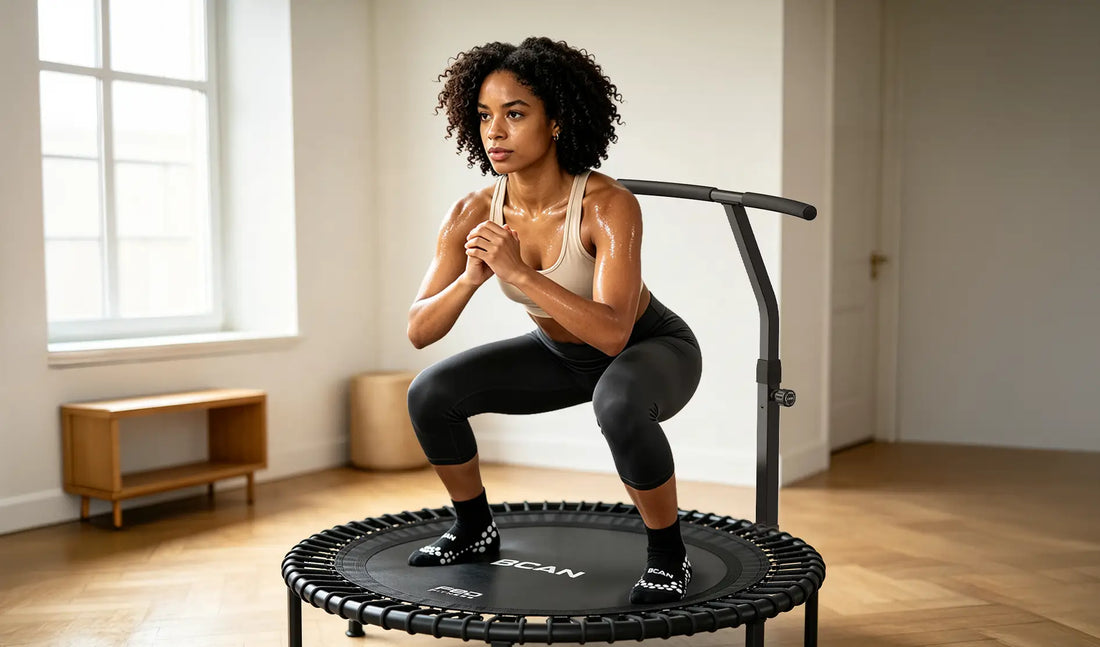
Is a Mini Trampoline Actually Effective for Weight Loss?
A mini trampoline can absolutely help you lose weight. The trampoline just isn't the part that decides whether you do.
Here's the pattern: someone buys a rebounder, bounces a few times a week for a month, sees the same number on the scale, and decides it doesn't work. Into the closet it goes, then onto Marketplace.
But the trampoline was rarely the problem. Two people can buy the same rebounder, run the same routine, and end up in completely different places three months later — one drops a size, the other doesn't budge.
So the real question isn't whether a mini trampoline works. It clearly can. It's why it works for some people and stalls for others — because that's the part you control.
Quick Takeaways
- A mini trampoline can support weight loss, but your habits decide the outcome, not the equipment.
- Rebounding feels easier than it is: you hit moderate-to-vigorous effort while your brain rates it as light.
- In one study, the same workout gave some people three times the fat loss of others; the difference was diet and daily activity, not effort.
- You'll feel fitter in 1–2 weeks, but visible body-composition change usually takes 4–12 weeks.
- The two quiet saboteurs: eating back the calories you burn, and moving less the rest of the day.
Why Mini Trampoline Workouts Feel Different from Traditional Cardio
Rebounding feels easier than it is. The mat absorbs the impact and hands energy back on every bounce, so you can work at moderate-to-vigorous intensity while your body registers it as light, almost playful. That gap is the whole appeal.
Running on pavement loads the entire body with repeated impact, and a rebounder removes most of it.
The elastic surface gives under you and springs back, so your legs aren't pounding anything, and the effort spreads across your whole body instead of hammering your knees.

The interesting part is what happens in your head. In an exercise study run at the University of Wisconsin–La Crosse, people bounced at a genuinely solid intensity, around 79% of their max heart rate, yet rated the effort as only "light to moderate."
Their bodies were working hard, while their perceived effort stayed low.
That disconnect is rare in cardio, and it's a big reason people keep coming back to a rebounder even after they've quit every treadmill they've ever owned.
What Actually Makes a Workout Effective for Weight Loss?
Every workout works the same way for weight loss: it helps you hold a calorie deficit over time. Diet does most of the heavy lifting; exercise protects the results and your muscles; and the specific machine is a detail.
This principle underpins everything else, so it is worth stating clearly.
You lose fat when you take in less energy than you burn, sustained over weeks and months.
No rebounder, treadmill, or rowing machine changes that rule. They're all just tools for spending more energy and building fitness.
And the part most fitness marketing skips: when researchers compare diet alone against diet plus exercise, the weight loss at six months often looks similar.
Where exercise earns its keep is in keeping the weight off and protecting your muscles while you lose fat.
So the smart way to think about a rebounder isn't "this is my fat-burning machine." It's "this is how I stay consistent, build fitness, and hold onto muscle while my eating creates the deficit."
A rebounder is a tool, much like any piece of gym equipment.
You lose weight only when you maintain a calorie deficit. When you burn more calories than you consume, the body draws on stored fat for energy, and that stored fat is the excess weight you are carrying.
Volume matters too.
General health guidelines point to 150 to 300 minutes of moderate activity a week, and the research on weight loss specifically leans toward the higher end of that, north of 250 minutes a week, for changes you can see.
A gentle five-minute bounce now and then is good for you, but on its own, it is not a weight-loss program.
If effectiveness comes down to the fundamentals, then results come down to how well a person applies them. That is the question worth examining next.
Why Some People See Results with Rebounding — and Others Don't
Same trampoline, same routine, completely different results. The reason almost always lives in six places, and two of them are saboteurs that people never see coming.
If you have wondered why someone else achieved results with a rebounder while you did not, the explanation is almost certainly one of the factors below.
Consistency over months, not weeks
Consistency is the single strongest predictor of results, by a wide margin. Results compound, but only if the work survives past the first burst of motivation.
A great two-week streak that fizzles in week three does almost nothing.
A modest, unglamorous routine repeated for four months changes your body. The people who succeed are not those with the best workouts.
They are the ones still training consistently after the novelty has worn off.
Eating back the burn
This is the most common saboteur of exercise-based weight loss.
After exercise, some people get noticeably hungrier and, without meaning to, eat back everything they burned and then some.
You exercise and burn a few hundred calories, then feel hungry, or feel you have earned a treat, and eat a few hundred calories back. The result is no change, or even a gain.
Researchers have a name for them: "compensators." And the effect is dramatic.
In one 12-week study where everyone did the same supervised workouts, the "responders" lost about 5.2 kilograms of fat while the "non-responders" lost only 1.7 — roughly a third as much — largely because of how their appetite reacted to the exercise.
A 300-calorie session can feel like permission for a 400-calorie snack, and the deficit quietly reverses.
The calories burned during exercise are effectively replaced at the kitchen counter.
Moving less the rest of the day
This factor undermines progress in a less obvious way.
Your body burns a surprising amount of energy through ordinary daily movement: walking, fidgeting, standing, and taking the stairs.
This is the standard 1,500 to 2,000 calories a day recommendation. The average person needs that just to function at a basic level.
Scientists call it NEAT, but it varies wildly from person to person.
The catch is that when people add a workout, many unconsciously dial down everything else. They sit more, rest more, take the elevator, and feel like they've "earned" a lazy afternoon.
Your body is quietly defending its energy budget, and a hard 20-minute bounce can get partly canceled out by a more sedentary rest of the day.
It's a major reason the scale stalls even when you're putting in the work.
The best way to counter this is to maintain your normal daily activity and treat the rebounder session as additional movement, not a reason to slow down for the rest of the day.
Diet quality
You cannot out-train a poor diet.
Rebounding burns a meaningful but modest number of calories per session, small compared to how fast we can eat them.
If the eating isn't in a deficit, no amount of bouncing rescues it. We break down the calorie numbers by body weight in our calorie-burning guide if you want the math.
Actually pushing the intensity
The "feels easy" quality of rebounding becomes a drawback if you only ever coast. Gentle bouncing is healthy, but it burns relatively few calories.
To drive weight loss, you have to push, breathing hard enough that talking is easy but singing isn't, and you need to keep nudging it up as you get fitter.
Plenty of people plateau simply because the workout that challenged them in week one is a warm-up by week eight, and they never adjusted.
Sleep and stress
Sleep and stress are easy to overlook, yet they have an outsized effect. They form the foundation of a healthy lifestyle, and no amount of exercise offsets the damage of poor sleep or chronic stress.
The body does not function well when either is consistently compromised.
In one tightly controlled study, dieters eating the same calories lost far less fat when they slept 5.5 hours instead of 8.5, and lost more muscle in the bargain.
Short sleep cranks up hunger and undercuts everything else you're doing. You can do the workouts perfectly and still get robbed at night.
Note that only one of those six factors concerns the workout itself. The remaining five concern the lifestyle around it, which is why the trampoline is rarely the deciding factor.
Who Is Most Likely to Benefit from a Mini Trampoline Workout?
The people who win with a rebounder tend to be deconditioned beginners, anyone whose joints can't handle running, and above all, the person who finds bouncing fun enough to keep doing it.
If running hurts your knees, if you are starting from a low fitness base, or if you enjoyed rebounding the first time you tried it, a rebounder is likely a good fit.
For the full breakdown of who should pick a rebounder versus another machine, our rebounding vs treadmill guide lays it out side by side.

Why Mini Trampolines Can Be Easier to Stick With Than Other Cardio Equipment
Enjoyment is not a trivial factor. A workout that feels like play gets repeated, and repetition is what changes your body.
We made the full case for this in the treadmill comparison, so the short version: the workout you enjoy is the workout you'll still be doing in three months, and the one you'll still be doing in three months is the only one that works.
For a lot of people, bouncing clears that bar in a way a treadmill never did.
Common Signs a Workout Routine Isn't Sustainable
A routine usually warns you before it dies. Dread, a sliding frequency, and the all-or-nothing pattern are the loudest alarms.
You can catch a failing routine early if you know the signals. Watch for these:
- You feel a flicker of dread before sessions instead of neutral or mild anticipation.
- Your frequency is quietly dropping: four days last week, three this week, two the next.
- You're stuck in all-or-nothing mode: a flawless week, then nothing, then guilt, then another flawless week.
- You're bored stiff with the same 15-minute video.
- You came out of the gate too hot, 45 minutes a day in week one, and you can feel the crash coming.
- You're sore in a bad way because you did too much too soon.
The fix is almost always the same, and it's counterintuitive: start smaller than feels necessary.
A routine you think is "too easy" but actually do beats an ambitious one you abandon. Shrink the session until showing up is easy, then grow it.
What Results Can You Realistically Expect from Rebounding?
Expect to feel fitter within a week or two, and to see body-composition change over roughly 4 to 12 weeks of consistent work. The timeline isn't magic; that's just how long the fundamentals take to show up.
A rough map of what tends to happen:
- Weeks 1–2: You feel better before you look different. More energy, better mood, less out of breath on the stairs. That's your heart and muscles adapting, not fat loss yet, and it's the stretch where a lot of people quit because the mirror hasn't caught up.
- Weeks 2–4: Clothes might start sitting a little differently. Early scale movement is often water, not fat, so don't read too much into it in either direction.
- Weeks 4–12: With consistency and sensible eating, visible change tends to show here.
A warning about the scale is warranted because it derails more weight-loss efforts than any workout flaw does. Your weight swings daily with water, food, salt, and hormones.
Worse, if you're losing fat and building a little muscle at the same time, which rebounding encourages, the scale can sit dead still while your body quietly recomposes underneath. Track more than one thing.
Waist measurement, monthly photos, how your jeans fit, your energy, your strength. The scale is one noisy data point, not the verdict.
None of this is a promise, and none of it is medical advice. Your results ride on the six variables above, not on the brand of trampoline under your feet.
What Type of Mini Trampoline Makes Workouts More Comfortable?
A quiet, soft landing and a stable place to hold on remove the two things that make beginners quit early. In practice, that means a bungee mat instead of steel springs, and a handlebar if your balance is still finding its feet.
Bungee-based rebounders give a softer, deeper, quieter bounce than the older steel-spring kind, which matters for your joints and your downstairs neighbors.
A stability handlebar gives nervous beginners and older users something to hold while their ankles learn the rhythm.
A model like the BCAN BT4 Soft Land Pro pairs a bot with a bungee mat with an adjustable T-handlebar, which is about as low-friction an entry point as rebounding gets.

Can a Mini Trampoline Replace Traditional Cardio?
For general fitness and weight loss, yes, as long as you hit the intensity and weekly minutes that any effective cardio needs. The one thing it can't replace is sport-specific training, like running to prepare for a race.
A rebounder can carry your whole cardio routine if you let it work hard enough and often enough.
The exception is goal-specific training: if you're training to run a 10K, you have to run, because those adaptations are specific to the activity.
Final Thoughts
The trampoline was never really the deciding question.
A mini trampoline is a legitimate, effective piece of cardio equipment, gentle on your joints, easy to keep up, and perfectly capable of helping you lose weight.
But it does that the same way every workout does: by helping you hold a calorie deficit you build mostly in the kitchen, repeated patiently over months.
Buy the rebounder you'll actually use, then win or lose it on consistency, your eating, and how much you move the rest of the day.
Get those right, and a mini trampoline works beautifully. Get them wrong, and the fanciest machine on earth won't save you.
The good news is that every one of those levers is yours to pull.
FAQs
Why Does Rebounding Feel Easier Than Running?
The mat absorbs impact and returns energy with each bounce, so your legs aren't pounding against a hard surface, and the effort spreads across your body.
People also tend to rate the effort lower than their heart rate suggests, which is why a solid workout can feel like play.
Can Low-Impact Workouts Still Help With Weight Loss?
Yes. Impact level has little to do with weight loss; calorie burn and consistency do.
A low-impact workout you do four times a week will outperform a high-impact one you dread and skip. Low impact often means better adherence, which helps.
Why Do Some People Lose Weight Rebounding While Others Don't?
Usually one of six reasons: inconsistency, eating back the calories burned, moving less the rest of the day, no calorie deficit, coasting at low intensity, or poor sleep.
Only one of those is the workout itself. The rest are the habits around it.
Is Rebounding Easier to Stick With Than Traditional Cardio?
For many people, yes, because it tends to feel more like play than a chore, and enjoyment is what keeps you coming back.
The best cardio is the one you'll actually keep doing. Our treadmill comparison digs into this trade-off.
Can Beginners Lose Weight With a Mini Trampoline?
Absolutely. Rebounding is beginner-friendly thanks to its low impact and gentle learning curve, especially with a handlebar for balance.
Start with short sessions a few times a week, build gradually, and pair it with sensible eating.
What Makes a Rebounder Workout Effective?
Enough intensity to raise your heart rate, enough total weekly minutes, and consistency over months, all wrapped around a calorie deficit.
Gentle bouncing is healthy, but to lose weight, you have to push the intensity and eat in a deficit.
Is a Mini Trampoline Enough Exercise for Home Fitness?
For general cardiovascular fitness and weight management, it can be plenty, especially combined with some strength work twice a week.
If you have sport-specific goals like distance running, you'll want to add that specific training.
References
- Donnelly JE, et al. American College of Sports Medicine Position Stand. Appropriate physical activity intervention strategies for weight loss and prevention of weight regain for adults. Medicine & Science in Sports & Exercise. 2009;41(2):459–471.
- U.S. Department of Health and Human Services. Physical Activity Guidelines for Americans, 2nd edition. 2018.
- Cugusi L, et al. Effects of a mini-trampoline rebounding exercise program on functional parameters, body composition, and quality of life in overweight women. Journal of Sports Medicine and Physical Fitness. 2018;58(3):287–294.
- King NA, et al. Individual variability following 12 weeks of supervised exercise: identification and characterization of compensation for exercise-induced weight loss. Obesity. 2010;18(4) (PMID 20886014).
- Pontzer H, et al. Constrained total energy expenditure and metabolic adaptation to physical activity in adult humans. Current Biology. 2016;26(3):410–417.
- Nedeltcheva AV, et al. Insufficient sleep undermines dietary efforts to reduce adiposity. Annals of Internal Medicine. 2010;153(7):435–441.
This content is for informational purposes only and does not constitute medical advice. For questions related to your health or medical conditions, please consult your physician. Always seek advice from a qualified healthcare professional before starting any exercise program or health regimen. In the event of a medical emergency, call 911.


Leave a Comment
We’d love to hear from you — your insights can inspire others!