


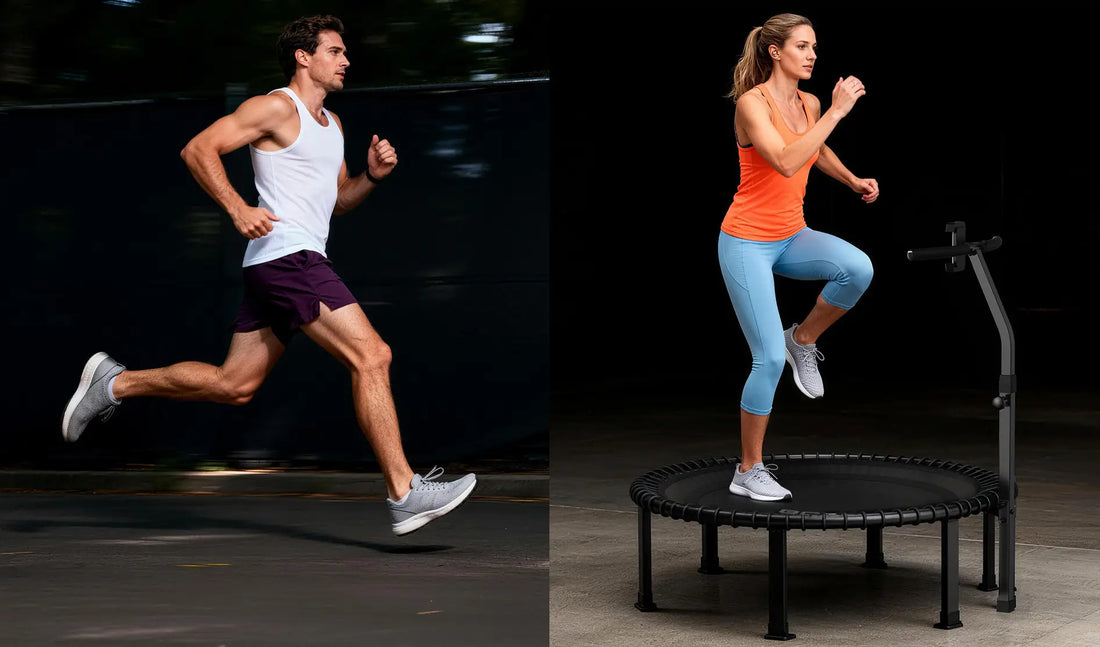
Is Rebounding Better Than Running for Weight Loss?
Running and rebounding can both strip fat, but they're built for different bodies and different lives.
We treat running as the serious option and a mini trampoline as the soft, slightly silly alternative.
But here's what gets left out: running hurts a lot of the people who do it — depending on the study, 19% to 79% of runners get injured in a given year, with the knee taking the worst of it. That's the trade-off nobody mentions when they call running the gold standard.
So the real question isn't which one burns more calories. Running wins that at speed. It's quieter than that: which one will you still be doing — pain-free and happy — six months from now?
Quick Takeaways
- Running burns more calories per minute at speed; rebounding's edge is much lower impact and easier consistency.
- Studies put annual running-injury rates anywhere from 19% to 79% of runners, with the knee the most common casualty.
- Beginners get hurt running at more than double the rate of seasoned runners, so low-impact rebounding is a gentler on-ramp.
- For most runners, the smartest move isn't switching; it's adding rebounding as cross-training and active recovery.
- "Better for weight loss" really just means "the one you'll keep doing without getting hurt."
Do Rebounding and Running Burn Similar Calories?
At a brisk run, running burns more calories per minute than rebounding, no contest. At an easy pace, the two get closer. But calories-per-minute is a weak way to pick a workout, because the one you'll actually keep doing beats the one with the bigger number on paper.

To address the calorie question directly: running has a higher top end. At faster paces, it will out-burn a rebounding session.
We will not claim otherwise simply to sell a rebounder.
What matters is an honest account of the numbers, which much rebounding content does not provide.
Some websites claim a mini trampoline burns calories at rates rivaling sprinting. Those figures come from outdated calculators and marketing, and they overstate the burn.
Measured honestly, rebounding lands in the moderate range, roughly a brisk-walk-to-light-jog level of burn, and it climbs from there with effort.
If you want the full breakdown by body weight and intensity, we ran all the numbers in our guide to how many calories rebounding burns.
For this decision, the takeaway is simple: running has the calorie edge at speed, and that edge matters less than you'd think once you factor in impact, injuries, and whether you'll stick with it.
How Does Calorie Burn Depend on Intensity?
Effort is the lever, not the equipment.
A hard rebounding session with high knees outperforms a slow jog, and an all-out run outperforms a gentle "health bounce." Neither activity has a hidden metabolic advantage; both reward greater effort, and both allow you to coast.
Why Does Rebounding Often Feels Easier?
For most people, rebounding tends to feel easier than it actually is.
The mat absorbs the landing and springs you back up, so your legs aren't pounding anything like a pavement or outdoor trail does, and people routinely rate the effort lower than their heart rate says it should be.
That gap is a gift for consistency. We get into the stick-with-it side of that in our rebounding vs treadmill guide, so we'll move on.
The Biggest Difference: Joint Impact
This is where running and rebounding truly split. Running sends a force of two and a half to three times your body weight through your joints, thousands of times per run. A rebounder's mat absorbs and spreads most of that. For a lot of people, that single difference decides the whole question.
Calorie burn receives most of the attention, but joint impact is what quietly determines whether you are still exercising in three months or recovering from an injury. It deserves equal focus.
Why Running Can Be Hard on the Knees and Ankles?
Running is a repetitive-impact activity.
Every footstrike drives a hard force up through your foot, ankle, knee, hip, and spine, and a single run is thousands of those strikes.
Your body adapts to that load over time, which is how experienced runners stay healthy. But the loading is also what creates running's signature injury pattern.
And those injuries are common.
A major review of the research found that anywhere from about 19% to 79% of runners pick up a lower-body injury in a given year, with the knee the most frequent trouble spot.
The usual suspects have nicknames for a reason: runner's knee, IT band syndrome, shin splints, Achilles trouble, plantar fasciitis.
Almost all of them are overuse injuries, the slow result of repetitive pounding rather than a single bad step.
None of this is medical advice, and it isn't an argument that running is dangerous. Millions of people run for decades and love it. It's simply the context for the comparison: running's biggest downside is an injury risk that comes baked into the repetitive impact.
For beginners, older adults, people with joint concerns, or anyone who dislikes running enough to abandon it, rebounding can offer a more sustainable, lower-risk, and more enjoyable alternative.
Why Rebounding Feels Lower Impact?
A rebounder takes the main injury driver, repetitive impact, and softens it.
The elastic mat gives under you and hands the energy back gradually, so instead of slamming your skeleton into a hard surface, the force spreads out across your body and peaks lower at the ankle.

You'll see this backed by an old NASA-era study that compared the forces in running versus jumping. It's often misquoted online as proof that bouncing burns more calories, which it doesn't say.
What it actually showed is that the impact during jumping is distributed more evenly through the body and peaks lower at the ankle than running does. That's the part that matters here. Rebounding isn't injury-proof, but it sidesteps the exact mechanism that hurts the most runners.
We cover the detailed biomechanics in the treadmill comparison if you want to go deeper.
Which One Is Easier to Recover From?
Lower impact means a lower toll the next day. Because a rebounding session loads your joints far less than a run, most people feel less beat up afterward and can bounce more often without the accumulated wear that hard running piles on.
If your goal is to move most days of the week, that's a meaningful practical advantage. Running usually demands rest days between hard efforts. Rebounding is friendlier to a daily habit.
Which Exercise Is Easier to Stick With Long Term?
Whichever one feels like play instead of punishment, and that's genuinely personal. Some people find the outdoor rhythm of a run blissful. Others dread every step and happily bounce instead. The one you'll repeat is the one that works.
We made the full enjoyment-and-adherence case in the treadmill post, so the short version here: there's no universal answer, and anyone who insists running is "obviously better" or bouncing is "obviously more fun" is guessing about you.
Be honest about which one you will dread, because dread is what fills closets with abandoned equipment.
Rebounding vs Running: Which Is Better for Beginners?
For most true beginners, especially if you're deconditioned or carrying extra weight, rebounding is the gentler and safer place to start. Running's "too much, too soon" trap sidelines a huge share of new runners in the first few weeks.
Novice runners get injured at more than double the rate of seasoned recreational runners, mostly because an unprepared body can't yet handle the repetitive impact that a trained runner's body shrugs off.
New runners also drop out at high rates, and the heavier you are when you start, the higher the odds you'll get hurt or quit, often because the program ramped up faster than the body could adapt.
Rebounding gives you a softer on-ramp.
You can build aerobic fitness, balance, and the daily habit of moving with a fraction of the joint stress, then layer running in later if you decide you want it.
If you do go the running route, treat a Couch-to-5K plan as a floor, not a race: keep most efforts easy, progress slowly, and repeat a week whenever you need to.
For a proper beginner's guide to low-impact starting, see our post on why rebounders work for low-impact workouts.
Who Might Prefer Running?
Runners and aspiring racers, people who love being outdoors, and anyone who wants free, no-equipment cardio they can do anywhere with nothing but a pair of shoes.
Although we sell rebounders, it would be misleading to suggest running has no advantages. It has several worth taking seriously.
It's free, and it goes anywhere.
A rebounder is a worthwhile purchase that lives in one room.
There's the outdoor factor, too.
Exercising outside in green space has been linked to bigger boosts in mood and energy than the same workout done indoors, and bouncing in your living room can't fully replicate a sunrise by the river.
Then there's the part that keeps people running for life: belonging.
Run clubs, races, and the free weekly parkrun turn running into a community and an identity, and "becoming a runner" is a powerful reason to keep lacing up.
The famous runner's high is no myth: that calm, floaty feeling after a sustained effort. And the health payoff is well-established, with large studies linking regular running to meaningfully lower risk of early death.
Running is a fantastic activity. The only question is whether it's the right one for you.
Who Might Prefer Rebounding?
People with sensitive joints, anyone coming back from a running injury, apartment dwellers who need quiet weather-proof cardio, deconditioned or heavier beginners, and anyone who finds running flat-out miserable.

If running has hurt you before, if your knees complain, if you live above a light-sleeping neighbor, or if the thought of a 6 a.m. run in the rain makes you want to skip the workout entirely, a rebounder solves those problems.
It is low-impact, quiet, weather-proof, and always available in the corner of the room.
Can You Combine Rebounding and Running?
Yes, and most runners probably should. They're not rivals fighting for the same slot in your week. A rebounder is one of the most practical pieces of cross-training a runner can own.
This is rarely discussed, and it may be the most useful point in this article.
Stop thinking of it as rebounding versus running and start thinking about rebounding plus running.
The logic comes straight out of sports medicine.
Running injuries are overwhelmingly overuse injuries, driven by repetitive impact and by piling on mileage too quickly. The two best defenses are getting stronger and managing how much total pounding your legs absorb across a week.
That second one is exactly where a rebounder earns its keep.
Cross-training lets you keep your cardio engine working hard while taking the impact load off your joints, which is the whole point of swapping a low-impact session in for a run now and then.
Here's how a runner can actually put a rebounder to work:
- Active recovery on off days. A gentle bounce the day after a hard run keeps the blood moving and the habit alive without adding more pounding.
- Holding your fitness through a niggle. When a knee or shin gets grumpy, and you need to back off running, rebounding keeps your aerobic base intact while things settle. If you're in pain, see a professional, but for managing a minor flare, it's gold.
- Cutting impact without cutting cardio. Want running's benefits with less wear? Replace one or two runs a week with rebounding to lower your total impact load while keeping your weekly cardio steady.
- Building a base before you run. Beginners who want to run eventually can build fitness on the mat first, then transition.
A simple week for a recreational runner might look like three runs (one easy, one faster, one longer), two rebounding sessions for recovery and extra aerobic volume, one strength workout, and a rest day.
You keep the running you love, you add cardio, and your joints absorb less pounding overall.
For recovery-day and everyday use, a quiet bungee-style rebounder makes the habit sustainable indoors, since you can bounce early or late without a sound.
The BCAN BT4 Soft Land Pro uses latex bungee cords for a soft, near-silent landing and adds a 5-level adjustable T-handlebar, which is reassuring when you're bouncing on tired legs or easing back from a layoff.

Common Misconceptions About Rebounding vs Running
Most of what people "know" about this matchup is wrong in both directions. Running isn't the only legitimate cardio, and rebounding isn't a magic calorie furnace.
Let's clear up the big ones.
- "Running is the only real cardio." Not true. Any activity that pushes your heart rate into a training zone counts, and rebounding routinely hits moderate-to-vigorous intensity.
- "Rebounding is just for kids and isn't serious." Not true. Physical therapy clinics use rebounders for rehab precisely because they deliver a proper workout with low joint stress.
- "You have to run to lose weight." Not true. Weight loss comes from a sustained calorie deficit, not from any single exercise. The activity you'll do consistently, paired with sensible eating, is what works.
- "Rebounding burns way more calories than running." Not true, and we won't pretend it is. At intensity, running burns more calories per minute. Rebounding's advantage is impact and enjoyment, not some hidden metabolic boost.
This is also where those viral claims about rebounding being dramatically more efficient than jogging fall apart; they trace back to distorted or unverifiable sources, so treat them with suspicion.
- "Low impact means low intensity." Not true. Impact is the force on your joints. Intensity is how hard your heart and lungs work. They're different things, and you can get a genuinely tough, sweat-soaked workout on a rebounder with very little joint stress.
Final Thoughts: Which Is Better for Weight Loss?
Neither is universally better, and any source that claims otherwise is usually selling something.
Running has the higher calorie ceiling, the run-anywhere freedom, and a set of joys, community, the outdoors, the runner's high, that a living-room bounce can't match.
Rebounding has a dramatically lower impact, a much smaller injury risk, and the kind of low-friction convenience that keeps you consistent when motivation dips. The best choice for your weight loss is the one your body tolerates and your week can sustain.
For a lot of people, that's not a choice at all. It's both, running for the days you want to get outside and push, rebounding for recovery, for bad-weather days, and for protecting your joints so you can keep running for years.
Pick the mix you'll actually stick with, pair it with a sensible diet, and let consistency do the rest.
FAQs
Does Rebounding Burn More Calories Than Running?
Not at higher intensities. A brisk run burns more calories per minute than a typical rebounding session. At an easy pace, they're closer. For weight loss, how consistently you train and whether you stay injury-free matter more than the per-minute difference.
Is Rebounding Easier on Your Knees Than Running?
For most people, yes. The mat absorbs much of the landing force that running drives straight through the knees and ankles, so rebounding loads the joints far less. That's general fitness information, not medical advice, so check with a professional about your specific situation.
Can Rebounding Replace Running?
For general fitness and weight loss, yes, as long as you bounce hard enough and often enough. The one thing it can't replace is running itself. If your goal is to race, you have to run to train for it, though rebounding makes excellent cross-training alongside it.
Is Rebounding Good for Beginners?
Very. It's low-impact and forgiving, which makes it a gentler start than running for anyone deconditioned, returning to exercise, or carrying extra weight. A model with a stability handlebar helps with balance while you find your rhythm.
Can You Lose Weight Faster With Rebounding?
Not inherently. Weight loss is driven by a calorie deficit over time, not by the choice of machine. Rebounding can help you lose weight if it's an activity you can do consistently without getting hurt, which, for many people, is exactly its advantage.
Is Rebounding Considered Cardio Exercise?
Absolutely. Rebounding raises your heart rate into the same moderate-to-vigorous zones as other cardio, and it improves cardiovascular fitness, balance, and endurance. It's cardio in every sense, with a fraction of the impact.
References
- van Gent RN, et al. Incidence and determinants of lower extremity running injuries in long-distance runners: a systematic review. British Journal of Sports Medicine. 2007;41(8):469–480.
- Videbæk S, et al. Incidence of running-related injuries per 1000 h of running in different types of runners: a systematic review and meta-analysis. Sports Medicine. 2015;45(7):1017–1026.
- Taunton JE, et al. A retrospective case-control analysis of 2002 running injuries. British Journal of Sports Medicine. 2002;36(2):95–101.
- Lauersen JB, et al. The effectiveness of exercise interventions to prevent sports injuries: a systematic review and meta-analysis of randomized controlled trials. British Journal of Sports Medicine. 2014;48(11):871–877.
- Thompson Coon J, et al. Does participating in physical activity in outdoor natural environments have a greater effect on physical and mental wellbeing than physical activity indoors? A systematic review. Environmental Science & Technology. 2011;45(5):1761–1772.
- Pedisic Z, et al. Is running associated with a lower risk of all-cause, cardiovascular, and cancer mortality, and is the more the better? A systematic review and meta-analysis. British Journal of Sports Medicine. 2020;54(15):898–905.
This content is for informational purposes only and does not constitute medical advice. For questions related to your health or medical conditions, please consult your physician. Always seek advice from a qualified healthcare professional before starting any exercise program or health regimen. In the event of a medical emergency, call 911.
Products


Leave a Comment
We’d love to hear from you — your insights can inspire others!