


10-Minute Rebounder Workout for Beginners at Home: A Simple Low-Impact Routine to Get Started
You don’t need much home equipment to get in a quick 10-minute workout. Using a rebounder workout beginner routine will help get your body moving without placing a lot of strain on your joints. It fits easily into a busy schedule without taking up much room in your home, office, or shared living space.
One of the challenges to starting a new workout routine is time commitment. With jogging or weightlifting, it often feels like a big chunk of time has to be separated from the rest of the day to hit the “bare minimum” movements.
The reality couldn’t be further from the truth. Many people can get in a solid workout in as little as 10 to 15 minutes, 3 to 4 times a week. That is where a rebounder workout beginner routine can help. A rebounder, sometimes called a mini trampoline, offers a safe, efficient way to engage the legs, core, and stabilizer muscles without taking up a massive area in your home.
At FED Fitness, we aim to support individuals of all lifestyles with easy-to-use equipment, including a quick 10-minute routine you can do before work, after running errands, or when the kids are napping, so you finally get some self-care time.
Why Short Rebounder Workouts Work Well for Beginners
A well-rounded, 10-minute rebounder workout beginner routine is simple. It doesn’t require signing up for a class or pushing your body well beyond what it’s ready to handle over a couple of hours.
The trick is to listen to your body and be consistent. Short workouts fit into your day and help beginners learn more about how their bodies move. You can adjust to the soft, responsive surface of a rebounder without feeling overwhelmed by the complex machinery common in local gyms.
The World Health Organization recommends regular physical activity to improve health and reduce the risk of chronic issues. They do not recommend instantly going from beginner to trying to lift 300 pounds for the first time. Consistent effort that aligns with your lifestyle is a wonderful beginning to a beneficial health journey.
What You Need Before Starting
You don’t need all that much to get started with a rebounder, especially with a shorter workout in 10 minutes. Make sure the area you’re setting up the rebounder in has plenty of clearance around the sides and overhead. Also, check that the legs and bungees are properly set and that the mini trampoline is on a flat, stable surface.
You should wear loose, comfortable clothing that doesn’t restrict movement, including athletic shoes for grip and support. Eventually, you can try barefoot, but it’s safer to have traction when you’re a beginner.
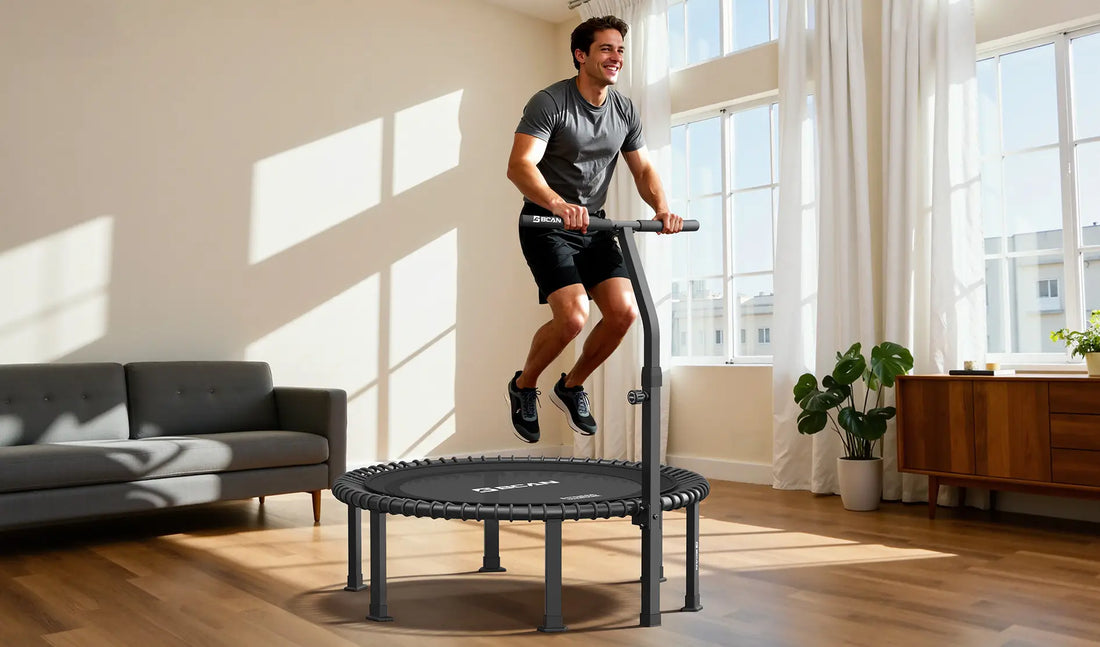
A handlebar is also a good idea. With the BT4 Soft Land Pro Adult Bungee Trampoline from FED Fitness, you get an adjustable handlebar for added safety and a phone holder so you can bounce to your favorite music. Other than that, a water bottle and a hand towel are a good idea for sweating.
10-Minute Beginner Rebounder Workout Routine
Okay, now for the good stuff. You need a basic, 10-minute rebounder workout beginner routine. Keep in mind this is for a beginner, so go slow and listen to your body as you move from stage to stage.
Minute 0:00–1:00: Step-On Balance Check
Start by stepping into the center of the mini trampoline. Place one foot down first, then the other about hip-width apart. Don’t start bouncing. Instead, let your body adjust to the device's feel as you shift your weight from one foot to the other.
Keep your knees bent and focus on your breathing and posture. That first minute is all about finding your center and building confidence so you can move on to more complex movements.
Minute 1:00–2:30: Health Bounce
Long after you become a rebounder master, you’ll think back and appreciate the healthy bounce. All you do is bounce gently, maybe lifting your heels off the mat an inch or so. It’s not about getting a high jump, but consistent movement that engages your stabilizer muscles. This is considered a warm-up for many who’ve been using a rebounder for years.
Minute 2:30–4:00: Gentle March
Move from the health bounce into a gentle march by lifting one foot a few inches (or think of the knee as the center of movement), then placing it back down while you lift the other. You’re imitating a marching movement as you’ve seen in the movies with military members.
You can let your arms swing naturally to help you feel steady, but don’t forget you have an adjustable handlebar available on the BT4 Adult Mini Trampoline from FED Fitness for extra balance support.
Minute 4:00–5:00: Side-to-Side Weight Shift
By now, you should start to feel some pressure from working out. It may be gentle, but using a good portion of your body’s muscle resources really helps your balance and stability.
When you’re comfortable, add a small bounce as you shift your hips slightly from side to side. Keep the movement narrow. You’re not making big motions, but controlled lateral movements. There’s a big difference between side-to-side motion and up-and-down movement, which most associate with a rebounder.
Minute 5:00–6:30: Light Jogging Bounce
Begin next with a light jogging bounce by alternating your feet and picking them up one at a time in a slight jogging motion. Keep your bounce low so that your feet barely leave the mat. Relax your arms and shoulders and focus on your breathing as you move. If things are too intense, just slow down.
Minute 6:30–7:30: Recovery Health Bounce
You’re going to return to the health bounce now to begin cooling down. You can scale the jogging bounce to a longer duration if you want an extra intense workout, but start slow for now. Remember to maintain your posture, stay in the center of the mat, and focus on your rhythm.
Minute 7:30–8:30: Simple Arm Reaches
A fun way to continue the low-impact part of a rebounder workout beginner routine is to add in your arms. You can continue the health bounce and then reach both arms forward, overhead, back, or make small circle motions. Add variety and experiment a little, but remember to listen to your body so you don’t overstrain.
Minute 8:30–9:30: Gentle March with Arms
A gentle march is a natural cool-down. You can maintain a simple arm swing and keep your steps small. You want smooth movement, not speed, as you’re trying to make the body feel more secure and relaxed, leading up to the end of your beginner workout.
Minute 9:30–10:00: Slow Bounce and Step-Off
Finish your 10-minute rebounding workout with a slow health bounce that gradually reduces movement until you’re standing still. Take 3-5 slow breaths and let them out. Hold the handlebars as you step off the rebounder, one foot at a time.
That’s it! You’ve just completed a fantastic 10-minute mini trampoline workout perfect for beginners. Give yourself a pat on the back and set a reminder on your smartphone for another session a couple of days later. Good work!
Why Home Rebounder Workouts Are Easier to Stick With
A rebounder workout beginner routine is a lot easier than going to the gym every couple of days. Using the BT4 Soft Land Pro Adult Bungee Trampoline by FED Fitness provides you with a small piece of equipment available in 40” and 48” sizes. It holds up to 500 pounds, making it fit for most beginners hoping to improve mobility, stability, and simply get the body moving.
You’re getting a convenient way to work out. Adding a quick morning session before heading to work or taking a midday break at the office isn’t intimidating. Yes, you may make a few mistakes in the beginning, but a 10-minute workout is short enough that you’ll eventually perfect your movements.
Be patient with yourself and listen to your body. It’s impressive to make the shift from a relatively stagnant lifestyle to getting up and moving. You should be proud of yourself. Have fun, be safe, and enjoy your rebounder workout.
FAQs
Is 10 Minutes of Rebounding Enough for Beginners?
Yes. For many beginners, 10 minutes feels much longer. Over time, you’ll be able to fit in 10-minute sessions 3 times a week. Eventually, try to work up to 20-minute sessions 3-4 times a week.
Can Beginners Lose Weight with Short Rebounder Workouts?
Short rebounder workouts help support a more active lifestyle. When combined with a healthy diet, plenty of sleep, and hydration, you may see changes in your body. How those changes occur depends a lot on your individual situation.
Should Beginners Jump High on a Rebounder?
Short, controlled movements are the way to go with beginners. You want consistency, and that’s best achieved with routine, not with extreme jumps that risk your safety.
Can You Rebound Every Day as a Beginner?
You can, but it’s better to start with no more than 3 sessions a week. You want to get your body used to the movement as you build more control in your stabilizer muscles and overall balance.
What Should Beginners Wear for Rebounding?
Wear comfortable athletic clothing and supportive shoes or grip socks. Try to avoid anything that is too loose and may wrap around your arms, legs, or items on your rebounder that you may have overlooked.
References:
- World Health Organization. Physical activity. World Health Organization. 26 June 2024.
- Posch M, Schranz A, Lener M, Tecklenburg K, Burtscher M, Ruedl G, Niedermeier M, Wlaschek W. Effectiveness of a Mini-Trampoline Training Program on Balance and Functional Mobility, Gait Performance, Strength, Fear of Falling and Bone Mineral Density in Older Women with Osteopenia. Clin Interv Aging. 2019 Dec 20;14:2281-2293.
This content is for informational purposes only and does not constitute medical advice. For questions related to your health or medical conditions, please consult your physician. Always seek advice from a qualified healthcare professional before starting any exercise program or health regimen. In the event of a medical emergency, call 911.


Leave a Comment
We’d love to hear from you — your insights can inspire others!