


Rebounding vs Running: Is Rebounding Good for Beginners Who Hate It?
If running has never “clicked” for you, rebounding might be the cardio you've been waiting for.
Now, you probably have some preconceptions when imagining yourself exercising on a mini trampoline. It might feel like it’s for other people, might feel a bit weird or awkward, or you might doubt whether it’s actually going to get you the results you’re after.
Running might suck for you, but it’s so renowned for being healthy and great exercise that maybe you can just white-knuckle through it?
Well, if you’re on the fence and really hate the idea of running, this guide compares rebounding vs running for beginners, looking at joint impact, how each one feels, whether a mini trampoline can actually build fitness, and how to start if you've spent years avoiding cardio.
By the end, you'll know whether bouncing belongs in your routine, and exactly how to begin.
Let me say the quiet part out loud: plenty of people don't hate cardio; they hate running. The pounding, the boredom, the way your knees file a complaint by week two.
If that's you, you're in good company, and you have options.
Why So Many Beginners Struggle With Running
Running is hard on new bodies, and the numbers back that up. Novice runners get hurt at more than double the rate of experienced ones, which is why so many beginners quit before the habit ever forms.
I’ll start with the exercise of running, and this comes from me personally, because I find it sucks. I don’t hate it, and I’ll do it from time to time, but I don’t do it regularly enough to find my flow with it.
It’s hard work, demanding, boring, and physically demanding upfront. That includes cardiovascular effort, coordination, and impact tolerance, all at once.
For someone who's out of practice, that combination feels punishing rather than rewarding. So they stop. Not because they're lazy, but because the activity gave them pain and tedium (basically, being bored) instead of momentum.
Then there’s the injury risk.
A systematic review and meta-analysis found novice runners sustain roughly 17.8 injuries per 1,000 hours of running, compared with about 7.7 for recreational runners.
Across the wider research, the average runner has close to a 43% chance of a running-related injury in a given year. Most of those are overuse problems in the shins and knees, the kind that creep in when someone goes from zero to daily miles too fast.
None of this means running is bad. It's a fantastic sport for people who love it. But if you're not one of them, forcing it is rarely the answer.
What Makes Rebounding Feel Different From Running?
Rebounding swaps hard ground for a giving surface, which changes everything about how the workout lands, literally. You get the heart-rate benefits of cardio with a fraction of the jarring impact, and most people find it genuinely fun.
That difference in feel is the whole reason the rebounding vs running comparison matters for beginners.
Running has a repetitive impact on concrete. Rebounding is springy, playful, and forgiving. Same goal, completely different sensation. Let's break down what actually changes.

Is Rebounding Easier on the Knees Than Running?
For most people, yes, rebounding involves noticeably less peak impact than running on pavement. The elastic surface absorbs and spreads the force of each landing instead of sending it straight up your legs.
When you run, each stride hits the ground with a vertical force of roughly 1.5 to 3 times your body weight, and that force travels up through your ankles, knees, and hips in a split second.
A rebounder's mat gives way under you, cushioning the landing and lowering that peak load. Researchers have measured this impact-attenuating effect since the early studies on jumping versus running.
However, lower impact isn't the same as a medical fix. If you have a diagnosed knee condition, check with a qualified professional before starting any new activity. Running, rebounding, whatever.
For a lot of people, though, a softer landing simply feels more comfortable, and comfort is what keeps you coming back.
Why Some Beginners Stick With Rebounding More Easily
Rebounding tends to feel easier than it actually is, and that perception is a big deal. How you feel during exercise is one of the strongest predictors of whether you'll still be doing it months from now.
In an ACE-sponsored study, a structured rebounder workout pushed participants to about 79% of their maximum heart rate, yet they consistently rated it as feeling easier than the numbers suggested.
Compare that to running, which often feels exactly as hard as it is, or harder.
Why does that matter?
One study found that how people felt during moderate exercise predicted whether they were still active 6 and 12 months later, even after accounting for how hard they were working.
Other work links enjoyment directly to exercise habit and frequency. A workout you like is a workout you repeat. And a workout you repeat and stick with will actually give you proper, long-term results.
Can Rebounding Still Improve Cardio Fitness?
Absolutely, when you put in the effort. A real rebounding session reaches moderate-to-vigorous intensity and can improve your aerobic fitness over time, not just feel nice.
Quite a lot of evidence here.
A study of overweight women found that a 45-minute rebounding session averaged 72% of max heart rate and around 5.2 METs, which qualifies as moderate-to-vigorous and meets standard exercise-prescription guidelines.
A follow-up 12-week program improved participants' VO2max and work capacity, hard measures of cardio fitness.
However, intensity depends on how you bounce. Gentle, casual bouncing sits closer to a brisk walk, around 3.5 to 4.5 METs per the 2024 Adult Compendium.
So rebounding isn't a magic calorie machine, and it won't out-burn a hard run minute for minute. But put energy in, and it's a legitimate cardio workout.
The bonus is you can do it in your living room, rain or shine.
What Type of Beginner Actually Enjoys Rebounding Most?
Rebounding suits people who want effective cardio without the pounding, boredom, or intimidation of running. If you value comfort, convenience, and a bit of fun, you're the target audience.
A few people who tend to love it:
- The reluctant runner who knows they should do cardio but dreads lacing up.
- The joint-conscious mover who wants lower-impact activity that still raises a sweat.
- The busy person who'd rather bounce for 15 minutes at home than drive to a gym or brave the weather.
- The easily bored exerciser who needs something playful enough to hold their attention.
If you see yourself in even one of those, rebounding is worth a try. And you don't need to be coordinated or fit to begin. That's the point.
Common Beginner Mistakes When Switching From Running to Rebounding
The biggest mistake is using a rebounder like a treadmill. Runners are used to grinding through discomfort, but rebounding rewards control, rhythm, and easing in, not white-knuckle effort.
Coming from running, you might be tempted to go hard immediately. Resist it.
The most common stumbles when switching over are jumping too high too soon, locking the knees instead of keeping them soft, staring down at your feet, and doing forty minutes on day one because your running brain says more is better.
Each of those makes the experience worse and your next-day soreness sharper.
Ease in instead. Start with a gentle bounce where your feet barely leave the mat, keep your knees relaxed, stand tall with your eyes forward, and let the workout build over a couple of weeks.
Your body adapts faster when you're not fighting it.
What Does a Beginner Rebounding Workout Actually Feel Like?
It feels light, bouncy, and a little playful, more like rediscovering recess than enduring a workout. Your legs work, your heart rate climbs, but it rarely feels grim.
In the first few minutes, you'll notice your stabilizing muscles waking up as you find your balance on the moving surface.
After that, a steady bounce settles into an easy rhythm. You might be surprised that your heart is pumping while you're, well, kind of enjoying yourself.
That mismatch between effort and enjoyment is exactly what makes people stick with it.
How to Start Rebounding if You've Never Enjoyed Cardio
Start small and keep it fun. Five to ten minutes of easy bouncing, a few times a week, is a perfect on-ramp, and you build from there with no pressure.
Forget the all-or-nothing mindset that running culture can encourage.
The federal Physical Activity Guidelines suggest aiming for about 150 minutes of moderate activity a week, and they're clear that any activity counts and that beginners should build gradually. Rebounding is a friendly way to chip away at that total.
A simple first month might look like this.
- Week one: 5 to 10 minutes of gentle health bounces, three times.
- Week two: stretch sessions toward 12 to 15 minutes.
- Week three: add a little variety, like light marching or side-to-side steps.
- Week four: settle into 20-minute sessions at a pace that feels good.
Put on music you love, and the time disappears. And if a session feels like too much, scale it back without guilt. Consistency, not heroics, is what delivers results.
What Type of Rebounder Is Best for Beginners?
Look for a stable frame, a soft bungee-based bounce, and a support handlebar. Those three features remove the wobble and uncertainty that scare beginners off in the first week.
Not all rebounders are built the same, and the cheap ones can make a great activity feel sketchy. Steel-spring models tend to give a harsher, noisier landing, while bungee-cord systems feel softer and quieter, which matters a lot when your goal is comfort.
A clearly stated weight rating tells you the frame is built to last, and a handle gives you something to hold while your balance develops.
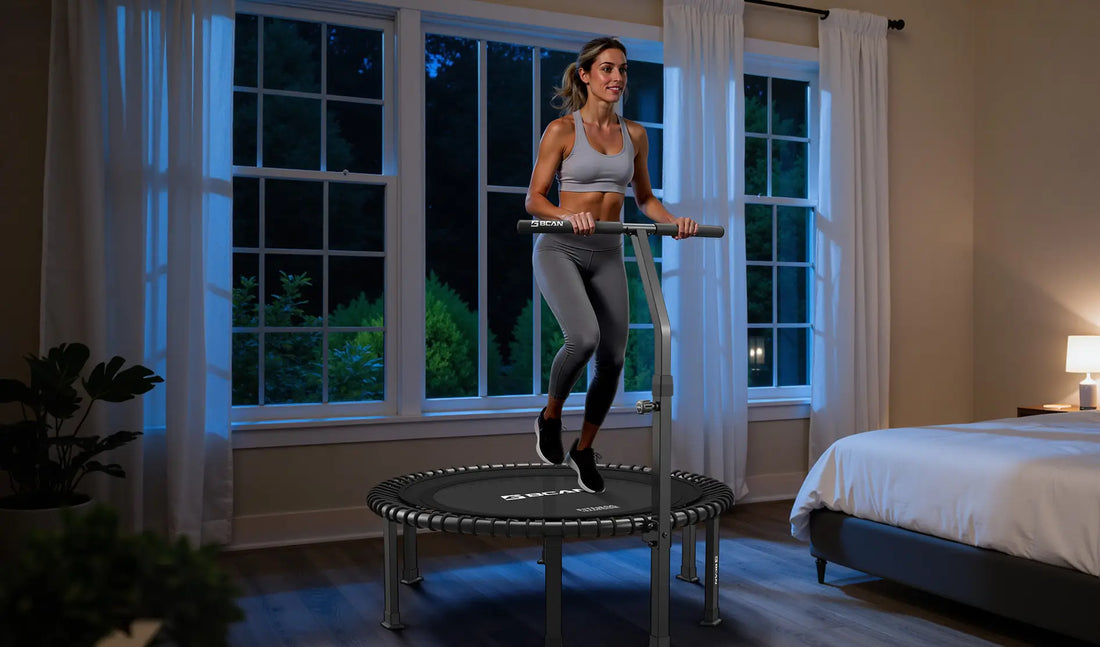
This is where the BCAN BT4 Soft Land Pro fits beginners so well. Its bungee design delivers that soft, forgiving landing, the frame stays planted, and the adjustable T-handlebar lets you practice with support and lower or remove it as you gain confidence.
Starting on equipment that feels secure means you spend your energy enjoying the bounce instead of fighting it.
Final Thoughts
If you've always felt like cardio wasn't for you, it might just be that running wasn't for you. Rebounding offers a genuinely different path: lower impact, real fitness benefits, and a workout that feels more like play than punishment.
The rebounding vs running question doesn't have one right answer for everyone. But for a beginner who dreads the pavement, bouncing is an easy, joint-friendly way to build a cardio habit that actually sticks.
Start gently, keep it fun, and let consistency do the work.
If you're ready to give it a go, a stable, beginner-friendly model like the BCAN BT4 Soft Land Pro makes those first sessions smooth and confidence-building. Step on and find out what cardio feels like when you don't dread it.
FAQs
Is Rebounding Easier Than Running?
In terms of how it feels, usually yes. People tend to rate rebounding as easier than the actual effort would suggest, while running often feels every bit as hard as it is. The lower impact and playful quality make the same heart-rate work feel more manageable.
Can Rebounding Replace Running for Beginners?
For building cardio fitness and a consistent habit, it certainly can. A proper rebounding session reaches moderate-to-vigorous intensity and improves aerobic fitness. It won't replicate running's exact calorie burn or train you for a race, but as a beginner cardio option, it stands on its own.
Is Rebounding Lower Impact Than Jogging?
Yes. Jogging on hard ground loads your joints at roughly 1.5 to 3 times your body weight per stride. A rebounder's elastic surface absorbs much of that force, lowering the peak impact your legs absorb.
Why Do Some People Enjoy Rebounding More Than Running?
It comes down to feel. Rebounding is springy, varied, and easy to do at home with music on, so it reads as fun rather than a chore. Since enjoyment strongly predicts whether people stick with exercise, that "fun factor" is more than a nice-to-have.
Can Rebounding Still Improve Cardio Fitness?
It can. Research on rebounding programs has shown measurable gains in VO2max and work capacity over several weeks of consistent training. The key word is consistent: the benefits come from showing up regularly, not from any single session.
Is Rebounding Good for People With Bad Knees?
Many people find the softer landing more comfortable on their joints than running on pavement, thanks to the lower peak impact. That said, this is general information, not medical advice.
If you have a diagnosed knee issue, talk with a qualified professional before starting.
How Long Should Beginners Rebound Instead of Running?
Start with 5 to 10 minutes a session, a few times a week, and build gradually toward 20 minutes or more as your fitness improves. Working up toward the recommended 150 minutes of weekly activity is a sensible target, reached one short, enjoyable session at a time.
References:
- Videbæk, S., et al. "Incidence of Running-Related Injuries Per 1000 h of Running in Different Types of Runners: A Systematic Review and Meta-Analysis." Sports Medicine, 2015.
- Frontiers in Bioengineering and Biotechnology. "Comparison of Ground Reaction Forces as Running Speed Increases Between Male and Female Runners." 2024.
- Bhattacharya, A., et al. "Body Acceleration Distribution and O2 Uptake in Humans During Running and Jumping." Journal of Applied Physiology, 1980.
- Cugusi, L., et al. "Exercise Intensity and Energy Expenditure During a Mini-Trampoline Rebounding Exercise Session in Overweight Women." Science & Sports, 2017.
- Cugusi, L., et al. "Effects of a Mini-Trampoline Rebounding Exercise Program on Functional Parameters, Body Composition and Quality of Life in Overweight Women." Journal of Sports Medicine and Physical Fitness, 2018.
- Porcari, J.P., et al. "ACE-Sponsored Research: Putting Mini-Trampolines to the Test." ACE ProSource, October 2016.
- Herrmann, S.D., et al. "2024 Adult Compendium of Physical Activities." Journal of Sport and Health Science, 2024.
- Williams, D.M., et al. "Acute Affective Response to a Moderate-Intensity Exercise Stimulus Predicts Physical Activity Participation 6 and 12 Months Later." Psychology of Sport and Exercise, 2008.
- Teixeira, D.S., et al. "Enjoyment as a Predictor of Exercise Habit, Intention to Continue Exercising, and Exercise Frequency." Frontiers in Psychology, 2022.
- U.S. Department of Health and Human Services. "Physical Activity Guidelines for Americans, 2nd Edition." HHS, 2018.
This content is for informational purposes only and does not constitute medical advice. For questions related to your health or medical conditions, please consult your physician. Always seek advice from a qualified healthcare professional before starting any exercise program or health regimen. In the event of a medical emergency, call 911.


Leave a Comment
We’d love to hear from you — your insights can inspire others!