


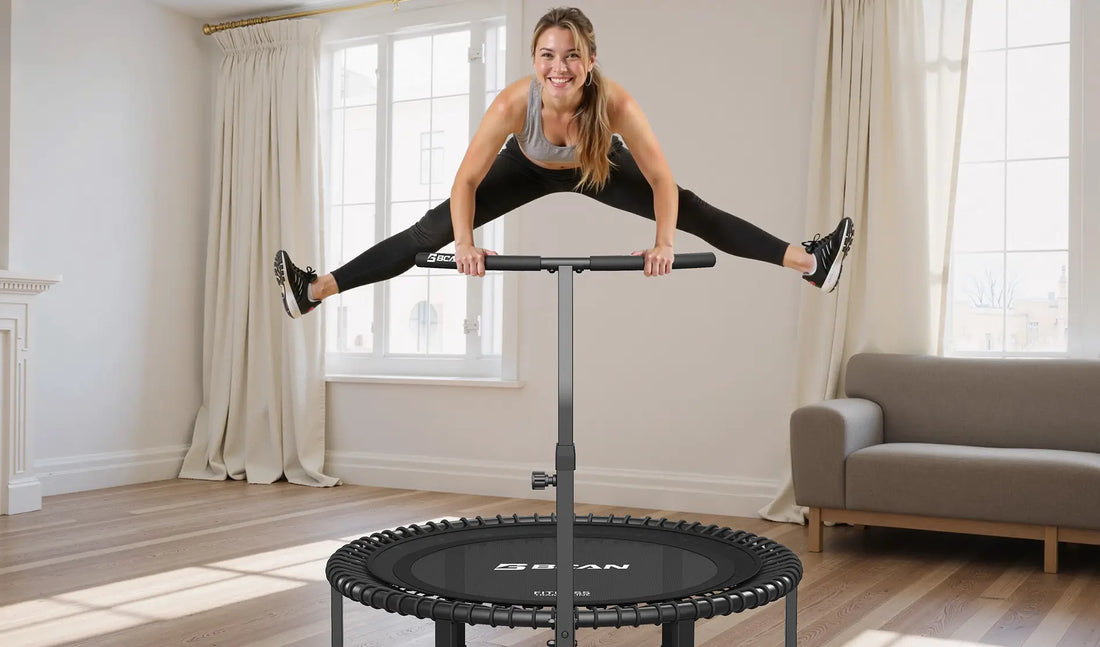
Beginner Trampoline Workouts: Easy Exercises to Get Started
Summary: Being new to working out or feeling intimidated by local gyms is pretty common. You can alleviate much of that stress by using rebounder exercises for beginners that are convenient in your home, fit your schedule, and engage many of the body’s muscles at the same time. Here are some beginner-friendly workouts to help you get started.
Whenever you’re starting a new fitness routine, it can be a little overwhelming to tie up your tennis shoes and hit the gym. Over 50% of Americans get intimidated by going to the gym because it's loud, other people might stare, and there’s complex equipment to learn.
A good alternative is to try rebounder exercise for beginners. With a rebounder, or mini-trampoline, you can follow along with a YouTube video or stick to simple movements, slowly building your confidence over time. All it requires is a little space in your home, apartment, or hybrid work office and a willingness to get moving.
What Is a Rebounder Exercise?
A rebounder is an effective way to perform controlled movements using a compact trampoline. Unlike the massive trampolines you may see in your neighbor’s backyard, these tend to range from 36” to 48” and store under a bed or in the corner of a living room.

The focus of rebounder exercises for beginners is control. You’re not shooting for extreme movements or high jumps with mid-air twists. You want controlled movement where the mat absorbs and disperses most of the force. That is why this can be a low-impact workout for those nervous about moving after being sedentary for a long time.
When done with control, you can help improve your overall well-being through repeated motion. That is because a rebounder engages your legs, hips, core, and stabilizing muscles, but doesn’t involve complex machinery in a typical gym.
Why Rebounder Exercises Are Ideal for Beginners
A rebounder for beginners is ideal because it’s easier to commit. It can take up to 32 weeks for real change to start in the body from regular exercise. The trick is consistency. You want to reduce the amount of friction to getting off the couch and moving.
A rebounder removes most of the barriers to regular working out. You don’t have to drive to a gym, deal with loud people working out, or try to relearn movements. It also fits in most homes, supporting short workouts during a busy day in the comfort of your living room or bedroom, even when it’s snowing or raining outside.
What’s most important is that you can modify the exercises you do on a rebounder based on your comfort and experience levels.
Important Safety Tips for Beginners Starting Rebounding
How to Get Started
Always place your rebounder on a flat, stable surface. Make sure nothing is crowding the mini trampoline, like lots of hanging plants or a fan on a low ceiling. Before you “hop on” the rebounder, make sure to wear comfortable, well-fitting athletic clothing that allows freedom of movement.
You don’t need to wear shoes, but it helps when you’re just starting. FED Fitness includes a free pair of grip socks with your purchase of a mini trampoline, such as the FED Fitness Bcan Series BT4 Soft Land Fitness Trampoline.
Use the support bar when you’re just getting going. Over time, you’ll build up the confidence to try more advanced moves, but nothing is pressuring you to go from 0 to 60 mph too quickly. Listen to your body and try to stay centered on the mat as you learn.

FED Fitness Bcan Series BT4 Soft Land Pro Adult Bungee Trampoline with Bungees Pre-Assembled
Stable and secure, with smooth and controlled bounce, low-impact cushioning, and an included support handlebar.
$299.99
$359.99
What to Avoid
Remember, you’re just starting with rebounder exercises for beginners. Try to avoid jumping too high or locking your knees. Keep looking forward and maintain good posture. If you start to feel pain or dizziness, stop and rest. It’s always a good idea to consult with your primary care physician before starting any workout routine.
7 Beginner-Friendly Rebounder Exercises
1. Health Bounce
The most basic and essential exercise for your rebounder is known as the “health bounce.” This is your foundation. It’s where you start, and where you return to as the “neutral” for all other workouts.
- Stand in the mat’s center
- Position your feet about hip-width apart
- Slightly bend your knees and keep your chest upright
- Use very small, controlled bounces
- Keep your feet in contact with the mat the whole time
You’re not trying to jump high. It’s more about control and rhythm so you can feel how the balance sits on your body and where your muscles respond. Over time, this will help with the calves, quadriceps, core, and stabilizing muscles.
2. Gentle March
A gentle march is the natural progression from the health bounce. It involves alternating leg movements, as if you were marching outdoors in a group.
- Begin with a health bounce
- Slowly lift one knee several inches from the mat
- Lower the knee with control
- Lift the opposite knee and repeat
Try to keep a comfortable pace as you move and allow your arms to swing naturally with your marching. This will help your hip flexors, quads, calves, and core as you shift weight from one side to the other.
3. Light Jogging Bounce
Light jogging is a fun way to ramp up your beginner workout. Don’t start this until you feel comfortable with a light jogging motion.
- Stand in the center of the mat
- Begin by alternating your feet a little faster
- Keep your bounces low and relax the shoulders
As you move, be sure to look forward. Looking down during a light jog may make you lean forward and risk a fall. Continue to breathe naturally. Stick to a jog, not a run, and slow down if you feel unbalanced. This will work your calves, hamstrings, quads, glutes, and core.
4. Side-to-Side Weight Shift
Rebounder exercises for beginners have just as much to do with side-to-side movement as with back-and-forth or up-and-down movement. You can get lateral movement using this workout.
- Stand upright in the mat’s center
- Shift your weight gently to one side
- Return to the center
- Shift to the opposite side
- Add steps as you build confidence
You can always add a slight bounce as you do this movement. You’re both improving your body awareness and balance while also hitting your glutes, inner thighs, and core.
5. Basic Jumping Jacks
Jumping jacks are highly effective for improving body movement, range of motion, and putting a smile on your face. Just keep them beginner-friendly for now, as they will increase your heart rate.
- Start with a gentle health bounce
- Step your feet slightly more apart
- Raise your arms overhead
- Return your feet together
- Lower your arms
- Repeat as needed
Keep a comfortable rhythm. Some people call this a “starfish” workout because that’s what you look like when in an open jack. This will work your shoulders, calves, glutes, quads, and core.
6. Heel Taps
Heel taps are a great way to improve your coordination while also strengthening your lower body.
- Stand in the mat’s center
- Extend one heel forward
- Return it to the center
- Repeat with the opposite heel
You can maintain a gentle bounce as you do this workout, but be sure to use the handlebar for support and maintain an upright posture. You want to avoid leaning back. This will work your hip flexors, calves, quads, and core.
7. Arm Reach Bounce
A rebounder isn’t just about your lower body. You can add arm movements to engage more muscles and increase coordination.
- Begin with a healthy bounce
- Reach both your arms forward
- Return them to your side
- Reach overhead
- Return slowly
- Continue alternating and repeating as needed
This is a great way to add complexity to your workout without requiring bigger jumps. Just try to avoid raising your shoulders to your ears. This will work your shoulders, upper arms, upper back, core, and stabilizers.
Beginner Workout Plan
A major advantage of rebounder exercises for beginners is that you can modify just about anything to suit your body, goals, and lifestyle. Start slow and listen to your body. A good beginner-friendly workout would be:
Warm-up (2 minutes)
- Health Bounce
- Gentle March
Main Workout (12 minutes: 2 min each)
- Light Jogging Bounce
- Side-to-Side Weight Shift
- Basic Jumping Jacks
- Heel Taps
- Arm Reach Bounce
- Gentle March
Cool Down (3 minutes)
- Health Bounce
- Slow standing recovery with deep breathing
Shoot for working out about 2-3 times per week. The more you work out, the more you’ll feel confident, increasing things to 20-30 minutes around 3-4 times a week.
Conclusion
The best way to work out your body is with a routine you’ll actually stick to consistently. Rebounder exercises for beginners meet that balance of accessibility, convenience, impact, and versatility. You can scale the workouts as you get more experienced.
If you’re not sure what equipment will work for your home, check out the BT4 from FED Fitness. Available in 38”, 40”, and 48”, you can use the bungee-supported mini trampoline with a 500 lbs. weight capacity for any beginner-friendly workout. Take your time, have fun, and let your body be your guide to improving movement, balance, and strength with a rebounder.
FAQs
Are Trampoline Exercises Safe for Beginners?
For most healthy adults, rebounders offer a beginner-friendly way to improve your overall well-being. Stay controlled and follow proper form so you get the most benefits.
Can Beginners Lose Weight with a Trampoline?
Rebounding helps support a more physically active lifestyle. When combined with balanced nutrition and consistent exercise habits, it can contribute to weight management.
How Long Should Beginners Use a Trampoline?
The duration of your workout depends mostly on you. Start with a 10-20 minute session about 2-3 times per week.
Do You Need a Handlebar?
FED Fitness highly recommends you start with a handlebar. You’ll feel more confident after sticking to consistent movement that improves your balance.
References:
- Gervis, Z. (2019 Mar 19). Americans aren’t lazy – we’re just scared of the gym. New York Post. Health Edition
- Clark JE. (2016 Aug 5). The impact of duration on effectiveness of exercise, the implication for periodization of training and goal setting for individuals who are overfat, a meta-analysis. Biol Sport. 33(4):309-333. doi: 10.5604/20831862.1212974.
This content is for informational purposes only and does not constitute medical advice. For questions related to your health or medical conditions, please consult your physician. Always seek advice from a qualified healthcare professional before starting any exercise program or health regimen. In the event of a medical emergency, call 911.
Products


Leave a Comment
We’d love to hear from you — your insights can inspire others!