


Can Rebounding Help Improve Balance and Fall Prevention in Older Adults?
Balance is a skill, and like any skill, it responds to practice.
This guide looks at what the research actually says about a low-impact rebounder workout and balance in older adults, including where the evidence is strong, where it's thinner than the marketing suggests, and how to start safely.
You'll also find the features that make a rebounder senior-friendly and the situations where bouncing isn't the right call.
Let's be upfront about something. Rebounding is often sold as a fall-prevention miracle, and that's overselling it. The honest version is more interesting and more useful.
Why Balance Becomes More Important With Age
Balance quietly shifts from something you never think about to something worth training on purpose. The stakes go up, and the good news is that it responds well to the right kind of practice.
According to the CDC, more than one in four adults aged 65 and older reports a fall each year, which works out to over 14 million people. Around 37% of those who fall report an injury that needed medical attention or restricted their activity for at least a day.
That isn't meant to alarm you.
It's meant to reframe balance as something worth spending a few minutes a week on, the same way you'd maintain strength or stamina.
Because balance isn't a fixed trait you either have or lose, it doesn't simply disappear on a schedule. It's trainable at any age, and that's the whole point of this article.
What Causes Balance to Decline in Older Adults?
Balance relies on several systems working together, and each one drifts a little with age. Understanding which ones are slipping explains exactly why an unstable surface makes such a useful training tool.
Your body keeps you upright using a handful of inputs, and time nudges all of them:
Proprioception, your sense of where your limbs are in space, declines as muscle spindle function and nerve conduction slow. This one matters most because you rely on it more than on vision for staying balanced.
The vestibular system in your inner ear loses sensitivity. In testing of adults over 70, between 82% and 94% showed measurable dysfunction in the semicircular canals that detect head rotation.
Muscle loss. After 40, adults lose roughly 1% of muscle mass a year without strength training. Less muscle means less power available to correct a wobble.
Vision changes. Reduced contrast sensitivity and depth perception make curbs, steps, and surface changes harder to read.
Reaction time slows, so catching yourself mid-stumble takes just a fraction longer.
Notice the pattern. Most of these are about sensing a loss of balance and responding fast enough. Which is precisely the loop a wobbly surface forces you to rehearse.
How Rebounding May Help Support Balance and Coordination
Rebounding puts you on a surface that constantly moves, so your body has to sense and correct in real time. Research on mini-trampoline training shows measurable gains in balance, mobility, and, most interestingly, the ability to recover from a stumble.
The strongest single finding comes from a 14-week mini-trampoline study published in the Journal of Electromyography and Kinesiology.
Older adults who trained on a mini-trampoline improved their plantarflexor strength by about 10% and, more strikingly, their ability to regain balance during simulated forward falls by about 35%.
That's not about avoiding a stumble. It's about catching yourself when one happens, which is arguably the more valuable skill.
Other work points in the same direction.
A randomized controlled study of women aged 56 to 83 found that 12 weeks of mini-trampoline training, twice weekly, improved balance, functional mobility, gait, and strength, and reduced fear of falling.
A pilot RCT in stroke patients found mini-trampoline balance training outperformed conventional group balance sessions on standard balance and mobility measures.
Now the honest part, and it matters.
Broadly, exercise that challenges balance has strong evidence supporting its ability to reduce falls.
A large meta-analysis of 88 trials and nearly 19,500 participants found exercise cut the rate of falls by about 21%, and programs that specifically challenged balance and ran more than three hours a week reached reductions closer to 39%.
The Cochrane review reaches the same conclusion.
But that evidence is about balance-challenging exercise as a category, not about rebounders specifically.
No trial has yet shown that a rebounder reduces fall rates directly. The mini-trampoline studies measure balance, mobility, strength, and confidence, which are the ingredients of steadier movement, and the sample sizes are modest.
So the fair claim is this: rebounding is a legitimate way to train balance, and balance training is well supported for reducing falls. It is not a proven fall-prevention device, and anyone telling you otherwise is selling harder than the science allows.
Why Some Older Adults Find Rebounding Easier Than Traditional Exercise
A rebounder workout tends to feel gentler than it is, and it's kind to the joints. For anyone put off by pounding, gym intimidation, or bad weather, that combination lowers the barrier considerably.
Three things make it approachable. The mat absorbs much of the landing force, so the impact traveling up through your ankles, knees, and hips is lower than when walking on concrete.
It fits in a corner of the living room, so there's no drive, no class schedule, and no audience. And it's quietly enjoyable in a way that a treadmill often isn't.

In an ACE-sponsored study, participants consistently rated a rebounder session as feeling easier than the measured intensity suggested.
And since how you feel during exercise is one of the better predictors of whether you'll still be doing it months later, "feels manageable" translates directly into "actually gets done."
Can Rebounding Help Improve Confidence During Movement?
Confidence is measurable, and it moves. The mini-trampoline research reports reduced fear of falling, which is a meaningful outcome in its own right.
Fear of falling is its own problem, and it's a stubborn one. It makes people move less, which weakens the muscles and dulls the reflexes that keep them steady, which makes them more fearful still. It's a loop, and breaking it matters.
This is where the 12-week study in older women is quietly encouraging: alongside the physical gains, participants reported less fear of falling.
Practicing on a surface that gently challenges your balance, in a controlled setting, with a handlebar in reach, seems to rebuild trust in your own footing.
And when you trust your footing, you walk more freely, take the stairs without hesitating, and stay active. The physical and the psychological pull in the same direction.
What Other Exercises Can Help Improve Balance?
Rebounding is one good option among several, and the honest answer is that the best-evidenced balance programs are worth knowing about. A rebounder complements them rather than replacing them.
Worth considering:
| Approach |
What the evidence shows
|
|
Tai Chi
|
Associated with roughly 31% to 58% reductions in falls, it improves gait speed, single-leg balance, and functional reach.
|
|
Otago Exercise Program
|
A home-based strength-and-balance program linked to 23% to 40% fewer falls, especially effective for frailer adults.
|
|
Multimodal strength + balance training
|
Around 20% to 45% reductions in falls.
|
|
Simple daily drills
|
Heel-to-toe walking, single-leg stands (near a counter), and sit-to-stand practice. Free and effective.
|
The common thread across everything that works is that it challenges your balance and includes some strength work. That's the active ingredient, whichever format you choose.
A rebounder is a genuinely enjoyable way to get that challenge, but pairing it with strength training two days a week is what the guidelines actually call for.
What Features Make a Rebounder Safer for Seniors?
Three features matter most: an adjustable support handlebar, a soft bungee-based bounce, and a stable frame with a clear weight rating. For an older beginner, the handlebar isn't a nice-to-have; it's essential.
What to look for, and why it matters:
An adjustable, padded handlebar. You need it for getting on and off, and for steadying yourself while you bounce. Height adjustment matters because a bar at the wrong height can actually make you less stable than no bar at all. Look for a non-slip, padded grip.
Bungee cord suspension rather than steel springs. Bungees give a softer, quieter, more forgiving landing, which is easier on the joints and far less jarring.
A stable, wide frame with a stated weight rating and non-slip feet, set up on a flat, clear floor with nothing to trip over nearby.
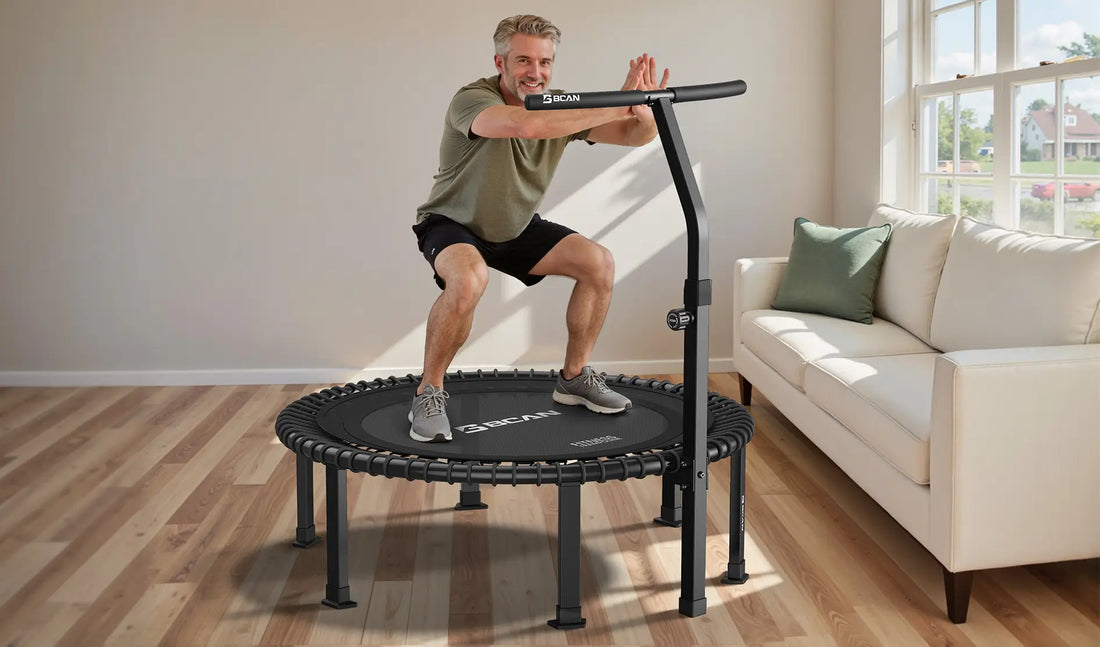
The FED Fitness Bcan Series BT4 Soft Land Pro Adult Bungee Trampoline with Handlebar was built with exactly this in mind. Its adjustable T-handlebar gives you a secure hold that you can set to your height and lower or remove as your confidence grows, and the bungee system delivers the soft landing that makes a low-impact rebounder workout comfortable rather than jarring.
For an older adult starting out, equipment that feels solid underfoot changes the whole experience.

FED Fitness Bcan Series BT4 Soft Land Pro Adult Bungee Trampoline with Handlebar
Stable and secure, with smooth and controlled bounce, low-impact cushioning, and an included support handlebar.
$299.99 $359.99
Common Mistakes Older Adults Should Avoid
The classic errors are bouncing too high, letting go of the handlebar too soon, and doing too much in the first week. Each one turns a gentle activity into an unnecessary risk.
Watch for these:
Jumping high. You don't need air. Small, controlled bounces where your feet barely leave the mat deliver the balance challenge without the hazard.
Abandoning the handlebar early. Keep it until your balance is genuinely steady, and even then, keep it within reach.
Locking the knees. Keep a soft bend so your muscles absorb the landing rather than your joints.
Doing too much on day one. Five minutes is a perfectly respectable first session.
Skipping strength work. Balance training and strength training belong together; the guidelines ask for muscle-strengthening on two or more days a week.
Bouncing on an unstable setup, on a rug, or in a cluttered space. Clear the area first.
Pushing through pain. Effort is fine. Pain is a signal.
How Older Adults Can Start Rebounding More Safely
Start supported, start small, and progress slowly. Hold the handlebar, bounce gently with your feet on the mat, and give yourself weeks rather than days.
A sensible on-ramp: hold the handlebar with both hands and simply shift your weight side to side to get used to the surface moving.
Progress to gentle health bounces, where you press into the mat and your heels lift slightly, but your feet stay in contact.
Two or three minutes is plenty at first.
Build toward 10 to 15 minutes over several weeks, adding light marching once you feel steady. Keep the handlebar. Wear supportive shoes or go barefoot for better proprioceptive feedback, whichever feels more secure to you.
And if a session leaves you unsteady afterward, that's a signal to scale back, not to push on.
When Rebounding May NOT Be Appropriate
Rebounding isn't right for everyone, and it would be irresponsible to pretend otherwise. If any of the following apply to you, speak with your doctor or a physical therapist before you start.
Situations that call for professional input first:
Significant balance impairment, or difficulty standing unaided.
Dizziness, vertigo, or inner-ear problems.
Recent surgery, a recent fall, or a current injury.
A diagnosed condition affecting your bones, joints, balance, or blood pressure.
This is general educational information, not medical advice, and no article can assess your individual situation.
A doctor or physical therapist can, and that conversation more often opens doors than closes them. If rebounding isn't suitable right now, seated cardio, supported strength work, or a supervised program like Otago is a sound place to build from.
Final Thoughts
So, can rebounding help improve balance in older adults? The evidence says it's a genuine way to train the systems that keep you steady, with measurable gains in balance, mobility, strength, and confidence, plus that striking finding on recovering from a stumble.
What it isn't is a guaranteed fall-prevention device. Balance-challenging exercise as a whole has strong evidence behind it, and rebounding is one enjoyable, joint-friendly way to get that challenge, ideally alongside strength work and, if you like, tai chi or an Otago-style program.
Start gently, keep the handlebar, and give it a few consistent weeks. Steadier footing is built the same way every other skill is: a little at a time.
FAQs
Can Rebounding Improve Balance in Seniors?
The research supports it. Studies of mini-trampoline training in older adults report improvements in balance, functional mobility, gait, and lower-limb strength over programs lasting 12 to 14 weeks. The unstable surface forces your body to sense and correct constantly, and that repetition is what trains the balance system.
Is Rebounding Good for Fall Prevention?
Here's the careful answer. Exercise that challenges balance has strong evidence for reducing the rate of falls, cutting it by around 21% overall and by as much as 39% for balance-focused programs done regularly.
Rebounding is a form of balance-challenging exercise, and one study found it improved older adults' ability to regain balance during a forward fall by about 35%.
But no trial has directly tested whether rebounders reduce fall rates, so it's fair to call it promising, not proven.
Is a Rebounder Safe for Older Adults?
For many, yes, with sensible precautions: a sturdy frame, an adjustable handlebar, small controlled bounces, and a clear space. But safety depends on the individual. If you have balance problems, dizziness, a recent injury, or a diagnosed condition, check with your doctor or physical therapist before starting.
Why Does Rebounding Challenge Coordination?
Because the ground keeps moving, every landing shifts slightly, so your ankles, hips, and core have to make constant micro-adjustments that solid floors never demand. That's the training effect, and it's also why the first few sessions feel awkward.
Should Seniors Use a Handlebar on a Rebounder?
Yes, and consider it essential rather than optional. A handlebar helps you get on and off safely and steadies you while bouncing. Choose an adjustable, padded one, since a bar set at the wrong height can hinder more than it helps. Keep using it until your balance is genuinely reliable, and keep it within reach even after that.
Can Rebounding Help Stability?
It can contribute. Stability comes from strength, proprioception, and quick reactions working together, and rebounding trains all three by making you respond to a surface that never sits still.
Pair it with strength work twice a week, stay consistent, and give it a couple of months.
References:
- Centers for Disease Control and Prevention. "Facts About Falls." CDC.
Aragão, F.A., et al. "Mini-Trampoline Exercise Related to Mechanisms of Dynamic Stability Improves the Ability to Regain Balance in Elderly." Journal of Electromyography and Kinesiology, 2011. - Posch, M., et al. "Effectiveness of a Mini-Trampoline Training Program on Balance and Functional Mobility, Gait Performance, Strength, Fear of Falling and Bone Mineral Density in Older Women with Osteopenia." Clinical Interventions in Aging, 2019.
- Miklitsch, C., et al. "Effects of a Predefined Mini-Trampoline Training Programme on Balance, Mobility and Activities of Daily Living After Stroke: A Randomized Controlled Pilot Study." Clinical Rehabilitation, 2013.
- Sherrington, C., et al. "Exercise to Prevent Falls in Older Adults: An Updated Systematic Review and Meta-Analysis." British Journal of Sports Medicine, 2017.
- Sherrington, C., et al. "Exercise for Preventing Falls in Older People Living in the Community." Cochrane Database of Systematic Reviews, 2019.
- "Age-Related Dysfunction in Balance: A Comprehensive Review of Causes, Consequences, and Interventions." 2025.
- "Tai Chi for Fall Prevention and Balance Improvement in Older Adults: A Systematic Review and Meta-Analysis of Randomized Controlled Trials." 2023.
- "The Otago Exercise Program's Effect on Fall Prevention: A Systematic Review and Meta-Analysis." Frontiers in Public Health, 2025.
- Porcari, J.P., et al. "ACE-Sponsored Research: Putting Mini-Trampolines to the Test." ACE ProSource, October 2016.
This content is for informational purposes only and does not constitute medical advice. For questions related to your health or medical conditions, please consult your physician. Always seek advice from a qualified healthcare professional before starting any exercise program or health regimen. In the event of a medical emergency, call 911.


Leave a Comment
We’d love to hear from you — your insights can inspire others!