


Is Rebounding Safe for Seniors with Knee Pain or Arthritis?
Summary: Seniors with bad knees or arthritis still need safe ways to get in daily movement. While walking and running are options, they can place undue stress on the joints. A rebounder offers an alternative in which much of the impact is absorbed by the mat, helping seniors get moving and strengthen stabilizer muscles for better balance. Every person is different, and the type of rebounder plays a role in the outcome.
When an older person still wants to burn a few calories or feel energized for a workout, they need a low-impact cardio for seniors solution. Low impact workouts mean any type of physical activity that doesn’t involve a lot of stress on the joints. That reduction of force on joints like elbows, knees, and hips is crucial at an older age.
Knee discomfort is a hassle, even if you’re in the best shape of your life. For seniors, it gets a little harder. When a knee hurts from a long-standing injury or arthritis, even the simplest tasks, like climbing stairs or walking to the kitchen table, can be a little challenging.
Here is a quick overview of how a rebounder can be a safe way to improve balance, get in some much-needed movement, and be gentle on the knees for aging adults.
Common Arthritis Symptoms and Precautions
There are around 58.5 million people in the United States with some form of arthritis. While arthritis isn’t a “normal” part of getting older, certain forms are more common in seniors because of worn joints and inflammation that happens after a longer life.
While everybody is different, some of the more common symptoms of arthritis include:
- Discomfort in the joints (knees, knuckles, elbows, shoulders, etc.)
- Stiffness and swelling
- Reduced range of motion (even with physical therapy)
- Difficulty completing daily tasks using those joints
The symptom range is pretty extreme. Some seniors may only have minor stiffness after sitting for too long in the same place. Others might struggle to bend their knees and rise from a chair.
Symptoms can also shift from day to day. That’s why many seniors look for solutions like is a rebounder good for bad knees to ensure a good level of movement that is both controlled and repeatable.
Before starting any exercise, especially if you're older, consult your medical team. Stop the movement if it feels painful or the knee suddenly “gives way.” Always use a handlebar for stability and support, and begin with feet remaining on the mat. That will ensure you get movement and balanced support, but reduce most other risks.
What Does “Low-Impact Exercise” Actually Mean?
A “low-impact” workout doesn’t mean there isn’t any effort. A better definition is something that causes minimal stress or damage to your body. It also doesn’t mean you cannot sweat. Swimming is one of the best workouts known for Olympic-level practitioners burning thousands of calories during a workout day, but it’s also low-impact on the body.

With a rebounder, it's more about finding a low-impact cardio for seniors that raises the heart rate, challenges the muscles, but is gentle on the body. Not everyone has an Olympic-sized swimming pool in the backyard. A rebounder is a more practical solution. This isn’t jumping extremely high and trying tricks. It’s steady, consistent movement that makes life a little easier.
What Makes Rebounding Different from Traditional Cardio?
Most traditional cardio is about the surface you’re using. Maybe that’s walking on a sidewalk, running on a track, or using stationary cycling. While good, the stress your body feels from hitting the ground each time you step or run can be dangerous for seniors with bad knees. Up to 8 times the body weight of force can be sent through the body when running.
A rebounder’s surface is more responsive. The mat lowers based on your weight rather than remaining solid on impact. That is far less stressful for your joints. It also changes how the body manages each movement.
There are continuous balance adjustments, so even a minor bounce forces the ankles, legs, hips, and trunk to work together. That’s a great way to improve stability and mobility for seniors, who are typically at much higher risk of falling due to balance issues.
Is Rebounding Easier on the Knees Than Running or Walking?
A well-built rebounder can absorb anywhere from 65% to 85% of the force a person puts onto the mat during a bounce. While running, you’re putting repeated impact on the joints. When rebounding, the mat gives way under the feet, absorbing that impact.
Walking is slightly different. It can be low-impact, depending on how far or how fast a person moves. Again, every human body is different. A gentle health bounce may be softer for one senior, while another may like the predictability of walking. The low-impact cardio for seniors that helps the most is the one that can be repeated.
While walking is great, having a rebounder that easily fits in the home so seniors can get some movement on a rainy day or during the winter could make a big difference.
How the Rebounder Mat Absorbs Impact
Think of a rebounder mat like a balloon. It stretches the more you press on it, like a balloon stretches when inflated. Different bungee cords or springs can then help “return” the mat to its starting position, resulting in a bounce.
That movement softens how a foot lands, which is why is a rebounder good for bad knees is often a “yes.” Different rebounder models will also matter. Something that better absorbs impact is likely a better solution for an older user. It’s also important to think of the force as a distribution rather than an elimination.
The knees will still bend and muscles contract, but the rebounder has a more comfortable format for that movement. Every weight-bearing activity will create some loading, so paying close attention to the body and working with a physio is always recommended.
Why Technique Matters More Than Jump Height
Low-impact cardio for seniors requires careful attention to form. Beginners often assume they have to do high jumps or crazy twist motions when using a mini trampoline. The reality is that controlled, careful movements under good form are preferred, especially with consistency.
High jumping is more challenging. The senior has to control landing and stay centered. It’s better to stand near the center of the mat with feet around hip-width apart. Relax the knees, keep the chest upright, and keep your eyes forward.
Use the support bar and gently move up and down until you’re more confident trying something more advanced. That simple movement tells you a lot about where you are physically and how to create a workout plan with goals down the road.
Always remember, the objective is repeatable action, not extreme jumping.
Why Experiences Can Vary Between Individuals
Knee pain isn’t universal. Discomfort may be due to osteoarthrosis, an old high school athletic injury, joint irritation after a long bus trip, or simply reduced strength. Two seniors will likely respond differently on the same rebounder.
Body weight, leg strength, and even the types of shoes being used all play a role in comfort and results. It’s better to start slowly, record your progress, and observe how your body reacts. A short session can provide a lot of useful information.
Can Seniors with Arthritis Use a Rebounder?
Yes, some seniors with arthritis may be able to use a rebounder comfortably. The more the symptoms are stable and assuming a healthcare provider hasn’t offered conflicting advice, it’s worth a shot.
A regular workout helps with is a rebounder good for bad knees, but it is not a replacement for an individualized plan from a physical therapist. It’s more a form of movement support that may fit well into a broader workout routine. At the very least, it helps people who need an at-home workout get in some daily movement.
What Type of Rebounding Is Most Appropriate for Beginners with Knee Concerns?
The best way to start with a low-impact cardio for seniors on a rebounder is with the health bounce. This is where you:
- Stand in the middle of the rebounder
- Plant both feet onto the mat about hip-width apart
- Hold the handlebar lightly for support
- Softly bend the knees and shift pressure gently into the mat
- Bounce, but don’t let the feet leave the surface
This single movement will be the foundation for building a longer workout routine. It is enough to start improving balance, muscles, and stability. Over time, you can introduce marching in place or gentle bouncing that lifts the feet only an inch or so off the mat.
Seniors don’t need hours on end of workout. Try for a 5-7-minute workout 2-3 times per week. You can increase the intensity as needed and add light arm movements for complexity or a fuller-body exercise.
What Features Make a Rebounder Safer and More Comfortable for Seniors?
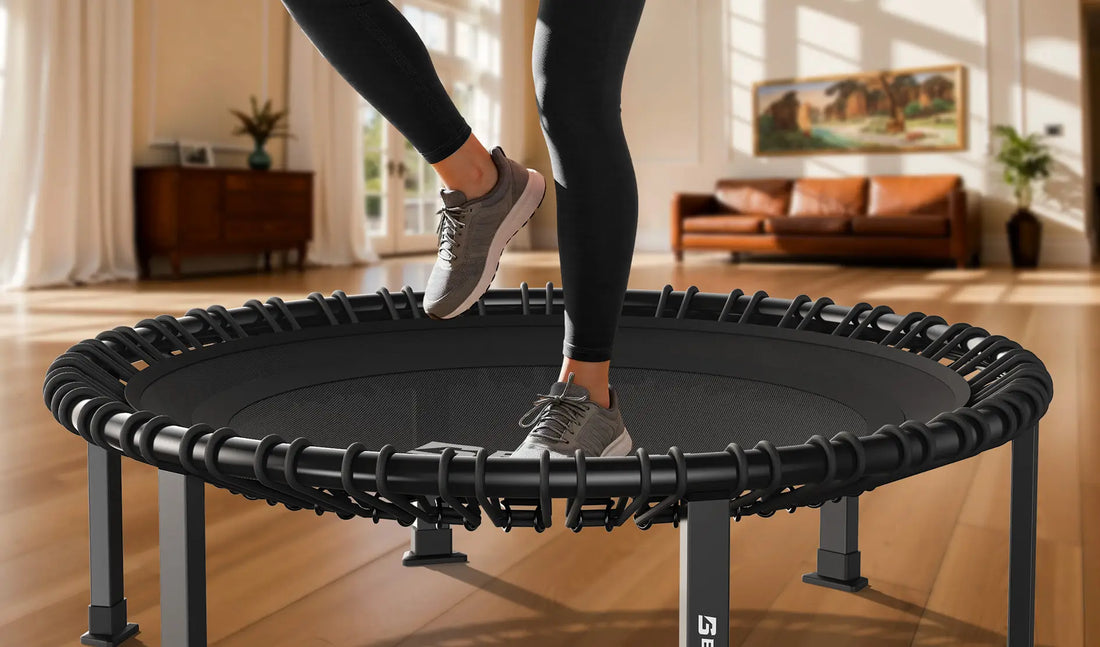
The type of rebounder you use makes a big difference in the low-impact cardio for seniors. To start, always ensure you have a support bar. Something that can be held onto when bouncing to ensure the risk of a fall is reduced. You should also look for features like those in the FED Fitness BT4 Soft Land Fitness Trampoline, such as:
- Pre-Assembly: One-piece frame with a durable design, with 60% of the bungees pre-installed for ease of setup.
- Multi-Levels: Offers up to 6 resistance levels to enhance the workout experience.
- Adjustable Heights: The BT4 has five handlebar height options, ranging from 26” to 36”.
- Weight Capacity: Supports up to 500 pounds of total weight.

FED Fitness Bcan Series BT4 Soft Land Pro Adult Bungee Trampoline with Handlebar
Stable and secure, with smooth and controlled bounce, low-impact cushioning, and an included support handlebar.
$299.99
$359.99
You also get a phone holder and grip socks to help improve your rebounding sessions. This particular model uses bungees along the side instead of traditional springs. That delivers an even smoother, gentler rebound, which could make a difference for bad knees.
When Rebounding May NOT Be the Best Option
Any senior asking, “Is a rebounder good for bad knees?” should speak with a health professional first for guidance. If they have unexplained knee pain, major swelling, recent joint surgery, or sometimes get sudden dizziness, it may be best to start with simple balance techniques.
The advice should always come from a medical professional. Even a minor arthritis “flare” can feel uncomfortable. Using a rebounder is fantastic, but you want to be aware of where you are health-wise and what is acceptable for your unique body’s needs. That is why many seniors use rebounders as a supportive device alongside other workouts such as water walking, ellipticals, seated cardio, and yoga or tai chi.
Final Thoughts
So, is a rebounder good for bad knees?
There is no guaranteed solution for working out with bad knees or arthritis. What works for your situation will vary from what works for other seniors. A rebounder is a good alternative as it has a softer, more responsive surface than hard pavement, sidewalks, or walking paths.
As long as you’re taking the time to adjust slowly and use support structures like good shoes, grippy socks, or a handlebar, you should consider rebounders as low-impact cardio for seniors. Pay attention to your body’s responses and speak with your healthcare team. You may be only one phone call away from a reliable, repeatable, and gentle way to get in your daily movement all year round with a mini trampoline like the FED Fitness BT4 Trampoline.
FAQs
Is Rebounding Safe for Seniors with Arthritis?
The reality is it may be, but you need to speak with your medical provider and ensure your symptoms are stable.
Is a Rebounder Easier on the Knees Than Running?
Yes. A rebounder often feels softer than running on pavement because the mat absorbs and disperses much of the force. However, different bodies will have different comfort levels.
Can Rebounding Worsen Knee Discomfort?
Any stress on the knees can worsen a pre-existing condition. Start slowly and listen to your body so you can adjust and get more support if needed.
References:
- CDC. (2024 Jun 4). Arthritis. Chronic Disease Indicators.
- Lee BA, Oh DJ. (2015). Effect of regular swimming exercise on the physical composition, strength, and blood lipid of middle-aged women. J Exerc Rehabil. 11(5):266-71. doi: 10.12965/jer.150242.
- Lance, A. (2019 Feb 28). Running load and the impact on your joints. Southern Suburbs Physio Centre.
Appeadu MK, Bordoni B. (2026 Jan). Falls and Fall Prevention in Older Adults. StatPearls. - Rathi MA, Joshi R, Munot P, Pandit S, Kulkarni CA. (2024 Jul 2). Rebound Exercises in Rehabilitation: A Scoping Review. Cureus. 16(7):e63711. doi: 10.7759/cureus.63711.
This content is for informational purposes only and does not constitute medical advice. For questions related to your health or medical conditions, please consult your physician. Always seek advice from a qualified healthcare professional before starting any exercise program or health regimen. In the event of a medical emergency, call 911.


Leave a Comment
We’d love to hear from you — your insights can inspire others!