


Low Impact Cardio for Seniors: Safe and Effective Ways to Stay Active
Staying active after 60 doesn't mean pounding the pavement or pushing through sore joints.
This guide covers the best low-impact cardio for seniors, comparing six practical options side by side so you can see how each one feels, what it works, and who it suits.
You'll also find the mistakes to sidestep and how to choose the right activity if your knees, hips, or back need extra consideration.
Movement should add to your life, not cost you a week of recovery. The good news is that gentle on the joints and genuinely effective are not opposites, and the research backs that up.
Why Low-Impact Cardio Is Important for Seniors
Low-impact cardio delivers the heart, lung, and mobility benefits of exercise without the jarring forces that make joints ache. For older adults, it's the most sustainable way to hit activity targets and keep everyday life feeling easy.
The official targets are clear.
The CDC and the federal Physical Activity Guidelines recommend that adults 65 and older aim for about 150 minutes of moderate aerobic activity each week, plus muscle-strengthening work on two or more days and regular balance practice.
The World Health Organization goes further, recommending varied activity that emphasizes functional balance and strength on three or more days a week.
There's a reason those guidelines exist. Older adults are the most sedentary age group, averaging around 9.4 hours of sitting per day, and more sedentary time is associated with poorer physical function.
The encouraging flip side is that trading some of that sitting for light activity is linked to better functioning. And you don't need to become an athlete. You just need to move more and enjoy it enough that you keep doing it.
Low-impact options make that realistic. They let you accumulate real minutes without the recovery cost, which is exactly what consistency requires.
Common Low-Impact Cardio Options for Seniors
There's no single best choice, only the best choice for you. Below are six proven options, each with how to do it, what it works for, who it suits, and where it falls short.
Read these with your own body and circumstances in mind. The differences matter more than they look on paper.
1. Brisk Walking
How to do it: Walk at a pace where you're breathing harder but can still hold a conversation. Aim for 20 to 30 minutes, most days. Keep your posture tall, shoulders relaxed, and let your arms swing naturally.
Muscles worked: Calves, quadriceps, hamstrings, glutes, and your core for postural support.
Who it suits: Almost everyone. It needs no equipment, no membership, and no learning curve, which makes it the easiest place to start.
Benefits: Pace really does matter. Research links brisk walking of roughly 15 minutes a day to about a 20% reduction in total mortality, while slow strolling delivered a far smaller benefit and required over three hours a day to show it.
Considerations: Weather and uneven sidewalks can get in the way, and a gentle amble won't do much. But the intensity is what earns the reward, so pick up the pace.

2. Mini Trampoline (Rebounding)
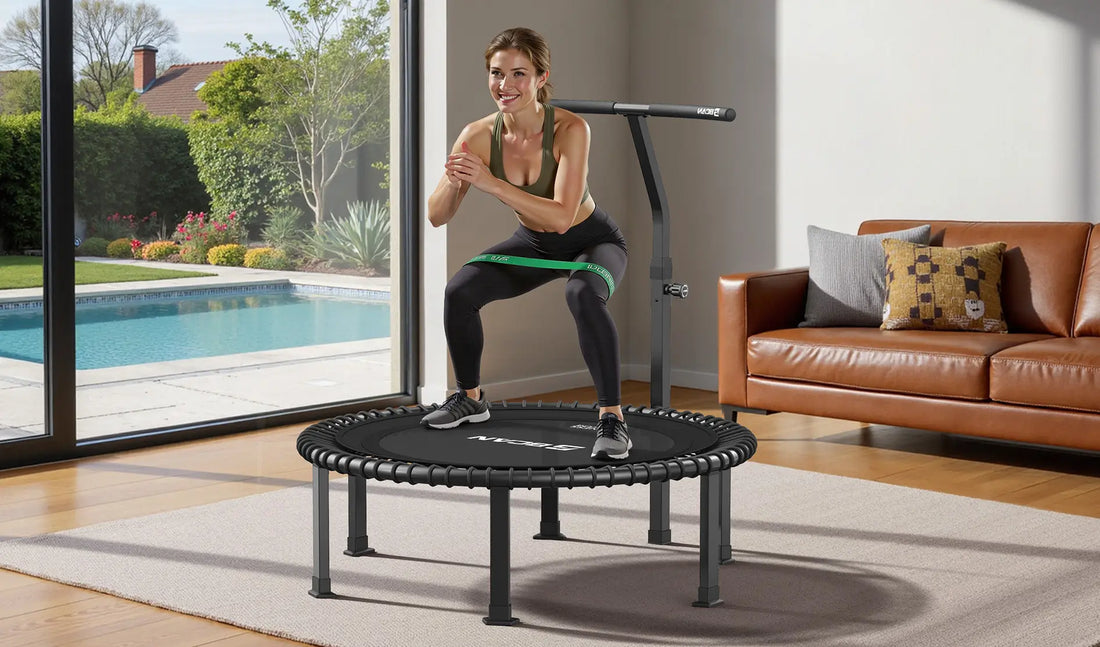
How to do it: Stand centered on the mat, feet shoulder-width apart, knees softly bent. Start with a "health bounce," pressing down into the mat so your heels lift slightly while your feet stay close to the surface. Hold the support handlebar until you are confident in your balance.
Muscles worked: Calves, quads, glutes, and a lot of small stabilizing muscles through the ankles, hips, and core.
Who it suits: Older adults who want cardio and balance training together, in a small space, without weather excuses.
Benefits: The elastic mat absorbs much of the landing force, so peak impact is lower than when walking on concrete.
The balance element is where it shines.
A randomized controlled study of women aged 56 to 83 found that a 12-week mini-trampoline program, twice a week, improved balance, functional mobility, gait, strength, and reduced fear of falling compared with a control group.
That matters because balance and functional training carry high-certainty evidence for reducing the rate of falls.
Considerations: You need to be able to stand and balance unaided to some degree. A support handlebar isn't optional for most beginners; it's essential.
If your balance is significantly impaired, start with something seated and work up, ideally with professional guidance.

3. Elliptical Trainer
How to do it: Step on, hold the handles, and drive through a smooth gliding stride. Keep your posture upright rather than leaning on the console. Start with 10 to 15 minutes at a comfortable resistance.
Muscles worked: Quads, hamstrings, glutes, and calves, plus shoulders, chest, and arms if you push and pull the moving handles.
Who it suits: Anyone who misses the feeling of running but not the pounding. It gives a vigorous workout with your feet never leaving the pedals.
Benefits: Impact is genuinely low. Research on joint loading found that ground reaction forces during elliptical exercise were significantly lower than during jogging, with peak forces closer to those of walking, while the cardiovascular demand is higher than during walking. You get more aerobic return for less pounding.
Considerations: Here's the honest caveat most articles skip. Low impact isn't the same as low demand. The same research found greater shear forces at the knee and higher hip-flexor and knee-extensor demands than walking.
The fixed stride path also suits some bodies better than others, so try before you buy.

4. Stationary Cycling
How to do it: Set the saddle so your knee stays slightly bent at the bottom of the pedal stroke. Pedal at a steady, comfortable cadence and add resistance gradually. Twenty minutes is a solid target.
Muscles worked: Quads, hamstrings, glutes, and calves.
Who it suits: This is the gentlest option for joints, and it's seated, so balance isn't a barrier. If your knees or hips are the limiting factor, start here.
Benefits: Cycling is non-weight-bearing, and the numbers show it. Compressive forces at the knee during cycling are roughly 0.3 to 2 times body weight, compared with about 2 to 4 times body weight for weight-bearing activities like walking and stair climbing.
Reviews also note that stationary bikes are easy to use, safe, and low-risk while improving cardiorespiratory fitness.
Considerations: Because it isn't weight-bearing, it does less for bone loading than walking or rebounding. It also does little for your upper body. And bike fit matters, since a poorly set saddle can create the very knee discomfort you're trying to avoid.

5. Water Aerobics and Aquatic Exercise
How to do it: In chest-deep water, march, jog, kick, or follow a class routine. Buoyancy supports your weight while the water resists every movement.
Muscles worked: Close to full-body, since water resists in every direction.
Who it suits: People who want the absolute lowest impact along with built-in resistance. It's a favorite for anyone who finds land-based exercise uncomfortable.
Benefits: Randomized trials in adults and older adults show water aerobics improves cardiovascular fitness and muscular endurance, with higher-intensity sessions adding benefits for body composition and blood lipids.
Both moderate and higher intensities improved quality-of-life measures.
Considerations: You need pool access, which means travel, cost, and scheduling. Like cycling, it's not weight-bearing, so it contributes little to bone loading. Getting in and out of the pool can itself be a hurdle.
6. Seated (Chair-Based) Cardio
How to do it: Sitting tall in a sturdy chair, perform continuous movements like seated marches, alternating leg extensions, arm punches, or overhead reaches. Keep it flowing for 10 to 20 minutes so your heart rate climbs.
Muscles worked: Varies by routine, typically arms, shoulders, core, and legs through marches and kicks.
Who it suits: Anyone with limited mobility, significant balance concerns, or a long stretch of inactivity behind them. It's also a great entry point that builds toward standing work.
Benefits: Seated routines raise heart rate and improve circulation, and reviews of chair-based programs report improvements in physical functioning, along with sleep and mood measures in long-term care settings. The fall risk is minimal because you're seated throughout.
Considerations: It's harder to reach higher intensities, there's no weight-bearing benefit for bone, and it doesn't challenge your balance. Think of it as a strong foundation rather than a permanent ceiling.
How to Choose the Right Low-Impact Cardio for Your Needs
Match the activity to your priority. The best low-impact cardio for seniors is whichever one you'll actually do three or four times a week.
A quick way to narrow it down:
| Your priority |
Best-fit options
|
|
Lowest joint load
|
Stationary cycling, water aerobics
|
|
Improving balance
|
Rebounding (with handlebar), walking
|
|
Limited mobility or just starting out
|
Seated cardio, then progress
|
|
Bone loading matters to you
|
Walking, rebounding (weight-bearing)
|
|
Small space, weather-proof, at home
|
Rebounder, bike, elliptical
|
|
No equipment or budget
|
Brisk walking, seated cardio
|
And if two options tie, pick the one you enjoy more. Enjoyment is not a soft factor; it's the thing that determines whether you're still doing this in six months.
Benefits of Low-Impact Cardio for Seniors
Beyond the heart and lungs, consistent low-impact cardio supports the everyday capabilities that keep you independent: steadier balance, easier stairs, better sleep, and a brighter mood.
Aerobic activity strengthens the heart and improves circulation, which is the headline benefit.
But for older adults, the functional gains often matter more day to day. Better balance means more confidence on uneven ground.
More leg strength means rising from a chair without a struggle. Better endurance means the grocery run no longer feels like an event.
The mood and sleep effects are real, too, and they show up across the research on aquatic and chair-based programs. And because low-impact work spares your joints, you can do it often. Frequency is what compounds.
A moderate session you repeat four times a week beats a punishing one you abandon after a fortnight.
Common Mistakes Seniors Make in Low-Impact Cardio
The most common error isn't doing too much; it's doing only cardio. Skipping strength and balance work leaves the biggest benefits on the table.
Watch for these:
Cardio only. Both the WHO and the U.S. guidelines call for strength work twice a week and regular balance practice alongside aerobic activity. Balance training, in particular, has high-certainty evidence behind it for reducing the rate of falls, so it's the last thing to skip.
Going too hard, too soon. Enthusiasm after a long inactive stretch leads to soreness that derails the habit. Build gradually.
Going too easy. A gentle stroll is better than sitting, but brisk walking, research shows, intensity earns the reward. If you can sing, pick it up a little.
Skipping the warm-up. Five easy minutes prepare your joints and make the session feel better.
Being "active" for 30 minutes and sedentary for fifteen hours. Your workout doesn't cancel out the rest of the day. Break up long sitting stretches.
Chasing novelty over consistency. The routine that works is the one you repeat.
Ignoring genuine pain. Normal effort and working muscles are fine. But sharp or persistent pain is a signal to stop and check in with a professional.
Choosing Low-Impact Cardio With Knee, Hip, or Back Concerns
If a joint is your limiting factor, start with the lowest-load options and build from there. Stationary cycling and water exercise place the least mechanical demand on the lower body, which is why they're the usual starting point.

FED Fitness Bcan Series BT4 Soft Land Pro Adult Bungee Trampoline with Handlebar
Stable and secure, with smooth and controlled bounce, low-impact cushioning, and an included support handlebar.
$299.99 $359.99
Load is the useful lens.
Weight-bearing activity like walking and stair climbing puts around two to four times body weight through the knee, while cycling sits at roughly 0.3 to 2 times, and water exercise offloads more still thanks to buoyancy.
Rebounding's elastic mat lowers peak impact compared with concrete, though it does ask you to balance and bear weight.
The elliptical is low-impact but, as noted, still asks something of the knee and hip.
A word of caution is worth stating. This is general educational information, not medical advice.
Comfort is not the same as clinical suitability. If you have a diagnosed knee, hip, or back condition, or you're recovering from an injury or surgery, speak with your doctor or a qualified physical therapist before starting something new.
They can tell you what's appropriate for your situation in a way that no article can.
That conversation is worth having. It usually opens doors rather than closing them.
Conclusion
Low-impact cardio isn't a compromise; it's a smart strategy. You get the cardiovascular and functional rewards without the wear and tear that makes people quit.
Pick the option that fits your joints, your space, and your temperament. Add a little strength and balance work alongside it, build up gradually, and keep it enjoyable enough to repeat.
Stay curious, stay consistent, and let the results arrive at their own pace. Your future self, taking the stairs without thinking about it, will be glad you started.
FAQs
What Is Low-Impact Cardio and How Is It Different From Regular Cardio?
Low-impact cardio means at least one foot stays supported, so you avoid the jarring landing forces of activities like running or jumping.
It still raises your heart rate and builds aerobic fitness. The difference is in the loading, not the effort.
You can work just as hard on a bike or an elliptical as on a run, with a fraction of the impact traveling through your joints.
How Often Should Seniors Do Low-Impact Cardio?
Guidelines for adults 65 and older point to about 150 minutes of moderate aerobic activity a week. Split into manageable chunks, that's roughly 30 minutes on five days, or 20 to 25 minutes most days.
Alongside that, aim for muscle-strengthening on two or more days and balance practice regularly. Start below your target and build if that feels like a lot.
Is Rebounding Safe for Seniors With Joint Pain?
Many older adults find a rebounder's soft, giving surface more comfortable than walking on hard ground, because it lowers the peak impact of each landing.
The catch is that rebounding requires you to stand and balance, so a support handlebar and a cautious start really matter.
This is general information rather than medical guidance. If you have persistent joint pain or a diagnosed condition, check with your doctor or physical therapist first, since they can assess what suits your circumstances.
Are There Any Equipment-Free Low-Impact Cardio Options?
Plenty. Brisk walking is the obvious one and costs nothing but a decent pair of shoes. Seated chair cardio needs only a sturdy chair. Marching in place, stair walking at a gentle pace, and dancing around the kitchen to a few favorite songs all count. The best equipment-free option is whichever one gets you moving today.
References:
- Centers for Disease Control and Prevention. "Older Adult Activity: An Overview." CDC.
- U.S. Department of Health and Human Services. "Physical Activity Guidelines for Americans, 2nd Edition." HHS, 2018.
- Bull, F.C., et al. "World Health Organization 2020 Guidelines on Physical Activity and Sedentary Behavior." British Journal of Sports Medicine, 2020.
- Posch, M., et al. "Effectiveness of a Mini-Trampoline Training Program on Balance and Functional Mobility, Gait Performance, Strength, Fear of Falling and Bone Mineral Density in Older Women with Osteopenia." Clinical Interventions in Aging, 2019.
- Burnfield, J.M., et al. "Joint Loading in the Lower Extremities During Elliptical Exercise." Medicine & Science in Sports & Exercise, 2007.
- Luan, L., et al. "Stationary Cycling Exercise for Knee Osteoarthritis: A Systematic Review and Meta-Analysis." Clinical Rehabilitation, 2021.
- "Acceptability and Effectiveness of Stationary Bike Intervention on Health Outcomes Among Older Adults: A Systematic Review." BMC Geriatrics, 2025.
- "Effects of 12-Week Moderate-Intensity Versus High-Intensity Water-Aerobic Training on Physical Fitness, Cardiovascular Health, and Well-Being in Adults and Older Adults." 2024.
- "Effect of Brisk Walking on Health-Related Physical Fitness, Balance and Life Satisfaction Among the Elderly: A Systematic Review." Frontiers in Public Health, 2021.
- The Multifaceted Benefits of Walking for Healthy Aging." GeroScience, 2023.
- "Effects of Chair-Based Resistance Band Exercise on Physical Functioning, Sleep Quality, and Depression of Older Adults in Long-Term Care Facilities." 2022.
- Sedentary Behavior and Physical Functioning in Middle-Aged and Older Adults: The REGARDS Study." 2022.
This content is for informational purposes only and does not constitute medical advice. For questions related to your health or medical conditions, please consult your physician. Always seek advice from a qualified healthcare professional before starting any exercise program or health regimen. In the event of a medical emergency, call 911.


Leave a Comment
We’d love to hear from you — your insights can inspire others!