


Best Hip Abductor Exercises: 10 Moves to Build Stronger Hips, Glutes, and Better Stability
Strong hip abductors are the quiet engine behind steady walking, sharp athletic movement, and a well-rounded lower body, yet most training plans barely touch them.
This guide rounds up the 10 best hip abductor exercises, ranked with real muscle-activation research, and shows you how to program them for your goals, whether you're a beginner, chasing glute growth, or building rock-solid stability.
You'll get the how-to, the muscles worked, the difficulty, and the mistakes to dodge for every move.
Here's the thing most people miss.
Squats and lunges build powerful legs, but they drive your legs up and down, not side to side. And that leaves the muscles on the outside of your hips underworked, which shows up as wobbly balance, cranky knees, and glutes that never quite round out.
Let's fix that.
What Are the Hip Abductor Muscles?
Your hip abductors are the muscles that move your leg away from the midline of your body and keep your pelvis level when you stand on one foot. The main players are the gluteus medius and gluteus minimus, with help from the tensor fasciae latae and the upper gluteus maximus.
The gluteus medius is the star.
It's a broad muscle on the outer pelvis that does most of the abduction work and acts as your key stabilizer every time you're on one leg. The gluteus minimus sits underneath and assists.
The tensor fasciae latae, or TFL, is a small muscle at the front of the hip that pitches in, and the upper fibers of the gluteus maximus help out too, especially when you add a forward lean.
Train them well, and you'll feel it in everything from your morning walk to your weekend sprint.
What Makes a Great Hip Abductor Exercise?
The best hip abductor exercise lights up the gluteus medius without letting smaller muscles take over, offers a way to add resistance over time, and matches your level and goal. Muscle-activation research gives us a clear way to rank the options.
Researchers measure how hard a muscle works using EMG, expressed as a percentage of your maximum contraction. Higher activation means a stronger training stimulus, and studies have rank-ordered exercises by exactly this measure.
That's how we know some moves are genuinely better than others, rather than just popular.
Beyond activation, a great abductor move keeps the work in your glutes instead of your TFL, lets you progress with bands, cables, or weight, and fits how experienced you are. The 10 below cover that whole spectrum.
10 Best Hip Abductor Exercises
Ranked with the gluteus medius in mind, from foundational to advanced. Every one earns its place.
1. Side-Lying Hip Abduction
Training principle: Lie on your side and lift your top leg straight up, leading with your heel. It isolates the gluteus medius better than almost anything, with research clocking it around 81% of maximum activation, the highest of the common options.
Primary muscles: Gluteus medius and minimus.
Difficulty: Beginner to intermediate.
Best for: Anyone building direct gluteus medius strength.
Common mistake: Rolling your hips backward so the TFL and hip flexors take over. Keep your hips stacked vertically and lead with the heel, toes pointed slightly down.

2. Clamshell
Training principle: Lie on your side with knees bent, heels together, and open your top knee like a clam. Its activation is more modest, around 38 to 40%, which makes it a superb warm-up and activation drill rather than a strength builder.
Primary muscles: Gluteus medius and minimus.
Difficulty: Beginner.
Best for: Warming up and learning to feel the glutes fire.
Common mistake: Rocking your pelvis backward to open wider. Keep your hips still and let the movement come only from the hip rotating.
3. Fire Hydrant
Training principle: On all fours, lift one bent knee out to the side, like the classic dog-at-a-hydrant pose. It trains abduction against gravity with zero equipment.
Primary muscles: Gluteus medius and maximus.
Difficulty: Beginner.
Best for: Home and bodyweight sessions.
Common mistake: Twisting your whole torso to lift higher. Keep your shoulders and hips square to the floor and only move the leg.
4. Lateral Band Walk
Training principle: Loop a mini-band around your legs, sink into a half-squat, and step sideways while keeping tension. It's a moderate glute-medius move at around 27% activation, and moving the band from your knees down to your ankles or feet ramps that number up.
Primary muscles: Gluteus medius.
Difficulty: Beginner to intermediate.
Best for: Warm-ups and home workouts.
Common mistake: Letting your knees cave inward or bobbing your upper body. Stay low, keep tension, and push out against the band with every step.
5. Monster Walk
Training principle: With a band around your legs and a partial squat held, step forward and diagonally, staying wide the whole time. It challenges the abductors dynamically while you're moving.
Primary muscles: Gluteus medius and maximus.
Difficulty: Intermediate.
Best for: Dynamic stability and athletic warm-ups.
Common mistake: Standing too tall and losing band tension. Stay in the athletic squat and keep the band taut throughout.
6. Standing Cable or Band Hip Abduction
Training principle: Anchor a cable or band to your ankle and lift the working leg out to the side against constant tension. The cable keeps tension on the muscle through the whole range of motion, so it's working the entire way.
Primary muscles: Gluteus medius.
Difficulty: Intermediate.
Best for: Isolated strength work with scalable load.
Common mistake: Swinging the leg with momentum or leaning hard to the opposite side. Stand tall, brace your core, and move under control.
7. Seated Hip Abduction Machine
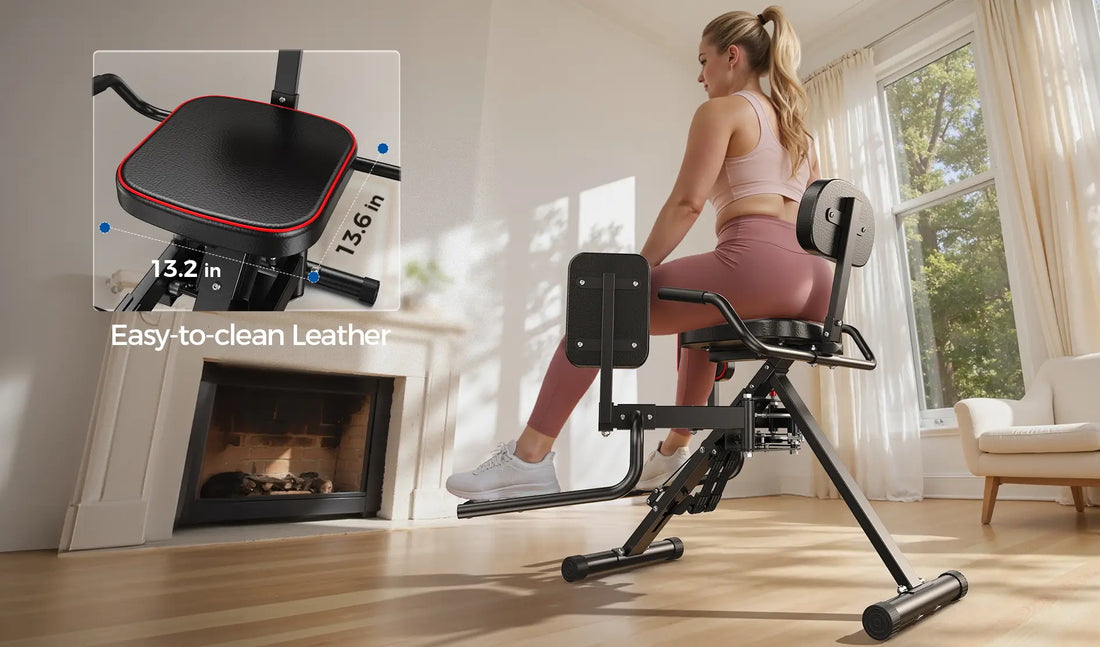
Training principle: Sit down, place your legs against the pads, and press them outward against resistance. The guided path loads the abductors directly and makes adding weight simple, which is why it's such a reliable strength tool. The FED Fitness 2-in-1 Hip Abductor & Adductor Machine handles both this move and its inner-thigh counterpart from one seat.
Primary muscles: Gluteus medius and minimus, with the TFL assisting.
Difficulty: Beginner-friendly, easily progressed.
Best for: Progressive strength, home gyms, and anyone who wants a guided movement.
Common mistake: Loading too much weight and cutting the range short, or leaning your torso to heave the pads open. Use a weight you control through a full range.
8. Side Plank with Hip Abduction
Training principle: Hold a side plank and raise your top leg. It's one of the highest overall glute recruiters because your bottom-side abductors stabilize you while the top leg works.
Primary muscles: Gluteus medius, plus deep core.
Difficulty: Advanced.
Best for: Combined stability and strength.
Common mistake: Letting your hips sag toward the floor or rushing the reps. Keep a straight line from head to heels and move slowly.
9. Single-Leg Glute Bridge
Training principle: Lie on your back, drive up through one heel, and keep your pelvis perfectly level as you rise. The abductors fight to stop the free-leg side of your pelvis from dropping.
Primary muscles: Gluteus maximus and medius.
Difficulty: Intermediate.
Best for: Hip stability and anti-drop control.
Common mistake: Letting the pelvis tilt or dip toward the non-working side. Keep both hip bones pointing at the ceiling the whole time.
10. Single-Leg Squat or Step-Down
Training principle: Lower under control on one leg, whether that's a step-down off a box or a slow single-leg squat, keeping your knee tracking over your toes. It's a top-tier glute activator that also demands real-world balance.
Primary muscles: Gluteus medius and maximus.
Difficulty: Advanced.
Best for: Building glutes and functional single-leg strength.
Common mistake: Letting the knee cave inward and the pelvis drop. Control the descent and drive your knee out in line with your foot.
The Best Hip Abductor Exercises for Different Goals
No single move is right for everyone. Match the exercise to what you're after, and you'll progress faster with less wasted effort.
Best for Beginners
Start with the clamshell, side-lying hip abduction, and single-leg glute bridge, or the seated machine if you have one. They're low-skill, easy to feel, and teach your glutes to fire before you add real load.
Best for Building Glutes
Combine the highest activators. Side-lying abduction hammers the gluteus medius, while single-leg squats and step-downs bring in the maximus.
Just remember the roundness most people want comes largely from the gluteus maximus, so pair these with heavy hip-extension work like hip thrusts and squats.
And that pairing's what turns strong glutes into rounder ones.
Best for Hip Stability
Prioritize single-leg moves: the single-leg glute bridge, side plank with abduction, and step-downs. These train the abductors to do their real job: holding your pelvis steady when only one foot's on the ground.
Best for Seniors
The seated machine and standing band abduction with a hand on a support are excellent, since they build strength with minimal balance risk. Clamshells work well too. As always, anyone with a health condition or recent injury should check with a doctor or physical therapist before starting.
Best for Home Workouts
You don't need much at all. And clamshells, fire hydrants, lateral band walks, monster walks, and glute bridges deliver a full abductor session with just a mini-band and floor space.
Sample Hip Abductor Workout Routines
Pick the plan that matches your level. Do each twice or three times a week, leaving about a day between hard sessions for recovery.
Beginner routine (2x per week)
- Clamshell: 2 sets of 12 per side
- Side-lying hip abduction: 2 sets of 12 per side
- Single-leg glute bridge: 2 sets of 10 per side
- Lateral band walk: 2 sets of 10 steps each direction
Intermediate routine (2 to 3x per week)
- Side-lying hip abduction: 3 sets of 15 per side
- Lateral band walk: 3 sets of 12 per side
- Standing cable hip abduction: 3 sets of 12 per side
- Monster walk: 3 sets of 10 steps
- Side plank with hip abduction: 3 sets of 8 per side
Strength routine (2 to 3x per week, add resistance over time)
- Seated hip abduction machine: 4 sets of 10 to 12
- Single-leg squat or step-down: 3 sets of 8 per side
- Weighted single-leg glute bridge: 3 sets of 10 per side
- Standing cable hip abduction: 3 sets of 12 per side, heavier
- Side plank with hip abduction: 3 sets of 10 per side
Common Mistakes During Hip Abductor Training
Most abductor mistakes come down to letting momentum or the wrong muscle do the work. Slow down, and you'll see the results improve immediately.
Keep an eye out for these:
- Swinging with momentum. Jerking the leg up or slamming the machine open cheats the muscle out of tension. Control every rep.
- Letting the TFL take over. If you feel the burn at the front-outer hip instead of the outer glute, ease the load and reset your posture.
- Going too heavy. These are smaller stabilizing muscles, so a weight you can move cleanly through a full range beats a heavy one you cut short.
- Rolling the hips back. On side-lying moves and clamshells, keep your hips stacked so the glutes stay in charge.
- Using too light a band, or the wrong placement. Bands lower down, at the ankles or feet, drive more activation than at the knees.
- Pelvic drop on single-leg work. Keep your pelvis level; if it dips, regress to an easier version.
- Skipping the abductors entirely. The most common mistake of all is never training them, then wondering why balance and knee tracking suffer.
Should You Train Hip Abductors and Adductors Together?
Yes, and it's a smart approach. The abductors and adductors are opposites that both stabilize your pelvis, so training them as a pair builds balanced, resilient hips.
Your inner-thigh adductors pull your legs together while your abductors take them apart, and the two constantly balance each other to keep your pelvis level and your stride efficient.
But train only one, and you'll invite imbalance.
You can work them in the same session or alternate them across the week, and a 2-in-1 machine makes covering both effortless from a single seat. We'll dig into the full adductor-versus-abductor comparison in a dedicated article, but the short version is simple: strong hips need both.
The Wrap-up
Hip abductor training isn't glamorous, but it quietly upgrades almost everything else you do, from steadier balance to sharper sprints to a more complete lower body.
Build your plan around the highest-activation moves, match the exercises to your goal, control every rep, and give the adductors equal attention. Whether you're training with a band on your living-room floor or a loaded machine, consistency's what turns these moves into real strength.
And strong, stable hips carry you through every step and stride of your day. Pick a routine above and start building them.
Frequently Asked Questions
How Often Should I Train Hip Abductors?
Two to three focused sessions a week is the sweet spot for building strength, with about a day of recovery between the harder ones. Light activation work like clamshells or band walks is gentle enough to sprinkle in more often, even as part of your warm-ups.
Can I Train Hip Abductors Every Day?
Heavy, high-effort abductor work every single day isn't ideal, since your muscles adapt and grow during recovery, not during the session. Low-intensity activation drills are fine daily, but save the challenging, loaded work for a few times a week.
Are Squats Enough?
Not on their own. Squats are fantastic, but they move your legs up and down and don't directly challenge the side-to-side abduction your outer hips are built for. And adding dedicated abductor exercises fills a gap that squats leave wide open.
What's the Best Hip Abductor Exercise for Beginners?
The clamshell and the seated machine are ideal starting points. Both are easy to learn, hard to get wrong, and let you feel the target muscles working. Side-lying hip abduction is a great next step once those feel comfortable.
Can Hip Abductor Exercises Build Glutes?
They build the gluteus medius and minimus well, which adds shape and strength to the upper, outer hip. For the rounder look that comes from the larger gluteus maximus, pair them with hip-extension moves like thrusts, squats, and deadlifts.
Do Hip Abductor Exercises Help Improve Balance?
They can contribute meaningfully. Because the abductors keep your pelvis level when you stand on one leg, strengthening them supports single-leg stability and steadier movement. Single-leg exercises like the glute bridge and step-down are especially useful for this.
What's the Best Home Hip Abductor Workout?
Grab a mini-band and run through clamshells, lateral band walks, fire hydrants, monster walks, and single-leg glute bridges. That combination trains the whole abductor group with no machine required, and it's all done on your living-room floor.
Should Runners Train Hip Abductors?
It's worth considering. Weak hip abductors are associated with iliotibial band issues in runners, and strengthening them may help in those cases.
The broader evidence on preventing running injuries is still mixed, so think of abductor work as one useful piece of your training, and see a professional if you're dealing with pain.
References:
- Boren, K., et al. "Electromyographic Analysis of Gluteus Medius and Gluteus Maximus During Rehabilitation Exercises." International Journal of Sports Physical Therapy, 2011.
- Distefano, L.J., et al. "Gluteal Muscle Activation During Common Therapeutic Exercises." Journal of Orthopaedic & Sports Physical Therapy, 2009.
- "Hip-Muscle Activity in Men and Women During Resisted Side Stepping With Different Band Positions." Journal of Athletic Training.
- "Activation of the Gluteus Medius According to Load During Horizontal Hip Abduction in a One-Leg Stance." Journal of Physical Therapy Science.
- Mucha, M.D., et al. "Hip Abductor Strength and Lower Extremity Running-Related Injury in Distance Runners: A Systematic Review." Journal of Science and Medicine in Sport, 2017.
- "Effects of Conservative Treatment Strategies for Iliotibial Band Syndrome on Pain and Function in Runners: A Systematic Review." Frontiers in Sports and Active Living, 2024.
- "Abductor and Adductor Strength Relation to Sprint Performance." Baltic Journal of Health and Physical Activity.
This content is for informational purposes only and does not constitute medical advice. For questions related to your health or medical conditions, please consult your physician. Always seek advice from a qualified healthcare professional before starting any exercise program or health regimen. In the event of a medical emergency, call 911.


Leave a Comment
We’d love to hear from you — your insights can inspire others!