


What Is Powerlifting? A Beginner's Guide to the Strength Sport
Powerlifting is a strength sport built on three barbell lifts — the squat, bench press, and deadlift — where the goal is simply to lift as much weight as possible.
This guide explains the three lifts, how competitions and scoring work, how powerlifting differs from weightlifting and bodybuilding, whether it's something you can start as a beginner, what gear you need, and how to get going.
By the end, you'll know what the sport is and whether it's for you.
What Are the Three Powerlifting Exercises?
Powerlifting is contested with three barbell lifts: the squat, the bench press, and the deadlift. Each tests raw strength through a single heavy repetition, and together they measure your total-body pressing, pulling, and leg power.
These three movements are the whole sport. A powerlifter trains dozens of exercises, but on competition day only these count.
| Lift | What it tests | The basic movement |
| Squat | Legs, hips and back working as one unit | Bar on the upper back, descend below parallel, stand up |
| Bench press | Upper-body pressing power | Lie flat, lower the bar to the chest, pause, press to lockout |
| Deadlift | Full-body pulling strength | Lift the bar from the floor to a fully upright, locked-out stand |
Each lift has rules that decide whether it counts, and that's where most first-time competitors lose attempts.
Squat
The lifter takes a loaded barbell across the upper back, descends until the crease of the hip drops below the top of the knee, then stands fully upright.
That depth requirement is strict. Come up even slightly high, and the lift won't count, however much weight is on the bar.
Bench Press
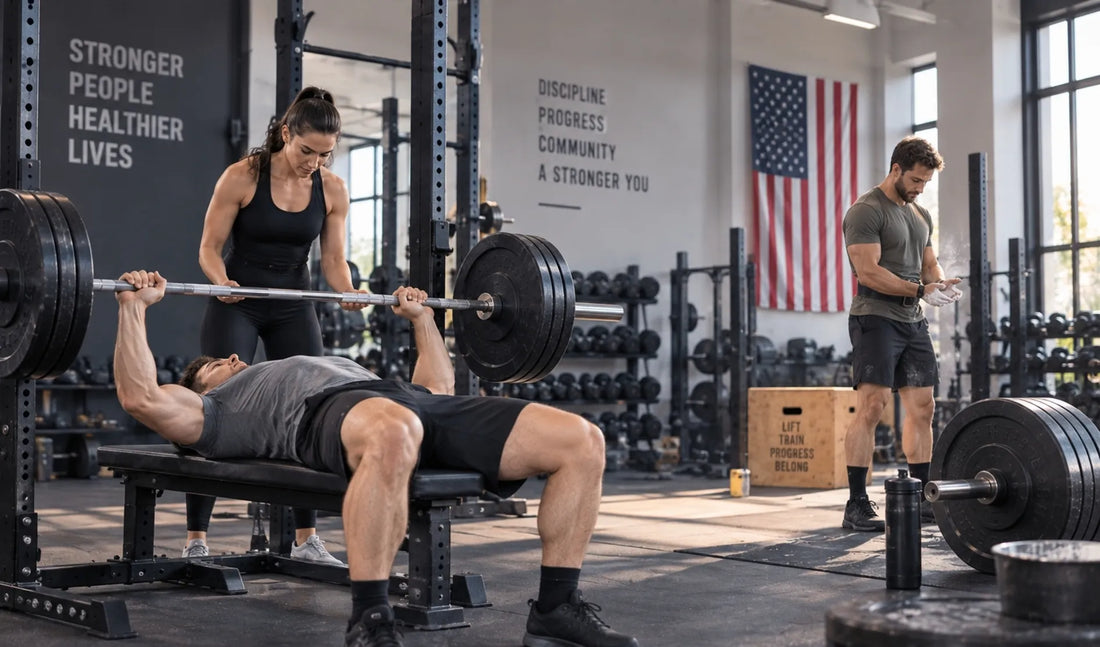
Lying on a flat bench, the lifter lowers the barbell to the chest, pauses it motionless there, then presses it back to straight, locked-out arms.
The pause is what separates a competition bench from a gym bench. Bouncing the bar off the chest isn't allowed, which is why a competition bench is usually well below what someone can touch-and-go.
Deadlift
The lifter grips a barbell resting on the floor and stands up with it until the knees and hips are fully extended and the shoulders are back.
The bar starts dead on the floor with no stretch reflex to help, so there's nothing to rebound out of. Just you against the weight. It closes out a competition, which is why meets so often come down to a final deadlift attempt.
Can Beginners Do Powerlifting?
Yes, and it's one of the better sports to start as a beginner. There's no strength requirement to begin training or to enter a meet — competitions run weight classes and novice divisions precisely so people can compete against others at their own level.
Powerlifting suits beginners for a practical reason: the programs are simple. Three lifts, a handful of accessory movements, and a straightforward instruction to add a little weight when you can. Compare that to a sport where you're learning a dozen movements at once, and you can see why people make fast progress early.
The real barrier isn't strength; it's technique.
All three lifts are skills, and all three punish a sloppy setup once the weight gets heavy. So the first few months are better spent learning the movements properly at manageable loads than testing what you can move. Coaching helps here — even a handful of sessions, or filming your sets and getting them checked by someone who competes.
And you don't need to train for years before entering a meet.
Plenty of lifters do their first competition within six to twelve months of starting, not to place, but because a meet teaches you how the commands work, what a judged lift feels like, and where you actually stand. Turning up is the point.
Just note that powerlifting is a maximal-effort sport, and the heavier the weight gets, the less room there is for poor form. Build the habits early while the bar's still light, because the sport gives you no chance to fix them later.
How Does a Powerlifting Competition Work?
A powerlifting meet runs through all three lifts in order, giving each competitor three attempts per lift. Your best successful attempt in each is added into a total, and the highest total in your division wins.
The format looks intimidating from the outside, but it's a clear, predictable structure once you see it. Below is how a meet unfolds, step by step.
1 Weight Class and Weigh-In
Before competing, every lifter weighs in and is placed into a bodyweight class, so a 130-pound athlete never has to go head-to-head with a 300-pound one. Men and women compete separately, each with their own set of classes.
2 Three Lifts
The meet always runs in the same order: all competitors complete their squats first, then the bench press, and finally the deadlift. Everyone finishes one lift before the platform moves on to the next.
3 Attempts
You get three attempts at each lift, nine in total across the day. You declare your opening weight, then choose how much to add for your second and third tries. Smart lifters open with a weight they're certain to make, then build from there.
4 The Total
Your best successful squat, bench, and deadlift are added together to form your total. That single number is what you're really competing on. But miss all three attempts at any one lift, and you "bomb out" with no total for the day, which is why openers matter so much.
5 Ranking
The highest total in your weight class and sex takes the win. To crown a best overall lifter across different weight classes, federations apply a scoring formula, such as DOTS or Wilks, that adjusts each total for bodyweight so a lightweight and a heavyweight can be compared fairly.
What Makes a Powerlifting Lift "Good"?
A lift only counts when it meets the technical standard and follows the referee's commands. Three judges rule on each attempt, and you need at least two of them to award a "white light."
Every attempt is watched by three referees, one head judge and two side judges.
They're checking the specifics: did the squat reach legal depth, did the bench pause on the chest, did the deadlift reach a full lockout, and did the lifter wait for each command before moving?
A passing lift earns two or more white lights.
A red light signals a fault, whether that's cutting depth short, pressing before the "press" call, or failing to control the bar.
Learning to nail the commands is just as important as being strong, and it's a common way that new lifters lose otherwise good attempts.
Powerlifting vs. Weightlifting vs. Bodybuilding
These three barbell pursuits are often confused, but they're completely different. Powerlifting maximizes weight on three slow lifts, Olympic weightlifting is about explosive overhead lifts, and bodybuilding is judged on physique rather than strength.
Olympic weightlifting features two lifts, the snatch and the clean and jerk, both of which drive a barbell overhead at high speed.
It rewards power, technique, speed, and mobility, and it looks explosive and athletic next to powerlifting's grinding maximal efforts.
Bodybuilding isn't a lifting contest at all.
Competitors are judged on the size, symmetry, and conditioning of their muscles on stage, so their training leans on higher reps, body-part splits, and strict dieting.
You can be a genuinely strong powerlifter without the stage-ready look of a bodybuilder, because the two sports chase entirely different goals. And powerlifting cares only about the weight you move.
Powerlifting vs. Strength Training: What's the Difference?
Strength training is the broad umbrella of all resistance work, while powerlifting is a specialized sport within it focused on maximizing the squat, bench, and deadlift for competition.
All powerlifting is strength training, but not all strength training is powerlifting.
General strength training might use machines, dumbbells, bodyweight moves, or any mix of exercises, in service of goals like health, muscle, or athletic performance.
Powerlifting narrows that focus sharply onto three barbell lifts and the singular aim of a bigger total.
Plenty of people train "like a powerlifter," building their routine around the big three and progressive overload, without ever stepping on a competition platform.
The training style and the sport overlap heavily, but the sport's real addition is the goal of competing.
What Equipment Do Powerlifters Use?
At its core, powerlifting needs a barbell, weight plates, a squat rack, and a bench. Beyond that, lifters use personal gear like a belt, specialized shoes, knee sleeves, and wrist wraps to lift more safely and comfortably.
The competition setup centers on an Olympic barbell, calibrated plates, a rack or stands to hold the bar, a bench for pressing, and a solid platform for pulling.
For personal gear in the raw, or "classic," division, lifters typically wear a singlet, flat or slightly heeled shoes, a supportive belt, thin knee sleeves, and wrist wraps.
An entirely separate equipped division adds heavy-duty supportive suits and bench shirts that store energy and allow dramatically heavier lifts.
You don't need a full competition rig to build a serious base at home.
The three main lifts need a barbell and rack, but a sturdy adjustable weight bench covers your pressing, and a pair of adjustable dumbbells handles the accessory work, rows, presses, lunges, and curls, that shore up weak points and drive your total upward.
How Strong Do You Need to Be to Start Powerlifting?
You don't need to be strong at all. There's no minimum, and local meets are welcoming to first-timers, with lifters totaling anything from a few hundred pounds on up.
What matters when you begin is technical competence in the three lifts and knowing the rules.
That means learning to squat, bench, and deadlift with clean, repeatable form before the weight gets heavy enough to expose a flaw — and learning what the judges actually look for, since a well-executed lift still gets three red lights if it misses depth or the bar doesn't pause.
If you're brand new to lifting entirely, spend six to twelve months building a base of general strength and grooving those three movements before you chase a competition. Strength comes with time, and the willingness to start is the only real requirement.
Is Powerlifting Right for You?
Powerlifting suits beginners who want a clear goal and don't mind repetition. You'll do the same three lifts most weeks, write down what you lifted, and try to beat it next time. If that sounds satisfying rather than boring, you'll get on with it.
Here's what the first few months actually look like. Two or three sessions a week, each built around a squat, a bench, or a deadlift, plus a handful of supporting exercises.
Not much variety.
Sets of five rather than sets of fifteen. Long rests between them, which surprises people — you'll spend more of the session waiting than working. And a notebook or an app, because the whole method depends on knowing what you did last time.
What you get in return is the clearest feedback in the gym. The bar either went up or it didn't. Nobody has to tell you whether you're progressing.
It's a weaker fit if you're starting mainly to lose weight or change how you look.
Powerlifting builds muscle, and it'll change your shape, but it's organised around moving weight rather than around appearance, so a bodybuilding-style program gets you there more directly.
Same if you want to be faster or more explosive for a sport — that's weightlifting or sport-specific work.
You also never have to compete. Plenty of people train the three lifts for years without entering a meet, and "I'm following a powerlifting program" is a perfectly normal reason to be under a barbell.
How Do You Start Powerlifting?
Start by learning the three lifts with good technique, then follow a simple beginner program that adds a little weight each session. Consistency, not intensity, is what builds a strong foundation.
Begin with form.
Get coaching, film your lifts, or work through reputable guides until your squat, bench, and deadlift are solid. From there, run a beginner program built on linear progression, adding a small amount of weight each workout, which works remarkably well for months.
Train consistently, eat and sleep to recover, and add accessory movements to patch weak spots.
When you're ready for the full experience, pick a federation and a local meet, then follow a roughly twelve-week prep that starts with higher reps and gradually shifts toward heavier, lower-rep work as the meet approaches.
Compete for the experience and the personal record, not to beat anyone else.
Final Takeaway
Powerlifting is one of the most accessible strength sports there is: three lifts, a clear goal, and a welcoming community, all centered on the simple question of how much you can lift.
Whether you want to compete or just train the big three for your own progress, the path is the same.
Learn the squat, bench, and deadlift, follow a steady program, and let your total climb over time. You don't need to be strong to start, only willing, and the strength will follow. Load the bar and begin.
Frequently Asked Questions About Powerlifting
What Are the Three Lifts in Powerlifting?
The three lifts are the squat, the bench press, and the deadlift, always performed in that order at a meet. Each lifter gets three attempts per lift, and their best successful attempt in each is combined into a total that determines the rankings.
Is Powerlifting the Same as Weightlifting?
No, they're separate sports. Powerlifting contests the squat, bench press, and deadlift, while Olympic weightlifting features the snatch and the clean and jerk, which are explosive lifts that drive the bar overhead.
The two demand different skills, though both build serious strength.
Is Powerlifting Good for Building Muscle?
Yes. Training the squat, bench, and deadlift heavily builds both strength and muscle, since these compound lifts recruit huge amounts of muscle mass.
Bodybuilding-style training targets size more directly with higher reps, but powerlifting absolutely adds muscle along the way.
Can Beginners Start Powerlifting?
Absolutely. There's no strength requirement to begin, and the community welcomes newcomers.
It's smart to spend a few months learning the lifts and building a base first, but anyone willing to train can start powerlifting and, if they choose, enter a beginner-friendly local meet.
Do You Have to Compete to Be a Powerlifter?
Not at all. Many people train the three lifts and follow powerlifting programs purely for their own strength and enjoyment, without ever entering a competition. Competing adds a fun goal and a community, but training the sport's lifts is enough to call it your own.
References
- USA Weightlifting. "What Is the Difference Between Weightlifting and Powerlifting?" USA Weightlifting.
- Lift Vault. "Powerlifting Rules & Commands for Squat, Bench & Deadlift." Lift Vault.
- International Powerlifting Federation. "IPF Technical Rules Book." IPF.
- StrengthLog. "Powerlifting vs. Bodybuilding: 10 Main Differences." StrengthLog.
- Powerlifting Technique. "How Strong Do You Need to Be at Your First Powerlifting Meet?" Powerlifting Technique.
This content is for informational purposes only and does not constitute medical advice. If you have questions about your health or a medical condition, please consult your physician. Always seek guidance from a qualified healthcare professional before starting any exercise program or fitness routine. FED Fitness assumes no responsibility for any consequences resulting from the use of this information.


Leave a Comment
We’d love to hear from you — your insights can inspire others!