


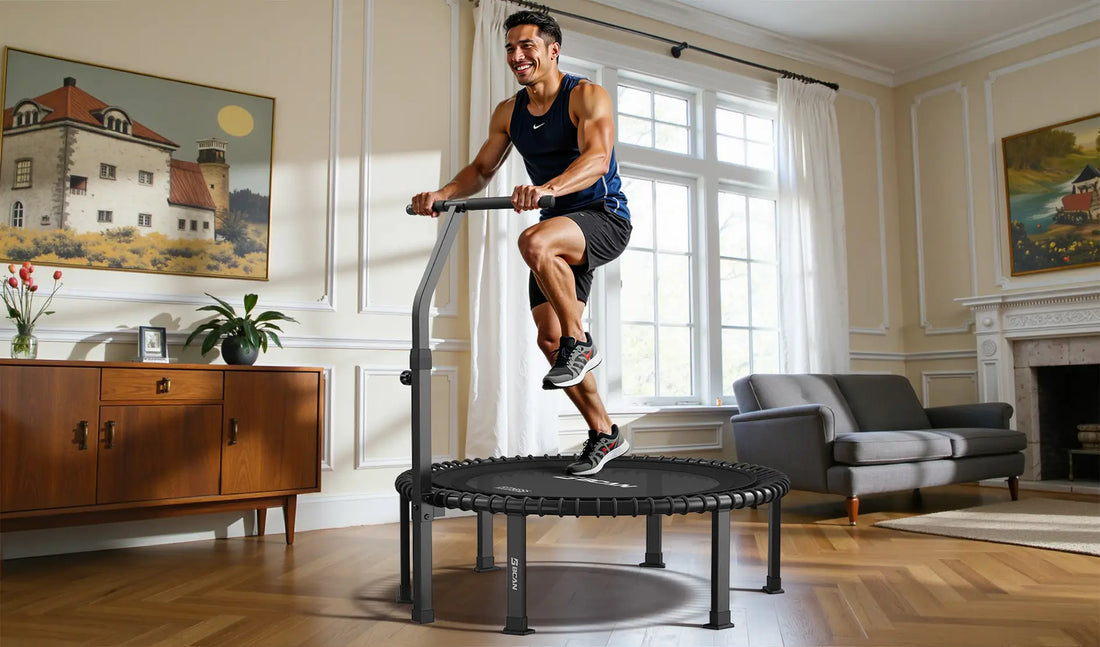
Common Beginner Mistakes When Using a Rebounder (and How to Avoid Them)
Rebounding looks easy enough until you step on the mat for the first time and your ankles start negotiating with the surface.
Like every exercise, there’s a right way and a wrong way, and the more you know before starting, the likelier you are to enjoy it and stick with it, and the less likely you are to hurt yourself or somebody else.
This guide walks through the most common beginner mistakes when using a rebounder, why each one trips people up, and the simple fix for every single one.
Get these right early, and you'll bounce with more confidence, better form, and a routine you'll actually want to come back to.
We've watched a lot of first-timers climb onto a mini trampoline. Almost everyone makes the same handful of errors in the first week.
The good news?
None of them are hard to correct once you know what to look for.
Why Rebounding Feels Awkward at First
Feeling wobbly on your first few bounces is completely normal. A rebounder is an unstable surface on purpose, so your smaller stabilizing muscles have to wake up and work in ways they rarely do on solid ground.
Think about it. When you walk across your kitchen floor, the floor doesn't move. A rebounder does.
Every time you land, the mat gives, shifts, and pushes back, and your feet, ankles, and core have to respond in real time. That feedback loop is the whole purpose of the exercise, but it's also why your legs might feel oddly tired after a short, gentle session.
So if your first attempt feels clumsy, you're not bad at this. You're just new. That awkwardness fades fast, usually within a few sessions, as your body learns the rhythm.
Mistake #1: Jumping Too High Too Soon
Skip the big air. The most effective starting move is the "health bounce," where your feet barely leave the mat, and your heels lift only slightly.
New rebounders often assume higher jumps mean a better workout. They don't. Big bounces add impact, throw off your balance, and burn through your confidence before you've built any control.
The health bounce keeps you grounded, lets you find your rhythm, and still gets your heart rate moving.
Master the small, controlled bounce first. You can always add height later, once your balance and timing are solid.
Mistake #2: Locking the Knees While Bouncing
Keep a soft bend in your knees at all times. Locked, straight legs send the force of each landing straight up through your joints instead of letting your muscles absorb it.
When jumping, when you lock out your knees, you turn your legs into rigid poles. This is a hard mistake to spot because it can be so subtle, but it’s well worth keeping an eye out for.
When you build your legs, even ever-so-slightly, they become springs, as intended.
Your quads, hamstrings, and calves do the work they're supposed to do, and the movement feels smoother and more cushioned. It’s better for your legs, the exercise, and just feeling great throughout.
The best way to imagine this is to imagine you're about to sit in a very shallow chair. That gentle hinge at the hips and knees is exactly the posture you want.
Mistake #3: Trying Advanced Workouts Too Early
Don't chase the high-intensity routines you've seen online during week one. Build a foundation with the basic bounce before layering in jacks, twists, or sprint intervals.
It's tempting to copy a 30-minute choreographed session on day three. But those instructors have hundreds of hours on the mat, and the moves that look fun on screen demand balance and coordination you're still developing.
Rushing it usually ends one of two ways: a frustrating session or a tweaked ankle that sidelines you.
Give yourself a week or two of simple bouncing. And when you do progress, add one new movement at a time so your body can adapt to each before stacking the next.

Mistake #4: Focusing Only on Calories Burned
Calorie count is the wrong scoreboard. Rebounding is a genuinely useful workout, but it isn't the calorie-torching miracle some marketing suggests, and obsessing over the number tends to backfire.
The 2024 Adult Compendium of Physical Activities places trampoline-style exercise at roughly brisk-walk intensity, around 3.5 to 4.5 METs (Metabolic Equivalents, which means how many times more an exercise burns energy than your standard resting rate), not the inflated 6 to 10 you'll see on some calculators.
However, just because it’s not incredibly intense doesn’t mean it’s not doing work.
AnACE-sponsored study found a 19-minute rebounder workout pushed participants to about 79% of their maximum heart rate, comparable to a jog.
The standout finding from that same study? People rated the workout as feeling easier than the numbers said it was.
That's the metric that matters for a beginner. A workout you enjoy and perceive as manageable is a workout you'll repeat, and consistency beats intensity every time.
Mistake #5: Poor Posture During Rebounding
Stand tall and stay aligned. Chest lifted, shoulders relaxed, core gently braced, eyes forward instead of down at your feet.
When beginners get nervous, they hunch and stare at the mat. That rounded posture makes balancing harder, not easier, because it shifts your weight forward and shortens your stabilizing muscles' reaction time.
Looking down also tends to pull your whole upper body with it.
Pick a spot on the wall in front of you and keep your gaze there. Engage your midsection like you're bracing for a light poke to the stomach. You'll feel steadier almost immediately. And you'll get more out of every bounce.
Mistake #6: Doing Too Much on Day One
Start short and build gradually. Five to ten minutes is plenty for a first session, even if you feel like you could keep going.
Enthusiasm is great. Overdoing it on day one is how you wake up the next morning convinced rebounding "isn't for you."
That next-day soreness has a name, delayed onset muscle soreness, and according to the Cleveland Clinic, it typically shows up 12 to 24 hours after a new activity and peaks within 24 to 72 hours.
It's a normal sign your muscles are adapting, not a red flag.
To fix this, simply ease in. Take your time. No need to rush and push yourself to go all out.
Add a few minutes each session rather than going all-out immediately, and your body will thank you with steadier progress and a lot less stiffness.
Remember, and this is the case throughout this guide, it’s understandable that you want proper results and are eager to get there, but you’re going to get far better results taking your time and being consistent with your practice than you will going hard for two weeks and then never doing it again.
Mistake #7: Using an Unstable or Poor-Quality Rebounder
Your equipment matters more than you'd think. A flimsy, wobbly trampoline makes every other mistake on this list worse and can sap your confidence before you've started.
Cheap rebounders tend to have weak frames, harsh spring suspension, and no support handle, which is a rough combination when you're still finding your footing.
Two things separate a beginner-friendly model from a frustrating one: the suspension type and a stable point of contact.
Bungee-cord systems give a softer, quieter landing than steel springs, and an adjustable handlebar gives you something to hold while your balance develops.
This is exactly where the BCAN BT4 Soft Land Pro earns its place for newcomers. Its bungee design softens each landing, the frame stays planted, and the adjustable T-handlebar means you can practice with support and remove it once you're steady.
Starting on stable, forgiving equipment removes a whole category of beginner problems before they happen.
Mistake #8: Ignoring Balance and Coordination Training
Think of balance as a skill you're building, not a side effect. The unstable surface is a training tool, and leaning into it pays off faster than ignoring it.
A lot of beginners brace stiffly and try to "survive" the wobble. But that instability is doing something valuable.
Research in specific groups suggests that balance and coordination respond well to mini-trampoline work: a randomized controlled study in older women (Clinical Interventions in Aging, 2019) reported improvements in balance, functional mobility, and gait after a structured 12-week program.
For most people, the practical takeaway is that these qualities are trainable, and a rebounder is a fun way to work on them.
Try adding small, deliberate challenges as you improve, like shifting your weight side to side or briefly holding a single-leg balance near your handlebar.
Keep it playful. Coordination grows through reps, not strain.
Mistake #9: Expecting Immediate Results
Give it weeks, not days. Fitness change is a slow, cumulative process, and rebounding is no exception, so judge it by your consistency, not by the mirror after session two.
The viral "NASA says rebounding is 68% more efficient than running" line doesn't help here.
That claim is a wild oversimplification of a small 1980 lab study that used eight men and a full-size competition trampoline, not a home rebounder, and it was never a fitness-outcome trial.
Setting your expectations by a misquoted headline is a recipe for disappointment.
Real progress follows a dose-response pattern: the more consistently you train over weeks and months, the more change you tend to see, as research on exercise and body composition shows.
Show up regularly, keep your sessions enjoyable, and let the results accumulate. They will.
What Beginners Should Focus on to Get the Best Results
Here's the short version of everything above, reframed as what to actually do:
- Start with the health bounce and keep your knees soft.
- Stand tall, core braced, eyes forward.
- Begin with short sessions and add time gradually.
- Use stable, beginner-friendly equipment with a support handle.
- Build balance and coordination as skills worth practicing.
- Measure success by consistency, not by calories or quick results.
Nail these basics, and the fancier workouts become easy to grow into. You're building a foundation, and a good one lasts.
Final Thoughts
Every beginner makes a few of these mistakes. That's not a problem; it's part of learning a new movement, and now you know exactly what to watch for.
Keep your bounces controlled, your posture tall, and your expectations realistic. And most of all, keep it fun, because the routine you enjoy is the one you'll stick with long enough to feel the difference.
If you're shopping for your first mini trampoline, starting on a stable, forgiving model like the BCAN BT4 Soft Land Pro makes those early sessions a whole lot smoother. Step on, start small, and enjoy the bounce.
FAQs
Is It Normal to Feel Unstable on a Rebounder at First?
Yes, and it's a good sign. The surface moves under you, so your stabilizing muscles are firing to keep you balanced. That instability is the workout doing its job. Most people feel noticeably steadier within a handful of sessions.
Should Beginners Jump High on a Rebounder?
No. Start low. The health bounce, where your feet barely leave the mat, builds control and protects your balance far better than big jumps. Height is something you earn once your form is dialed in, not where you begin.
Why Do My Legs Get Tired So Quickly When Rebounding?
Because muscles you don't normally challenge are suddenly working overtime. Every landing recruits your ankles, calves, and core to absorb and redirect force. It's a different kind of effort than walking or running, so quick fatigue early on is expected and improves with practice.
Is Rebounding Harder Than It Looks?
In some ways, yes. It looks gentle, and it can be, but balancing on a moving surface while keeping good form takes more coordination than people expect. The flip side is that it often feels easier than the actual intensity, which is part of why so many people stick with it.
How Long Should Beginner Rebounder Workouts Be?
Aim for five to ten minutes to start. Short and consistent wins. As your stamina and balance improve over a week or two, add a few minutes at a time until you reach a duration that feels challenging but sustainable.
What Posture Should You Use While Rebounding?
Tall and stacked: chest lifted, shoulders relaxed, core gently engaged, knees softly bent, and eyes forward rather than down. Picture a string pulling the top of your head toward the ceiling. Good alignment makes balancing easier and every bounce more effective.
Why Does Rebounding Feel Awkward at First?
Your body is learning a brand-new movement pattern on a surface that pushes back. That coordination takes a little time to develop. Stick with short, controlled sessions, and the awkward phase passes quickly, usually faster than you'd expect.
References:
- Porcari, J.P., et al. "ACE-Sponsored Research: Putting Mini-Trampolines to the Test." ACE ProSource, October 2016.
- Herrmann, S.D., et al. "2024 Adult Compendium of Physical Activities." Journal of Sport and Health Science, 2024.
- Posch, M., et al. "Effectiveness of a Mini-Trampoline Training Program on Balance and Functional Mobility, Gait Performance, Strength, Fear of Falling and Bone Mineral Density in Older Women with Osteopenia." Clinical Interventions in Aging, 2019.
- Cleveland Clinic. "Delayed Onset Muscle Soreness (DOMS)." Cleveland Clinic.
- Bhattacharya, A., et al. "Body Acceleration Distribution and O2 Uptake in Humans During Running and Jumping." Journal of Applied Physiology, 1980.
- Jayedi, A., et al. "Dose-Response Relationship Between Aerobic Exercise and Body Composition Among Adults With Overweight or Obesity." JAMA Network Open, 2024.
This content is for informational purposes only and does not constitute medical advice. For questions related to your health or medical conditions, please consult your physician. Always seek advice from a qualified healthcare professional before starting any exercise program or health regimen. In the event of a medical emergency, call 911.


Leave a Comment
We’d love to hear from you — your insights can inspire others!