


What Muscles Does a Hip Abductor Machine Work? Glutes, Balance & More
The hip abductor machine looks simple, but the muscles it trains do some of the most important stabilizing work in your body.
This guide breaks down exactly which muscles hip abduction works, which one does the heavy lifting, and why those muscles matter far beyond the gym, from walking to single-leg balance to staying steady as you age.
You'll also get the honest answer on whether the machine can build your glutes, and how to make sure the right muscles are actually firing.
If you've ever wondered why that outer-thigh machine feels so different from a squat, this is why. It targets a specific slice of your hip musculature that most big lifts barely touch.
How a Hip Abductor Machine Works
The machine trains hip abduction, the motion of pushing your legs away from the midline of your body. You sit down, place your legs against the pads, and press them outward against resistance, which directly loads the muscles on the outside of your hips.
That outward motion is the whole point.
Most compound exercises like squats and deadlifts move your legs up and down, so the muscles that move your legs sideways don't get much direct work. That's the gap the abductor machine fills, with a guided, seated path that's easy to learn.
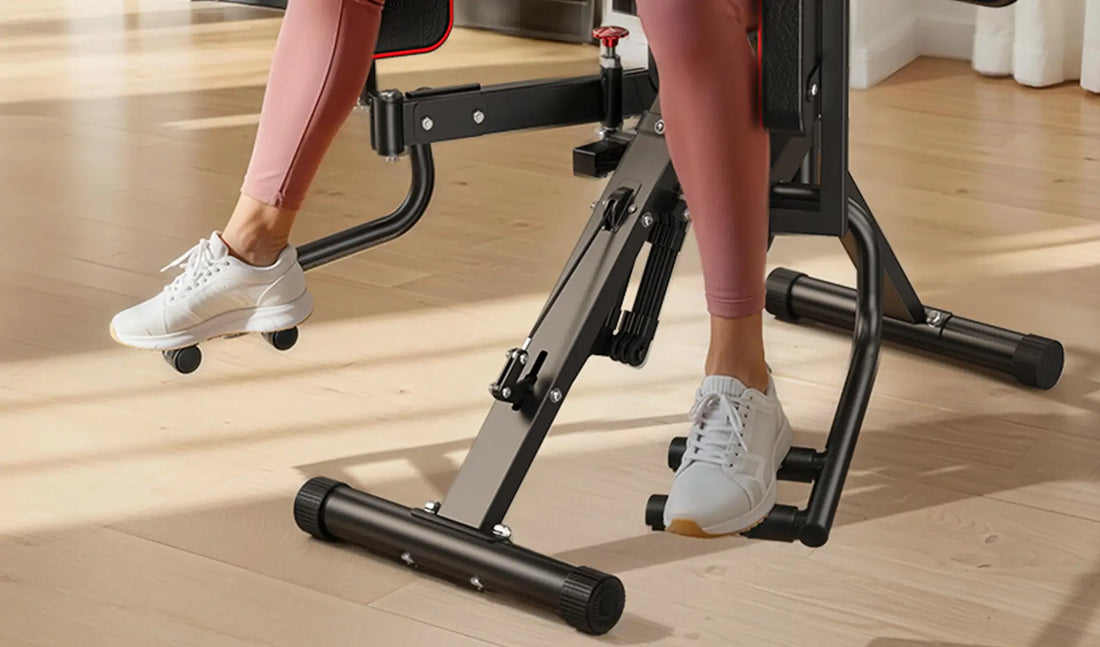
Many machines, including the FED Fitness 2-in-1 Hip Abductor & Adductor Machine, let you switch between the outer-thigh abduction movement and its inner-thigh opposite by flipping a pin.
And that guided setup makes it easier to feel the target muscles working, which matters more than you'd think. When you can feel a muscle, you're far more likely to train it well.

FED Fitness Flybird Series HA1 2-in-1 Hip Abductor and Adductor Machine
2-in-1 Hip Abductor & Adductor Machine, Easy, Smooth & Quiet Operation
$259.99
Primary Muscles Worked by a Hip Abductor Machine
The machine primarily targets the gluteus medius and gluteus minimus on the outer hip, with help from the tensor fasciae latae and the upper fibers of the gluteus maximus. Together, this abductor musculature moves and stabilizes your hip in the frontal plane.
Here's the muscle lineup:
- Gluteus medius: the main target. A broad, fan-shaped muscle on the outer pelvis, it's the workhorse of hip abduction and your key pelvic stabilizer when you stand on one leg.
- Gluteus minimus: the deep assistant. Tucked beneath the medius, it helps abduct and stabilize the hip, working almost as a partner to the medius.
- Tensor fasciae latae (TFL): a small muscle at the front of the hip that assists abduction and connects into the IT band. Useful, but it can take over if your form drifts.
- Gluteus maximus (upper fibers): your biggest glute's mainly a hip extensor, but it'll still pitch in on abduction through its upper fibers, especially when you lean slightly forward.
Which Muscle Does the Hip Abductor Machine Target the Most?
The gluteus medius, without much competition. Nerve-block research shows just how dominant the medius and minimus are in producing abduction force.
When researchers measured hip abduction force and then temporarily blocked individual muscles, blocking the gluteus medius and minimus dropped average abduction force from about 213 newtons to just 82.
Blocking the tensor fasciae latae barely moved it, and blocking the gluteus maximus reduced it only modestly. In plain terms, they're doing the vast majority of the work, and the machine trains them directly.
Secondary Muscles That Assist the Movement
The tensor fasciae latae and the upper gluteus maximus play supporting roles, contributing force and helping steer the movement.
The TFL sits at the front of your hip and assists every rep, though it isn't built to be the star. And the upper gluteus maximus chips in too, especially once you've added a forward lean.
And here's a useful cue: if you feel the machine mostly in the front-outer corner of your hip rather than the meat of your outer glute, the TFL is probably taking over.
Sitting a touch more upright and slowing down usually shifts the emphasis back to the gluteus medius, right where you want it.
Meanwhile, leaning slightly forward brings the upper gluteus maximus more into play, which is handy if glute shape's your goal.
Why These Muscles Matter Beyond the Gym
These muscles are stabilizers first and movers second. Every step you take, every moment you balance on one foot, your hip abductors are quietly keeping your pelvis level.
Here's where training them pays off in real life.
Walking
Every stride is a brief single-leg stance. When you're on one foot, the abductors of that standing leg keep the opposite side of your pelvis from dropping.
When they're weak, the pelvis dips and the body compensates with a telltale side-to-side sway, the mechanism clinicians call a Trendelenburg pattern. But strong abductors keep your walk smooth and level.
Standing on One Leg
Balancing on one foot, whether you're pulling on socks or climbing stairs, leans heavily on the gluteus medius and minimus. They're the muscles that hold your pelvis steady over a single planted foot, which is exactly what the classic single-leg balance test assesses.
Running and Sports
Cutting, pivoting, and sprinting all demand frontal-plane control, and that's abductor territory.
Hip abductor strength is among the stronger correlates of change-of-direction and sprint performance, because these muscles manage where your foot lands and how well you resist collapsing inward.
And for athletes, they're a real limiter.
Healthy Aging
Steady hips help you stay upright and confident on your feet over the years.
Research links hip abductor strength to better lateral balance and faster walking, and weaker abductors are associated with greater gait variability and higher fall risk in older adults.
Keeping these muscles strong is a smart long-term investment, ideally as part of a balanced program. Anyone with a health condition should check with a professional before starting something new.
Can the Hip Abductor Machine Build Glutes?
Partly, and here's the honest version. The machine builds your gluteus medius and minimus effectively, giving real strength and shape to the upper, outer hip, but it won't build big glutes on its own, because your largest glute muscle is primarily a hip extensor.

Let's be straight about this, since plenty of sites overpromise. The gluteus maximus, the muscle that gives the glutes their size and roundness, does its main work through hip extension: driving your hips forward and standing up out of a squat.
The abductor machine only involves it through those assisting upper fibers, so it's not the tool for maximus size. For real growth there, it's movements like hip thrusts, squats, deadlifts, and lunges that'll move the needle.
That said, the machine is a genuinely valuable accessory.
It develops the gluteus medius and minimus that compound lifts undertrain, adds side-hip strength and a more sculpted upper-glute look, and a slight forward lean recruits a bit more upper maximus.
Use it to round out your glute work, not to replace the heavy hip-extension lifts.
How to Better Activate the Right Muscles
Slow down, control the range, and mind your posture. The abductor group is smaller than your big leg muscles, so form and focus beat piling on plates.
A few practical pointers:
- Control the tempo. Push out smoothly, pause briefly at the top, and lower under control. Slamming the pads open with momentum robs the muscles of tension.
- Pick a manageable weight. These are small stabilizing muscles, so a load you can move cleanly through a full range works better than a heavy stack you jerk through. Think 3 to 4 sets of 12 to 20 reps.
- Set your posture. Sit tall to bias the gluteus medius, or lean slightly forward to draw in more upper gluteus maximus.
- Chase the feeling. You want to feel the outer glute, not the front of the hip. And if the TFL keeps taking over, don't force it; just drop the weight and reset your position.
- Train the whole hip. Pair abduction with hip-extension work and inner-thigh adduction for balanced, resilient hips.
The Wrap-up
The hip abductor machine trains a compact but mighty group: the gluteus medius and minimus, with support from the TFL and upper gluteus maximus. These are the muscles that keep your pelvis level, your balance steady, and your athletic movements sharp.
Use the machine with control, feel the work in your outer glutes, and think of it as one smart piece of a complete lower-body plan, not a magic glute-builder.
Strong, stable hips carry you through every step, sprint, and single-leg moment of your day. That's well worth a few focused sets.
Frequently Asked Questions
Does the Hip Abductor Machine Work the Gluteus Medius?
Yes, the gluteus medius is its primary target. This is the main muscle responsible for moving your leg outward and for keeping your pelvis level when you stand on one foot. The seated machine loads it directly, which is why you feel the effort concentrated in your outer hip.
Does It Work the Gluteus Maximus?
Only partially. Your gluteus maximus is mainly a hip extensor, so it assists abduction through its upper fibers rather than leading the movement.
Leaning slightly forward on the machine brings a bit more of it into play, but for real maximus development you'll want hip-extension exercises like thrusts and squats.
Does the Hip Abductor Machine Target the TFL?
It does, as a secondary assistant. The tensor fasciae latae helps with abduction and often kicks in noticeably.
If you feel the work mostly at the front-outer hip rather than the glute, the TFL is likely dominating, and adjusting your posture and slowing the tempo helps redirect the effort.
Can It Strengthen Weak Hip Muscles?
The machine is a straightforward way to build general strength in the hip abductors, and stronger abductors support balance and stable movement.
That said, if you suspect a specific weakness or you're dealing with pain, it's worth seeing a physical therapist who can assess you and guide the right approach.
Is It Enough to Build Glutes?
On its own, not for size. It builds the smaller gluteus medius and minimus well and adds shape to the upper hip, but the roundness most people want comes from the gluteus maximus, which grows through hip extension.
Combine the machine with heavy hip-hinge and squat work for a complete result.
Which Muscle Should I Feel Working?
Your outer glute, specifically the gluteus medius on the side of your hip. That deep, burning effort on the outside of the hip means you're on target.
If instead you feel it at the front of the hip or along the outer thigh, ease off the weight and reset your posture to bring the glutes back into focus.
References:
- Flack, N.A.M.S., et al. "A Review of the Anatomy of the Hip Abductor Muscles, Gluteus Medius, Gluteus Minimus, and Tensor Fascia Lata." Clinical Anatomy, 2012.
- "Tensor Fasciae Latae and Gluteus Maximus Muscles: Do They Contribute to Hip Abduction?" PubMed, 2024.
- Distefano, L.J., et al. "Gluteal Muscle Activation During Common Therapeutic Exercises." Journal of Orthopaedic & Sports Physical Therapy, 2009.
- "Comparison of Electromyographic Activity of the Superior and Inferior Portions of the Gluteus Maximus Muscle During Common Therapeutic Exercises." JOSPT, 2016.
StatPearls. "Trendelenburg Sign." NCBI Bookshelf. - "The Role of Hip Abductor Strength in Identifying Older Persons at Risk of Falls." Clinical Interventions in Aging.
- "The Effects of Hip Abductor Fatigue on Gait Instability in Older Adults." Journal of Neurophysiology, 2024.
- "Abductor and Adductor Strength Relation to Sprint Performance." Baltic Journal of Health and Physical Activity.
This content is for informational purposes only and does not constitute medical advice. For questions related to your health or medical conditions, please consult your physician. Always seek advice from a qualified healthcare professional before starting any exercise program or health regimen. In the event of a medical emergency, call 911.


Leave a Comment
We’d love to hear from you — your insights can inspire others!