


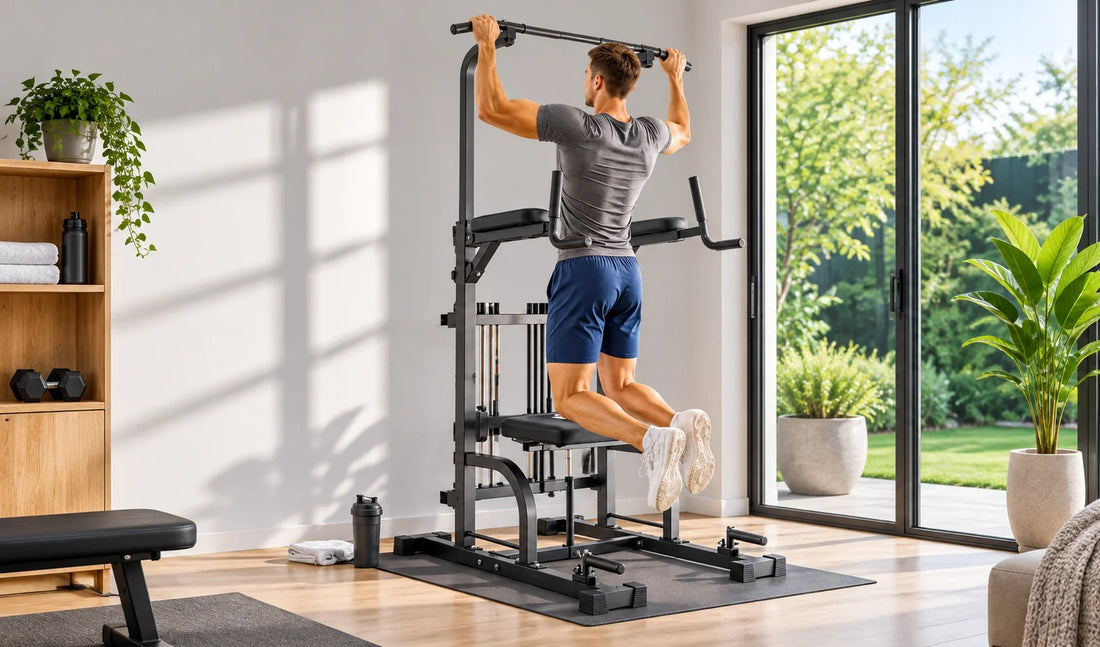
How to Choose the Best Power Tower for Your Home Gym
You don't need a room full of equipment to build a stronger upper body at home. Sometimes, all it takes is one well-chosen piece of equipment. A power tower gives you a dedicated space for pull-ups, dips, and core exercises without taking over your garage, basement, or spare bedroom. It's a practical way to get more out of your home workouts, whether you're working toward your first pull-up or adding more bodyweight training to your routine.
But here's the thing: not every power tower is right for every home gym. Some are built for straightforward bodyweight workouts. Others offer adjustable heights, pull-up assistance, or heavier-duty frames for more demanding training. So, how do you find the best power tower for your home gym? It comes down to choosing equipment that fits your space, supports your training goals, and feels comfortable and stable during use. Let's walk through what matters most.
What Can You Do With a Power Tower?
A power tower, also known as a pull-up dip station, is a freestanding piece of fitness equipment that lets you perform several upper-body and core exercises in one place. Unlike a traditional weight machine, a standard power tower uses your body weight as resistance. That makes it especially useful for building strength without needing a collection of dumbbells, barbells, or weight plates.
Here are some of the most common exercises you can do with one.
Pull-Ups
Pull-ups are a go-to exercise for building back strength, particularly in the latissimus dorsi (lats). They also engage your biceps, forearms, and other upper-back muscles. If you want to improve your upper-body pulling strength, pull-ups are a great place to start.
Chin-Ups
Chin-ups use an underhand grip, which generally increases the contribution of your biceps compared with a traditional overhand pull-up. Both exercises work your back and arms, so you can use them together to add variety to your training.
Dips
Dips primarily target your triceps, chest, and front shoulders. They're an effective bodyweight pushing exercise when performed with proper control. Keep your shoulders comfortable, avoid excessive swinging, and use a range of motion you can manage without pain.
Knee Raises and Leg Raises
Want to strengthen your core? Hanging knee raises and leg raises challenge your abdominal muscles and hip flexors while also requiring upper-body stability. If you're new to these movements, supported knee raises are often an easier starting point than hanging straight-leg raises.
Push-Ups
Some power towers include built-in push-up handles, giving you another way to train your chest, shoulders, and triceps. Depending on the handle design, they may also allow a more comfortable wrist position or a greater range of motion.
With these exercises, a power tower can cover a substantial portion of your upper-body and core routine. Pair it with squats, lunges, and other lower-body exercises, and you've got the foundation for a well-rounded home workout.
Which Type of Power Tower Is Right for You?
The best power tower isn't necessarily the biggest or most expensive one. It's the one that matches how you actually plan to train. Before comparing models, think about who's going to use it, which exercises matter most, and how much space you have.
Standard Power Towers for Bodyweight Training
If you can already perform pull-ups and dips—or you're comfortable using resistance bands to work toward them—a standard power tower may be all you need. Most standard models include a pull-up bar, dip handles, and padded supports for knee raises. Some also feature push-up handles near the base. They're a practical choice for anyone who wants a straightforward strength-training station without adding too much complexity to their home gym.
For example, if you're setting up a garage gym and mainly want to work on pull-ups, dips, and core strength a few times a week, a standard tower can cover those basics without requiring multiple machines. Just make sure the height, grip positions, and weight capacity work for your body and training style.
Adjustable-Height Power Towers for Different Users
Sharing your home gym with a partner or family member? Adjustable height can make a bigger difference than you might expect.
A pull-up bar that works perfectly for someone who's 6'2" may be difficult for someone who's 5'3" to reach comfortably. On the other hand, taller users need enough height to hang and perform pull-ups without feeling cramped.
An adjustable-height power tower makes it easier to accommodate different users without buying separate equipment. The FED Fitness Sportsroyals PT1 Adjustable Power Tower is one option designed with shared home workouts in mind. It offers nine height settings, ranging from approximately 57.09 to 83.07 inches, along with five backrest adjustment positions.

FED Fitness Sportsroyals PT1 Adjustable Power Tower Pull-Up Dip Station
- Full-Body Strength Training
- Designed for Your Ultimate Comfort
- Min Footprint, Max Versatility
That flexibility can be especially helpful in a family home gym, where different people may use the same station for pull-ups, dips, and supported knee raises. The PT1 also has a relatively compact footprint of 44 by 38 inches, making it worth considering when you're working with limited floor space.
The key takeaway? If multiple people will be using your power tower, adjustability is often more useful than adding features nobody needs.
Assisted Power Towers for Beginners
Let's face it: your first pull-up can be tough. Pull-ups require you to lift most of your body weight using your back and arm muscles. If you're just getting started, completing even one full repetition may feel out of reach. That's where an assisted power tower can help. Instead of requiring you to lift your full body weight from day one, an assistance system reduces the amount of resistance you need to overcome. This lets you practice the movement while gradually building strength.
The FED Fitness Sportsroyals PT4 Assisted Power Tower is designed around this kind of progression. Its assistance system uses adjustable resistance ropes and a support pad to help users perform pull-ups with additional support. As your strength improves, you can gradually reduce the assistance and work toward unassisted repetitions. The PT4 also includes adjustable dip handles and padded arm supports, giving you options for upper-body and core exercises beyond pull-ups.

FED Fitness Sportsroyals Series PT4 Assisted Power Tower Pull-Up Machine
- Suitable for Advanced Training
- More Bands, More Support
- Oversized Pad Comforts Leg Raises
This makes an assisted model particularly appealing if your main goal is to improve your pull-up performance rather than simply add another piece of equipment to your workout space. One important tip: focus on controlled repetitions and consistent progress. Reducing assistance too quickly isn't necessarily better if it comes at the expense of good technique.
Heavy-Duty Power Towers for Higher Weight Capacity
If you're a larger athlete, regularly train with added resistance, or simply prefer a more substantial piece of equipment, a heavy-duty power tower may be a better fit. These models typically feature reinforced steel frames, wider bases, and higher manufacturer-rated weight capacities.
For example, the FED Fitness Flybird PT6 Heavy Duty Power Tower has a manufacturer-rated maximum capacity of 800 pounds. Its outward-flaring steel base is designed to provide additional stability, while nine height settings and four grip positions allow users to adjust their setup for different exercises. The PT6 also includes adjustable foot-support positions and padded supports for core training. With an overall footprint of approximately 55.12 by 52.76 inches, it's a more substantial station that makes sense for a dedicated workout area with enough room around it.

FED Fitness Flybird Series PT6 Heavy Duty Power Tower
- 800LBS Heavy-Duty Stability
- Target Lower Abs Effectively
- Dual-Target Efficiency
Keep in mind that a higher weight rating doesn't automatically make every exercise appropriate. If you plan to perform weighted pull-ups or dips, check the manufacturer's instructions and account for both your body weight and any added resistance. For most people, the goal isn't to buy the highest-capacity tower available. It's to choose one that comfortably supports your intended workouts.
What Makes a Power Tower Stable and Safe?
A power tower should feel secure when you're pulling yourself up, lowering into dips, or performing knee raises. Because these exercises place forces on the frame in different directions, stability matters just as much as the number of features a tower offers.
Base Design and Frame Stability
Start with the base. A wider or deeper base can help improve resistance to tipping, especially when combined with a well-designed frame and properly distributed weight. Common designs include H-shaped bases, extended support legs, and reinforced triangular structures.
But base shape alone doesn't tell you everything. Frame construction, connections, equipment weight, and floor conditions all affect stability.
Look for a power tower with:
- A sturdy steel frame and reinforced connections
- A base that sits evenly on the floor
- Non-slip feet to help limit unwanted movement
- Secure bolts, adjustment knobs, and locking mechanisms
- Clear assembly and maintenance instructions
Where you place the tower matters, too.
A firm, level surface is ideal. If you're setting up in a garage or basement, check for uneven concrete or flooring that could cause the equipment to rock. A protective gym mat can help prevent floor damage, but it shouldn't be used to compensate for an unstable setup. Before every workout, make sure the equipment feels secure, and that adjustable parts are properly locked in place.
Weight Capacity and Build Quality
Weight capacity is an important specification, but it shouldn't be the only number you consider. A tower rated for 400 pounds isn't automatically more stable or comfortable than another model rated for 300 pounds. Those numbers describe the manufacturer's stated load limits, not every aspect of how the equipment performs.
For example, two towers may both support your body weight, but one may offer a wider base, more comfortable handles, or a more suitable height range. That's why it's worth looking beyond the advertised capacity.
Pay attention to the quality of the frame, the strength of its connections, the adjustment hardware, and the overall design. If you plan to use a weighted vest or dip belt, remember that your total load includes both your body weight and the additional resistance.
And regardless of the stated capacity, avoid swinging or kipping movements unless the manufacturer specifically approves the equipment for that type of training. A stable setup makes it easier to focus on your workout instead of worrying about the equipment beneath you.
How Much Space Do You Need for a Power Tower?
One of the biggest advantages of a power tower is that it combines several exercises into one station. Still, compact doesn't mean it will fit anywhere. Before buying, measure both your available floor space and ceiling height. You'll also need room to move comfortably around the equipment.
Ceiling Height and Pull-Up Clearance
If you're planning a basement gym, ceiling height should be one of the first things you check. Many American homes have 8-foot ceilings in certain rooms, and some basements have even less clearance.
Here's why that matters. Suppose your pull-up bar sits 83 inches above the floor and your ceiling is 96 inches high. That leaves just 13 inches between the bar and ceiling. Depending on your height and body proportions, that may not provide enough clearance for your head at the top of a pull-up.
Remember, you need room above the bar—not just enough space for the equipment itself. If your ceiling is low, an adjustable-height model may give you more flexibility. However, lowering the bar can also affect how comfortably taller users can hang. Measure carefully and check the equipment's full height range before ordering.
Floor Space and Exercise Clearance
The dimensions listed on a product page describe the equipment's footprint, but your actual workout space needs to be larger. You'll need clearance for your legs during hanging knee raises, room around the dip handles, and enough space to get on and off the station safely.
As a general planning guideline, allowing roughly 2 to 3 feet of open space around the areas where your body moves can be a useful starting point. More may be needed depending on the exercise and equipment design. Always follow the manufacturer's specific clearance recommendations.
If you're working with a small spare bedroom, consider how the tower will fit alongside other equipment, furniture, and walkways. In a garage gym, think about whether you'll still have room for your car, storage, or future additions like a weight bench. A good home gym layout should make working out convenient, not turn every session into a furniture-moving project.
What Features Matter Most When Choosing a Power Tower?
Once you've narrowed down the right type and size, it's time to look at the details. A few well-designed features can make your workouts more comfortable and help you get more consistent use out of your equipment.
Pull-Up Bar Height and User Fit
Your pull-up bar should be high enough to let you perform the movement comfortably, but not so high that reaching it becomes a challenge. If you're shorter, adjustable height can make it easier to grab the bar and return to the floor. If you're taller, you'll want enough clearance to avoid excessive knee bending or awkward positioning.
For households with multiple users, an adjustable pull-up bar can make the equipment much more practical. Also, check how the adjustment mechanism works. A secure, easy-to-use system is especially helpful when several people regularly change the settings.
Grip Options and Dip Handle Spacing
Grip comfort matters more than you might think. Different pull-up grips change your hand and shoulder positions, which can influence comfort and muscle involvement. A standard overhand grip is a popular choice for pull-ups, while an underhand grip is commonly used for chin-ups. Neutral grips, when available, may feel more comfortable for some users.
The best grip is one that allows you to train with control and without joint pain. Dip handle spacing is another detail worth checking. Handles that are too wide or too narrow for your build can make the movement uncomfortable, particularly around the shoulders. If possible, choose a tower with grip options or adjustable dip handles that suit your body size.
Backrest, Arm Pads, and Adjustability
If you plan to perform supported knee raises regularly, don't overlook the backrest and arm pads. Comfortable padding can make it easier to maintain your position during the exercise, while a well-placed backrest provides additional support.
Adjustable backrests are especially useful when multiple people share the same equipment. That said, more adjustment settings don't always mean a better workout. Focus on the features you'll actually use. A simple, comfortable tower that fits your body is often a better investment than a complicated model with adjustments you rarely touch.
How Much Should You Spend on a Power Tower?
Power towers come in a range of prices, and the right budget depends on what you expect from the equipment. You don't necessarily need a premium model to get an effective workout.
If you're mainly interested in basic pull-ups, dips, and knee raises, an entry-level tower with a stable frame and suitable weight capacity may be enough. If your family shares a home gym, spending more for adjustable height and comfortable support features may be worthwhile.
And if you're working toward your first pull-up, an assisted model could provide more training value than a conventional station. The same applies to heavy-duty equipment. A higher-capacity frame may be worth the investment if your body weight, training demands, and available space call for it.
Rather than focusing only on the price tag, ask yourself how often you'll use the tower and whether its features support your long-term goals. A piece of equipment that fits your routine and gets used consistently is usually a better purchase than one with impressive specifications that ends up collecting dust.
Final Power Tower Buying Checklist
Before you make your decision, run through these questions:
- Training goals: Will I primarily use it for pull-ups, dips, core exercises, or a combination?
- Experience level: Do I need assistance to work toward my first pull-up?
- Weight capacity: Does the manufacturer's rating accommodate my body weight and any additional resistance?
- Stability: Does the frame have a solid base and secure adjustment mechanisms?
- Space: Have I measured my ceiling height, floor space, and exercise clearance?
- Comfort: Are the grip positions, dip handles, and padding suitable for my body?
- Adjustability: Will different people need to change the height or support settings?
- Long-term value: Does the equipment fit my budget and leave room for progress?
If you can answer these questions confidently, you're much closer to finding a power tower that works for your home gym.
Conclusion
The best power tower for your home gym is the one that makes it easier to train consistently. You don't need every feature on the market. You need a stable, comfortable station that supports the exercises you want to do and fits the space you have.
For straightforward bodyweight training, a standard tower can cover the essentials. For shared home gyms, adjustable height makes workouts more convenient. Beginners working toward unassisted pull-ups may benefit from an assisted model, while athletes with greater load requirements may prefer a heavy-duty design.
Whatever your starting point, focus on equipment that works for you today and supports your progress over time. Ready to build a stronger upper body at home? Explore the FED Fitness Power Tower Collection to compare options and find the right fit for your space, goals, and training style.
Frequently Asked Questions
Is a Power Tower Worth It for a Home Gym?
Yes, especially if you want to build upper-body and core strength without filling your home with multiple machines. A power tower allows you to perform exercises such as pull-ups, dips, and knee raises in one dedicated space.
It's particularly useful for people who enjoy bodyweight training or want a convenient way to supplement their existing workouts. However, it won't replace every piece of strength-training equipment, particularly for heavy lower-body exercises.
Is a Power Tower Better Than a Pull-Up Bar?
It depends on what you want to do. A pull-up bar is a simpler option if your main goal is performing pull-ups and chin-ups. It typically takes up less space, although some designs require secure installation.
A power tower offers more versatility by adding dip handles, core-training supports, and sometimes push-up handles. If you want several upper-body exercises in one freestanding station, a power tower may be the better choice.
Should You Buy a Power Tower or a Power Rack?
Choose based on your training priorities. A power tower is designed primarily for bodyweight exercises, including pull-ups, dips, and knee raises. A power rack is generally better suited for barbell training, such as squats and bench presses, when used with the appropriate equipment and safety accessories.
If your workouts revolve around barbells and heavy lifting, a power rack is likely the more useful investment. If you're focused on bodyweight upper-body strength and want a simpler setup, a power tower may be all you need.
Does a Power Tower Need to Be Bolted to the Floor?
Not always. Many power towers are designed to be freestanding, meaning they don't require permanent floor installation. However, requirements vary by model, so always follow the manufacturer's assembly and installation instructions.
Place your tower on a firm, level surface, tighten all hardware properly, and check for unwanted movement before training. If the manufacturer requires anchoring, don't skip that step. A properly installed power tower is essential for safe, consistent workouts.


Leave a Comment
We’d love to hear from you — your insights can inspire others!