


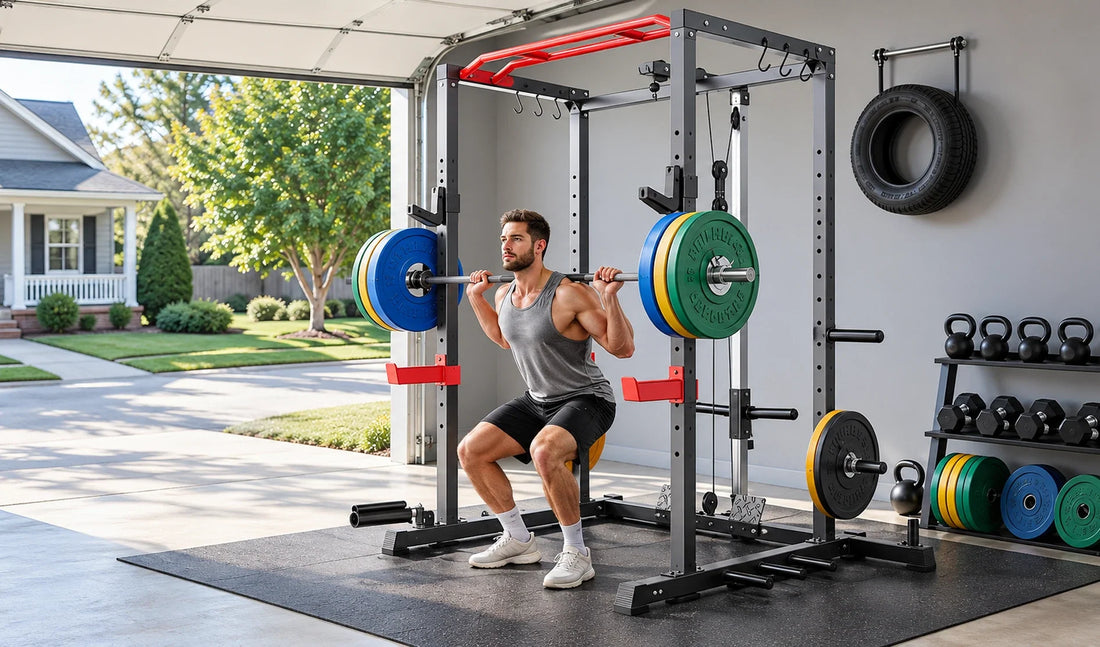
How to Choose the Best Power Rack for Your Home Gym
Most people who buy a power rack picture heavy squats without waiting for a crowded gym's only rack. Fewer picture carrying seven-foot uprights down the basement stairs, or the first pull-up that ends with their head against a ceiling joist. Those details decide whether a rack becomes the center of a home gym or a daily frustration.
A rack is not the right fit for every household, and it does not make solo lifting risk-free. Safeties add real protection, but beginners and anyone lifting near-maximal weights should still use a spotter. This guide covers what experienced home lifters check before buying so your power rack home gym is one you will use for years.
Which Type of Power Rack Is Best for Your Home Gym?
The right rack depends on your space, training goals, and budget. Home racks fall into three categories, each trading floor space and cost against protection and versatility.
Home gym racks vary in frame design and available features. Half racks and full power racks differ mainly in their frame structure, while pulley systems can be integrated into different rack configurations.
Power Rack Types at a Glance
| Configuration | Typical Safety Features | Best For | Space Considerations | Main Trade-Offs |
|
Half Rack |
J-hooks and adjustable spotter arms, depending on the model | Lifters who primarily perform barbell exercises and have limited floor space | Generally an open setup with a smaller footprint than a comparable full rack | Less enclosure around the lifting area; safety depends on proper spotter arm positioning |
| Full Power Rack | J-hooks and adjustable internal safety bars or straps, if included | Lifters who want to perform barbell exercises inside an enclosed frame | Requires clearance for the rack frame, barbell loading, and movement | Larger footprint than many half racks |
| Power Rack With a Pulley System | Rack safeties and cable attachments, depending on the configuration | Lifters who want to combine barbell and cable training | Requires additional clearance for cable exercises and attachments | More components, maintenance considerations, and potentially higher cost |
Half Rack
A half rack has two main uprights and an open front, so you lift in front of the frame. It suits smaller rooms and budgets yet handles the main barbell lifts. The trade-off is margin: spotter arms protect you only while you stay over them, so make sure they are included and keep your walkout short.
Full Power Rack
A full power rack, or power cage, surrounds the lifting area with four or more uprights, so you train inside the frame. Safety bars or straps can span both sides, which is why solo lifters often choose one, but whether they are included depends on the model. Straps, where offered, are quieter than steel and gentler on the barbell, which matters when someone is asleep upstairs.
Power Rack With a Pulley System
A pulley rack adds a cable station to the frame, so barbell and cable training share one machine. Depending on the attachments, it supports lat pulldowns, rows, and other cable work. It has the largest footprint and usually the highest price of the three, so it suits lifters with the room and budget who will use the cables regularly.
How Much Space Do You Need for a Power Rack?
Next, check that your chosen type fits. Most buyers measure the floor carefully and the ceiling casually, which is where trouble usually starts.
Ceiling Height and Pull-Up Clearance
Measure to the lowest point in the room. Ductwork, beams, and garage door tracks often sit lower than the drywall, and mats raise the floor and the rack with it. A standard 8-foot ceiling fits many racks, but rarely with room for full pull-ups on top; allow about 18 inches above the pull-up bar.
A rack near the ceiling usually cannot be built on the floor and tilted up, so plan to assemble it upright with a helper. Listed heights vary: within the FED Fitness lineup, for example, the RK1 Multi-Function Power Rack home gym measures 83.6 inches tall, and the SR2 All-in-One Squat Rack 86.4 inches.
Footprint and Working Space
A listed footprint, such as the RK1's 67.9 by 61.9 inches, is the smaller number. Allow about 3 feet on each side for loading plates and 4 feet in front for a bench and your walkout, then tape the area out and move through a set with an empty bar. Garage floors often slope toward the door, so a rack may need shims to sit level.
What Power Rack Features Matter Most?
Among racks that fit your room, compare what separates one model from another: how well it protects a solo lifter, how solid it stays under load, and how far it can grow with your training.
Safety Bars, Straps, and Spotter Arms
Power rack safeties come in different designs, each suited to a different rack configuration and lifting setup. Safety bars and safety straps are typically installed inside a four-post rack, while spotter arms extend outward from the uprights to support lifts performed outside the frame.
Safety Bars: These rigid steel supports sit inside the rack and catch the barbell if you cannot complete a lift. They are commonly used for squats and bench presses inside a full power rack. Adjust their height to allow a full range of motion while catching the bar before it reaches your body.
Safety Straps: These straps connect between the rack's uprights and catch the barbell during a failed lift. Their flexible construction provides a different contact surface from rigid steel bars. Check them regularly for fraying, cuts, or other signs of wear.
Spotter Arms: These steel supports attach to the rack's uprights and extend outward, allowing you to perform squats and bench presses outside the frame. They are commonly used with half racks and can also work with compatible full racks. Check the attachment's locking mechanism, weight rating, and the rack's stability requirements before use.
Regardless of the design, adjust the safeties for each exercise and your normal range of motion. Test their height with an empty bar before lifting, and never exceed the manufacturer's rated capacity.
Frame Stability and Weight Capacity
A light frame reveals itself when you rerack, shifting slightly every time the bar lands; a wide base and thick steel prevent that. The SR2 has 3×3-inch, 13-gauge uprights with six points of support, while the RK1 uses 2 mm commercial steel. When reracking, guide the bar to the uprights first and then down into the hooks, rather than aiming straight for the hooks.
Upright Size and Attachment Compatibility
Attachment fit depends on upright dimensions; the SR2's 3×3-inch uprights and 1-inch holes suit a wide range of accessories. Hole spacing matters more day to day: if your ideal bench safety height falls between two adjustment points, no setting may both clear a full rep and catch a failed one. Check how many of a rack's positions, such as the SR2's 31, sit within your bench and squat range.
What Exercises Can You Do With a Power Rack?
A power rack supports a range of strength exercises, but the movements you can perform also depend on the attachments and equipment available. Here are some common exercises and what you need to perform them.
- Barbell Squats: Squats work the quadriceps, glutes, and hamstrings while your trunk braces under the load. Front squats place more emphasis on the quads and require a more upright torso. You'll need a barbell, weight plates, and collars. Adjustable J-hooks hold the bar, while safety bars or straps provide support if you cannot complete a rep.
- Bench Press: The bench press targets the chest, front shoulders, and triceps. A narrower grip generally places more emphasis on the triceps, while grip width also affects range of motion and shoulder positioning. You'll need a weight bench, barbell, weight plates, and collars, along with adjustable J-hooks and safety bars for a secure setup.
- Overhead Press: Standing overhead presses train the shoulders and triceps while engaging the core and upper back for stability. A seated variation requires an adjustable or flat bench with enough clearance for the barbell. Basic equipment includes a barbell, weight plates, and collars, while adjustable J-hooks make it easier to unrack the bar.
- Pull-Ups, Chin-Ups, and Inverted Rows: Pull-ups and chin-ups use a pull-up bar to train the lats, upper back, and arms. An underhand grip during chin-ups places greater emphasis on the biceps. Inverted rows provide a horizontal pulling movement and can be performed with a barbell secured at an appropriate height or a compatible rack attachment. A pull-up bar and a securely positioned barbell or row attachment are the main equipment requirements.
- Rack Pulls and Pin Presses: These exercises use adjustable safety bars or pins to set the starting position of the barbell. Rack pulls target the upper portion of the deadlift, while pin presses train a specific portion of the bench or overhead press. You'll need a barbell, weight plates, collars, and adjustable safeties or pins positioned at the desired height.
- Attachment-Based Exercises: Additional attachments expand the rack's training options. Dip handles allow dips for the chest and triceps, while a landmine attachment paired with a barbell supports angled pressing and rowing movements. Check whether these accessories are included or sold separately, and follow the manufacturer's installation and weight capacity requirements.
Is an All-in-One Power Rack Home Gym Worth It?
If many of those movements appeal to you, an all-in-one rack bundles their attachments into one frame. Whether that is good value depends on what it includes and how you actually train.
Training Versatility and Included Attachments
Typical stations include a pull-up bar, dip handles, plate storage, and band pegs, all designed to fit the frame. The SR2, for example, supports 20+ exercises, from squats, bench presses, and deadlifts to glute bridges, preacher curls, and pull-ups, and includes a multi-grip pull-up bar, band pegs, barbell holders, and plate storage posts. The trade-off shows up a few months in: you pay for every station whether you use it or not, and switching stations mid-session still means moving hooks or handles.
Who Should Choose an All-in-One Rack?
Start by listing the exercises you did last month, or your planned program if you are new. If that list goes well beyond squats and presses, or several people in your household train differently, an all-in-one rack puts those stations in one footprint. If you mainly squat and bench, a simpler rack covers it, and unused attachments would only become clutter in a small room; just confirm its uprights and holes will accept the attachments you may add later.
Do You Need a Power Rack With a Pulley System?
Cables are the next part of that decision. You likely need them if pulldowns, rows, face pulls, or pushdowns are weekly staples; if your training centers on squats, presses, and deadlifts, pull-ups and inverted rows already cover much of your back work.
Benefits of Cable Training
A barbell's weight always pulls straight down, while a cable can pull from high, low, or across the body and keeps tension on the muscle through the whole movement. That suits the accessory work around your main lifts, from the back and rear shoulders to the triceps. It also helps if you cannot yet do a pull-up: a lat pulldown trains the same muscles with less than your bodyweight and lets you add load as you get stronger. Built into the rack, it does all this without a separate machine.
Plate-Loaded vs. Weight-Stack Cable Systems
Plate-loaded designs cost less and use the iron you already own, but every weight adjustment means moving plates, often the same ones on your barbell, which slows supersets. Weight stacks switch with a pin but cap you at the stack's maximum. Either way, check the pulley ratio, which alters how heavy the load feels at the handle; the RK1's is close to 1:2.
How Much Should You Spend on a Home Power Rack?
Rack type, attachments, and cables all move the price. Racks range from roughly $200 to well over $2,000, and the rack is rarely the whole bill, so look at what each tier buys and what the full setup costs.
Budget, Mid-Range, and Premium Power Racks
Budget racks cover the main barbell lifts, usually with lighter frames and fewer extras. Mid-range racks of about $500–800 often add pull-up bars, plate storage, and dip bars, which are worth paying for only if you would otherwise buy and use them. Premium racks mostly buy heavier steel, higher weight ratings, and built-in cable systems. Wherever you land, spend most on the rack and the barbell, which you use every session and will find hardest to upgrade, and never compromise on safeties rated for your loads.
Additional Equipment and Attachment Costs
Freight shipping on heavy steel, a barbell, plates, collars, a bench, and flooring add substantially to the total, and first-time buyers often discover these costs only after the rack arrives. Iron is the easiest place to stretch a budget: it lasts for decades, so many lifters add weight over time, often secondhand. Rubber mats deserve a line too. They protect the concrete or subfloor and keep the rack from shifting under load.
Final Power Rack Buying Checklist
Before you order, run through these checks. Each rules out a common reason a rack ends up returned or unused:
- Ceiling Clearance: Measure to the lowest beam, duct, or door track, allowing for mats, pull-ups, and plates at overhead lockout.
- Delivery and Assembly: Measure stairs and doorways, and line up a helper.
- Footprint: Tape out the rack plus about 3 feet per side and 4 feet in front, and check that the floor is level.
- Training Fit: Match the rack type, attachments, and any cable system to the lifts you do every week.
- Safeties: Confirm which are included, their ratings, and whether the hole spacing suits your bench and squat.
- Total Budget: Price shipping, the barbell, plates, a bench, and flooring along with the rack.
Product Recommendations
The right equipment depends on how you train, how much space you have, and which features matter most. FED Fitness offers several options for different home gym setups, from combined barbell and cable training to more specialized strength equipment.
Best for Barbell and Cable Training
For home gym users who want to combine traditional strength training with cable exercises, the FED Fitness RK1 Multi-Function Power Rack offers both in one setup. Its integrated cable crossover system supports exercises such as lat pulldowns and cable rows, while the included dip bars and landmine attachment add more training options without requiring several separate machines.

FED Fitness Sportsroyals Series RK1 Multi Function Power Rack
- Built with Gym Quality
- Real Weight Capacity
- All-in-One Cable Crossover System
Best for Guided Strength and Cable Training
For lifters who prefer guided barbell movements over traditional free-weight training, the FED Fitness SH1 Adjustable Smith Machine offers an alternative to a standard power rack. Its switchable 0° and 7° bar paths provide two movement options, while the integrated 1:1 cable system supports additional exercises such as rows and pulldowns.

FED Fitness SH1 0°/7° Adjustable All-in-One Home Gym Smith Machine
- 0° vertical or 7° angled Smith bar path
- 1:1 cable system
- Sized for a garage gym
Best for Versatile Home Workouts
For users who want several strength-training options in one setup, the FED Fitness SR2 All-in-One Squat Rack combines multiple training functions with adjustable bar positions. Its 31 height settings provide flexibility when setting up different exercises, making it an option for home gyms where equipment versatility matters.

FED Fitness SR2 All-in-One Squat Rack
- One Rack. 20+ Training Possibilities
- 20 Attachments Included
- More Ways to Train Than Standard 2-Post Racks
Best for Adjustable Rack Configurations
If your training space or barbell setup requires more flexibility, the FED Fitness SR1 Adjustable Width Squat Rack With Pull-Up Bar offers adjustable width settings for compatible 6- and 7-foot barbells. Its 22 height positions also provide more options for positioning the bar during different lifts.

FED Fitness Flybird Series SR1 Adjustable Width Squat Rack With Pull-Up Bar
Conclusion
The right power rack fits your room, matches the lifts you do every week, and leaves room in the budget for the bar, plates, and flooring around it. Measure overhead first. Then test every safety setting with an empty bar before the first heavy set, and keep a spotter for maximal attempts.
Frequently Asked Questions
Is a Power Rack Worth It for a Home Gym?
Yes, if you train regularly with a barbell and have the space, since one rack replaces several stations. It is less worthwhile if you mostly train with dumbbells or machines, and its safeties do not replace a spotter for beginners or maximal lifts.
What Is the Difference Between a Power Rack and a Squat Rack?
The main difference is how you train in them. In a power rack, you lift inside the frame, where safeties, if included, cover the bar's full path; with an open squat rack, you lift in front of the uprights and rely on spotter arms. A power rack offers more margin for solo training, while a squat rack saves space.
Does a Power Rack Need to Be Bolted Down?
Not always. Some racks are designed to stand on their own, while others must be anchored, so follow the manufacturer's guidance for your model. Anchoring still helps if a rack rocks during pull-ups, carries one-sided attachments or plates, or stands where children may climb it.
Can You Bench Press Safely in a Power Rack?
Yes, with the proper setup. Adjust the J-hooks so you can unrack the bar with nearly straight arms while keeping your shoulders in position. Set the safety bars just below the bar's lowest point during a normal rep, allowing you to complete the movement without hitting them.
Test the setup with an empty bar: when you relax your back arch, the bar should rest on the safeties without pressing against your chest or neck. If the safeties cannot provide enough clearance for both a full rep and a failed lift, use a spotter rather than benching alone.
References
- Barbell Logic. “Complete Guide to Barbell Safety.” Barbell Logic, 2020.
- Kerr, Z. Y., et al. “Epidemiology of Weight Training-Related Injuries Presenting to United States Emergency Departments, 1990 to 2007.” The American Journal of Sports Medicine, 2010.
- Saeterbakken, A. H., et al. “The Effect of Grip Width on Muscle Strength and Electromyographic Activity in Bench Press among Novice- and Resistance-Trained Men.” International Journal of Environmental Research and Public Health, 2021.
- Saeterbakken, A. H., & Fimland, M. S. “Effects of Body Position and Loading Modality on Muscle Activity and Strength in Shoulder Presses.” Journal of Strength and Conditioning Research, 2013.


Leave a Comment
We’d love to hear from you — your insights can inspire others!