This workout uses 7 compound exercises to train your legs, chest, back, shoulders, arms, and core in 30 minutes flat.
This routine is built around exercises that maximize muscle activation per rep. No isolation work, no wasted time. Every movement here targets multiple muscle groups at once, which is how you fit a beginner full-body dumbbell workout into half an hour.
A 2021 review in Sports Medicine confirmed that well-designed programs using compound movements can roughly halve training time while maintaining the same volume and results.
That's the logic behind this routine.
What Do You Need Before You Start?
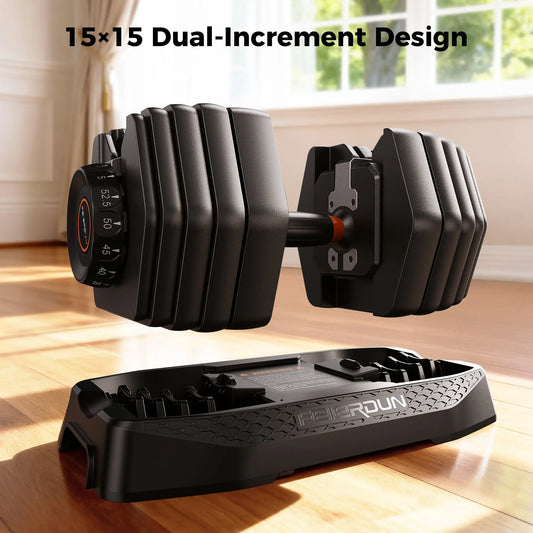
A pair of adjustable dumbbells or two to three pairs of fixed dumbbells in different weights. Something to lie on (a yoga mat, carpet, or even a towel works). And roughly a 6-by-6-foot space, so you’re not knocking into anything.
Starting weight recommendations
This is the question I get asked more than anything else. The honest answer is that it depends on the exercise, but here's a realistic starting point for most beginners:
- Upper body pressing (floor press, overhead press): Women 5 to 10 lbs, Men 10 to 20 lbs
- Upper body pulling (rows): Women 8 to 15 lbs, Men 15 to 25 lbs
- Lower body (squats, lunges, RDLs): Women 10 to 20 lbs, Men 20 to 35 lbs
Pick a weight where the last 2 to 3 reps of each set feel genuinely hard, but you can still keep your form clean.
When in doubt, start lighter than you think you need. You can always go up next week, and it's way easier to add weight than to recover from a strain you got in week one.
Warm-Up (3 to 5 Minutes)
Don't skip this. A 2006 review of randomized controlled trials found that warming up reduced injury risk in 3 out of 5 studies examined. It doesn't need to be complicated:
- 1 minute of marching in place or light jogging to raise your body temperature
- 10 bodyweight squats (slow and controlled)
- 10 arm circles in each direction
- 5 hip hinges with no weight (practice the RDL motion)
- 5 torso rotations per side
That's it. You're just waking your muscles up and getting blood flowing to the joints you're about to load. Save the static stretching for after your workout, if at all. Research shows static stretching before lifting can temporarily reduce strength by about 5%.
Workout Schedule
Run this program 3 days a week with a rest day between sessions.
Monday, Wednesday, and Friday works well. Tuesday, Thursday, Saturday are fine too. Just don’t stack training days back to back when you’re starting out.
With 60-second rest periods, the full workout takes right around 28 to 32 minutes, including warm-up. If you're running short on time, drop the renegade row,s and you'll come in under 25 minutes without losing much.
| Exercise |
Sets × Reps
|
Frequency
|
|
Goblet Squat
|
3 × 10
|
3×/week
|
|
Dumbbell Floor Press
|
3 × 10
|
3×/week
|
|
Bent-Over Row
|
3 × 10
|
3×/week
|
|
Standing Overhead Press
|
3 × 8
|
3×/week
|
|
Romanian Deadlift
|
3 × 10
|
3×/week
|
|
Reverse Lunge
|
3 × 8 per leg
|
3×/week
|
|
Dumbbell Plank Row (Renegade Row)
|
2 × 6 per side
|
3×/week
|
The Workout
Do each exercise in order. Rest 60 seconds between sets.
1. Goblet Squat: 3 sets × 10 reps
Works: quads, glutes, core
Hold one dumbbell vertically at your chest with both hands. Squat as deep as you can while keeping your heels on the floor.
The dumbbell acts as a counterbalance, which honestly makes this easier to learn than most squat variations.
Stand up by driving through your whole foot, not just your toes. The biggest mistake I see: knees caving inward. Push them out over your toes on the way down.
2. Dumbbell Floor Press: 3 sets × 10 reps
Works: chest, front delts, triceps
Lie on your back, knees bent, feet flat on the floor. Press the dumbbells straight up from chest level. Your elbows will touch the ground at the bottom of each rep.
That's actually a feature, not a bug. It protects your shoulders while still working your chest hard.
I prefer the floor press over bench press for beginners because it's one less piece of equipment to buy, and it naturally limits range of motion in a way that keeps your shoulders safe.
Let your elbows come to a dead stop on the floor before each rep. No bouncing.
3. Bent-Over Row: 3 sets × 10 reps
Works: lats, rhomboids, traps, biceps
Stand with feet hip-width apart, hinge forward at the hips until your torso is roughly 45 degrees from the floor.
Let the dumbbells hang at arm's length, then pull them toward your ribcage. Think about driving your elbows up and back, not pulling with your hands. This cue changed everything for me.
When you focus on your elbows, you'll feel your back muscles engage instead of your biceps doing all the work.
4. Standing Overhead Press: 3 sets × 8 reps
Works: shoulders, triceps, core
Standing, not seated. This matters. When you press dumbbells overhead while on your feet, your core has to work hard to keep you stable.
Research confirms that standing presses produce significantly more abdominal and oblique activation than seated versions. Start with the dumbbells at shoulder height and press straight up until your arms are fully extended.
If you notice yourself arching your back to lift the weight, it's too heavy. Drop down 5 lbs.
5. Romanian Deadlift: 3 sets × 10 reps
Works: hamstrings, glutes, lower back, grip
Dumbbells in front of your thighs, with a slight bend in your knees. Push your hips back and lower the dumbbells along your legs until you feel a strong pull in your hamstrings.
This exercise teaches the hip hinge pattern, which you'll use in basically every lower-body exercise from here on out. Keep your back flat the entire time. If it starts rounding, you've gone too deep. Stop where your hamstrings tell you to.
6. Reverse Lunge: 3 sets × 8 reps per leg
Works: quads, glutes, calves, core
Holding dumbbells at your sides, step one foot backward and lower your knee toward the floor. Push through your front heel to stand back up. Reverse lunges are easier to balance than forward lunges, and they're gentler on the knees.
Fair warning: your grip might give out before your legs do in the first few sessions. Totally normal. It catches up within a couple weeks.
7. Dumbbell Plank Row (Renegade Row): 2 sets × 6 reps per side
Works: lats, core (anti-rotation), shoulders
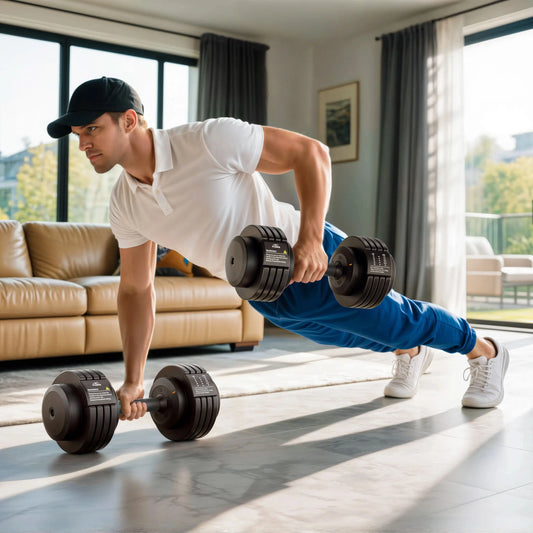
Get into a push-up position with your hands on the dumbbells. Brace your core, then row one dumbbell to your ribcage while keeping your hips level. Set it down.
Row the other side. This is a finisher that trains your back, core, and anti-rotation stability all at once. Use lighter dumbbells than you think you need.
Keeping your body from twisting is the hard part, not the row itself. If your hips are swinging side to side, go lighter.
How to Progress
When you can complete all reps across all sets with clean form, you've got two options: add 2 reps per set, or increase the weight by 5 lbs and drop back to the original rep count. Don't try to do both at once.
And if your dumbbells don't offer small enough increments, there are other ways to make things harder without changing the weight.
Slow down the lowering phase of each rep to 3 seconds. Add a 2-second pause at the bottom of your squats or floor presses.
Switch bilateral exercises to single-leg or single-arm versions (a goblet squat with 30 lbs becomes a single-arm front rack split squat with 30 lbs, which is a completely different challenge).
All of those count as progressive overload, and your muscles respond to them the same way they respond to adding weight.
Run this program 3 days a week with a rest day between sessions.
Monday, Wednesday, and Friday works well. Tuesday, Thursday, Saturday are fine too.
Just don't stack training days back to back when you're starting out.
Why Should Beginners Start With Full-Body Training?

Full-body dumbbell workouts are the fastest way for beginners to build strength because they train every major muscle group in a single session and allow for more recovery between workouts.
Think about it this way. If you train chest on Monday, back on Tuesday, legs on Wednesday (the classic "bro split"), each muscle group only gets worked once a week. But with a full-body approach, you're hitting everything two or three times a week with moderate volume.
And for someone who's new to lifting, that frequency matters more than doing 15 sets of chest in one day.
The ACSM position stand on resistance training recommends 2 to 3 sessions per week for novice lifters. Full-body training fits that perfectly.
You get Monday, Wednesday, Friday (or whatever three days work for your schedule), with built-in rest days so your muscles can actually recover and grow.
There's a practical benefit, too. Miss a session on a full-body plan? You still trained everything twice that week. Miss chest day on a split? Your chest doesn't get touched for 14 days.
For anyone juggling work, kids, or a chaotic schedule, full-body is more forgiving.
Can You Really Build Muscle at Home Using Only Dumbbells?
Dumbbells build muscle just as effectively as barbells and machines, and the research on this is surprisingly clear.
I used to think home dumbbell workouts were a stepping stone to "real" training at a gym. I was wrong.
A 2020 study in the Journal of Strength and Conditioning Research compared free weights to machines across 8 weeks of training and found no difference in muscle thickness gains. None.
A 2023 meta-analysis in BMC Sports Science pulled together 13 studies with over 1,000 participants and confirmed the same thing.
Dumbbells actually have a few advantages that machines can't match. Each arm works independently, which prevents your dominant side from doing all the heavy lifting (literally).
And research from Saeterbakken and Fimland (2012) showed that dumbbell exercises activate your core muscles significantly more than their machine counterparts. So you're building abs while pressing overhead. Machines can't do that.
The bottom line: if you've got a pair of dumbbells that challenge you, you have everything you need.
Beginner Dumbbell Workout FAQs
Can I Start If I Have No Fitness Background?
This workout is designed for people with zero experience. Every exercise here uses basic movement patterns your body already knows.
You already squat (every time you sit in a chair), hinge (every time you pick something up off the floor), and press (every time you put something on a high shelf). These exercises just add resistance to movements your body does daily.
Start light, learn the form, and give yourself permission to be bad at it for the first week or two. Everyone is.
Is 30 Minutes Really Enough to Build Muscle?
Thirty minutes is more than enough. Research shows that even very low training volumes produce significant muscle and strength gains in beginners.
A 2020 meta-analysis in Sports Medicine found that even the minimum effective dose (a single set of 6 to 12 reps at moderate intensity, 2 to 3 times per week) produced meaningful strength increases in novice trainees.
Your 7-exercise workout with 3 sets each delivers roughly 21 working sets per session. That's well above the minimum and right in the zone where dose-response research shows significant hypertrophy.
The concern about "only" 30 minutes comes from watching experienced lifters spend 90 minutes in the gym.
They need that time because their bodies have adapted to years of training and require more volume to keep growing. You're not there yet. And frankly, that's an advantage. You get to make progress on less.
Can Beginners Build Muscle With Dumbbells?
For the first 6 to 12 months of training, dumbbells are more than enough to build real, visible muscle.
The people who think they need a barbell or a gym to build muscle are working off outdated assumptions. The science doesn't support it.
If you're eating enough protein (roughly 0.7 to 1 gram per pound of bodyweight daily, spread across 3 to 4 meals), sleeping 7 to 9 hours, and following a structured program with progressive overload, dumbbells will absolutely get the job done.
And don't worry about the "anabolic window" or needing a protein shake the second you finish your last set.
A 2013 meta-analysis found that when total daily protein intake is accounted for, the timing of your meals doesn't significantly affect muscle growth. Just eat enough throughout the day. That's it.
Can Dumbbell Training Help With Fat Loss?
Strength training with dumbbells burns calories during your workout and keeps your metabolism elevated for hours afterward, making it one of the most effective tools for fat loss.
This is something a lot of people get wrong. They think they need to run for an hour to lose fat. But when you strength train, your body continues burning calories after the workout is over.
This is called EPOC (excess post-exercise oxygen consumption), and research shows that resistance training can keep your metabolism elevated for up to 14 hours after a session. Cardio burns more during the session itself, but strength training wins over the course of the full day.
And there's the muscle factor.
Muscle tissue burns more calories at rest than fat tissue does. So as you build muscle with your dumbbell workouts, your body burns more energy just... existing. It's a long game, but it's one of the most reliable approaches to lasting fat loss.
Should I Work Out If I'm Still Sore?
Mild to moderate soreness is normal and safe to train through. Sharp pain, swelling, or soreness that gets worse during your warm-up is not normal. Stop and rest.
That first-week soreness has a name: DOMS (delayed onset muscle soreness). Almost every beginner experiences it, and it's the number one reason people quit in week two.
Don't.
It fades significantly after the first 7 to 10 days as your body adapts.
The best thing for sore muscles? Honestly, more movement. A light warm-up will temporarily reduce that stiffness, and training through mild soreness doesn't cause damage or slow your recovery.
The distinction that matters: DOMS feels like a dull, achy tightness in the muscles you trained. It peaks about 24 to 48 hours after your workout and goes away on its own. An injury feels sharp, localized, and gets worse with movement. If you're dealing with the second one, take a few days off and see a doctor if it persists.
Can I Do This Workout Every Day?
No. Your muscles need 48 hours to recover between training sessions, so stick to 3 days per week with rest days in between.
I know it feels counterintuitive. More training should mean faster results, right? Not how it works.
Muscle growth happens during recovery, not during the workout. When you lift weights, you're creating microscopic tears in muscle fibers. The repair process is what makes them bigger and stronger. Skip the rest days, and you're tearing without rebuilding.
In many respects, the rest of the training is the most important part.
If you want to be active on off days, go for a walk, stretch, or do some light yoga. Just don't do another strength session targeting the same muscles.
Fixed vs. Adjustable Dumbbells: Which Is Better for Beginners?
Adjustable dumbbells are the smarter choice for most beginners because they take up less space, cost less than a full set of fixed weights, and grow with you as you get stronger.
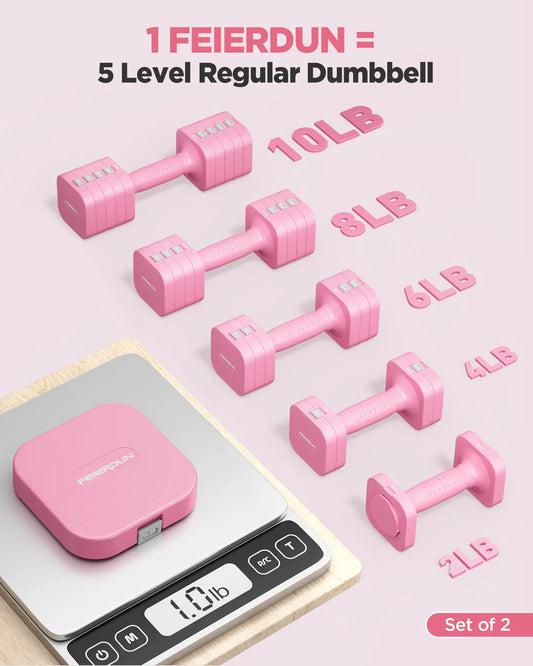
If I were setting up a home gym from scratch on a budget, adjustable dumbbells would be the first thing I'd buy. One pair covers a range from around 5 to 50+ lbs, sits in a corner or on a shelf, and saves you from buying new weights every few months as you get stronger.
The math on fixed dumbbells gets ugly fast.
A full set from 5 to 50 lbs runs well over $1,000 and needs its own rack.
The one knock on adjustable dumbbells is the time it takes to change weights between exercises. But for a beginner doing 3 sets per exercise with 60-second rests, that 10-second dial adjustment barely registers. It's a non-issue.
Once your adjustable dumbbells are sorted, the next investment worth making is an adjustable weight bench. It unlocks incline presses, chest-supported rows, seated shoulder work, and a bunch of other variations you can't do on the floor.
Get Started Today
There's one more thing that nobody else seems to talk about when writing beginner workout guides. A 2018 meta-analysis in JAMA Psychiatry (33 studies, nearly 1,900 participants) found that resistance training significantly reduces symptoms of depression.
And the effect held up regardless of whether the participants got dramatically stronger. Something about consistently showing up and challenging yourself with weights changes how you feel, not just how you look. That alone is worth 30 minutes three times a week.
So grab a pair of adjustable dumbbells. Start with the program above. Write down what you did after each session so you can track whether you're progressing. Eat enough protein. And commit to 8 to 12 weeks before you judge anything.
I think you'll like where you end up.
This content is for informational and educational purposes only and does not constitute medical advice. For questions related to your health or medical conditions, please consult your physician. Always seek advice from a qualified healthcare professional before starting any exercise program or health regimen. In the event of a medical emergency, call 911.